
☰ Course contents
Mathematics 🎓 University Year 1 Tensor Stress Block: Force That Depends on Direction
🎓 University Year 1 · Lesson 11 of 15

Tensor Stress Block: Force That Depends on Direction

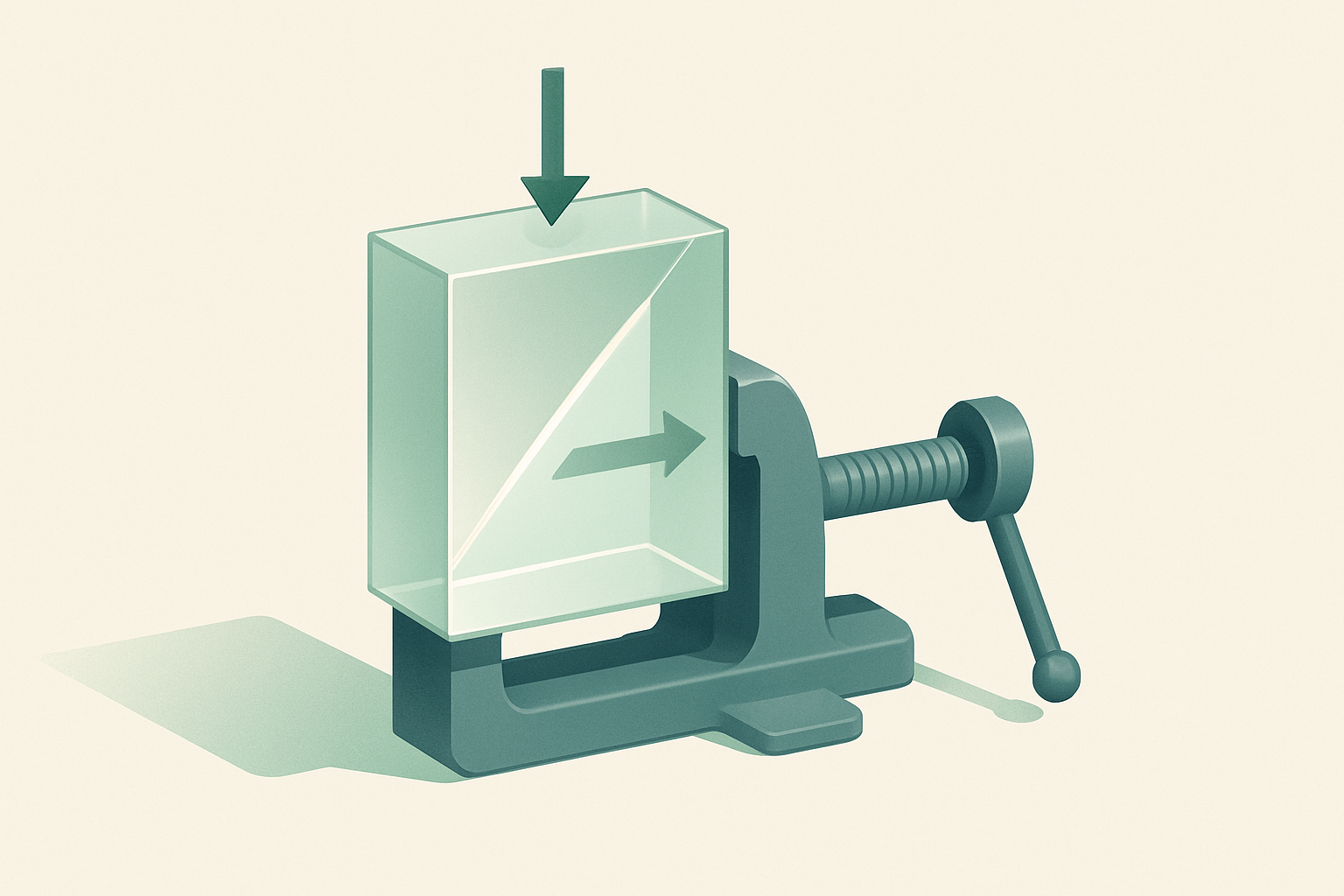
Push on a block and the force carried across an internal cut depends on how you slice it — capturing that direction-dependence in one object is what a tensor is for.
University Year 1Calculus II / Linear Algebra
Tensor Stress Block: Force That Depends on Direction — illustration
💡
The big idea: A scalar carries one number and a vector carries a magnitude with a direction. But some quantities need more: the internal force in a loaded solid depends on the orientation of the surface you imagine cutting through it. The stress tensor is the machine that takes a cut's direction and returns the force vector carried across it. It is a linear map from directions to vectors, written as a matrix, and its eigenvalues are the principal stresses an engineer worries about.
🎯 By the end, you'll be able to
  • Distinguish scalars, vectors and second-order tensors by what they map
  • Read the stress tensor as a matrix whose columns are traction vectors on the coordinate faces
  • Compute the traction on a cut from t = σn
  • Split a traction into normal and shear components
  • Identify principal stresses and directions as the eigenvalues and eigenvectors of the stress tensor
📎 You should already know
  • Vectors and the dot product
  • Matrix–vector multiplication
  • Eigenvalues and eigenvectors

One number is not enough

Hang a weight from a bar and ask: what force is carried across an imaginary cut inside it? If you slice straight across, the material on each side pulls the other with a pure tension. But slice at a slant and part of that same force now acts along the cut as a shear. The force depends on the direction of the cut.

A single number (a scalar) cannot capture that. Even a single vector cannot, because the answer changes as you rotate the cut. What we need is an object that takes a direction and gives back a force vector. That object is the stress tensor.

🔑 A tensor maps directions to vectors
The stress tensor σ is a linear machine: feed it the unit normal n of a surface and it returns the traction vector t — the force per unit area carried across that surface. As a 2×2 (or 3×3) matrix, its columns are just the traction vectors acting on the coordinate faces. Scalar → vector → tensor is a ladder of how much direction-information an object stores.
\[ \vec{t} = \sigma\,\vec{n} = \begin{bmatrix} \sigma_{xx} & \tau_{xy} \\ \tau_{xy} & \sigma_{yy} \end{bmatrix}\begin{bmatrix} n_x \\ n_y \end{bmatrix} \]
Cauchy's relation: the traction on a plane is the stress tensor applied to that plane's unit normal. The tensor is symmetric (τ_xy = τ_yx).
🎮 Tensor Stress Block LIVE
Rotate a cut through a stressed block and watch the normal and shear traction change.

Normal and shear parts

Once you have the traction t on a cut, split it into two pieces. The part along the normal n is the normal stress — pure push or pull. Whatever is left lies in the cut and is the shear stress that tries to slide the two faces past each other.

The normal stress is the projection σn = n · t = n · (σn). The shear magnitude is what remains of the traction after that normal part is removed.

\[ \sigma_n = \vec{n}\cdot(\sigma\vec{n}), \qquad \tau = \sqrt{\lvert\vec{t}\rvert^{2} - \sigma_n^{2}} \]
The normal stress is the traction's component along n; the shear is the leftover in-plane part.
📝 Worked example: A block is under uniaxial tension: σ = [[100, 0], [0, 0]] (units of MPa). Find the traction, normal stress and shear on a cut whose normal points at 45°, n = (1/√2, 1/√2).
  1. Traction: t = σn = [[100, 0], [0, 0]]·(1/√2, 1/√2) = (100/√2, 0).
  2. Normal stress: \( \sigma_n = \vec{n}\cdot\vec{t} = \tfrac{1}{\sqrt2}\cdot\tfrac{100}{\sqrt2} + \tfrac{1}{\sqrt2}\cdot 0 = \tfrac{100}{2} = 50 \) MPa.
  3. Magnitude of traction: \( |\vec{t}| = 100/\sqrt2 \), so \( |\vec{t}|^2 = 5000 \).
  4. Shear: \( \tau = \sqrt{5000 - 50^2} = \sqrt{5000 - 2500} = \sqrt{2500} = 50 \) MPa.
✓ On the 45&deg; cut the normal stress is <strong>50 MPa</strong> and the shear is <strong>50 MPa</strong> &mdash; even though the block is only pulled along one axis, a slanted cut feels shear.
✨ Principal stresses are eigenvalues
As you rotate the cut, is there a direction with no shear at all — pure push or pull? Yes: it is a direction where t is parallel to n, meaning σn = λn. That is exactly the eigenvalue equation. The principal stresses are the eigenvalues of σ and the principal directions are its eigenvectors — the largest and smallest normal stresses in the material, and where shear vanishes.

Why symmetry matters

The stress tensor is symmetric: τxy = τyx. This is not a convenience — it follows from the block not spinning up on its own (balance of angular momentum). A pleasant consequence is that a real symmetric matrix always has real eigenvalues and perpendicular eigenvectors, so the principal stresses are always real and their directions are at right angles.

⚠️ The tensor is the map, not any one traction
A common slip is to treat “the stress” as a single number or a single arrow. The traction t is a genuine vector, but it is the answer for one particular cut. The tensor σ is the whole rule that produces a different traction for every cut direction. Rotate to a new coordinate frame and the components of σ change, yet the physical stress state it describes does not.

Check your understanding

1. What does the stress tensor σ take in, and what does it give back?
σ is a linear map from a cut's unit normal n to the traction vector t = σn carried across that cut.
2. For σ = [[100, 0], [0, 0]], what is the traction on the face with normal n = (1, 0)?
σn = [[100,0],[0,0]]·(1,0) = (100, 0): a pure normal pull of 100 on the x-face.
3. How is the normal stress on a cut obtained from the traction t and normal n?
The normal stress is the component of the traction along the normal, the projection σ_n = n · t = n·(σn).
4. The principal stresses of a stress tensor are its…
A principal direction has zero shear, so σn = λn — the eigenvalue equation. Principal stresses are the eigenvalues of σ.
5. Why are the principal directions always perpendicular?
A real symmetric matrix has real eigenvalues and mutually perpendicular eigenvectors; the stress tensor's symmetry comes from balance of angular momentum.
✅ Key takeaways
  • A tensor stores more direction-information than a vector: the stress tensor maps a cut's normal n to the traction t = σn.
  • The columns of σ are the traction vectors on the coordinate faces; σ is symmetric because the block does not spontaneously rotate.
  • Split any traction into a normal part σ_n = n·(σn) and a shear part; even uniaxial tension produces shear on a slanted cut.
  • Principal stresses are the eigenvalues of σ and principal directions are its eigenvectors — the orientations where shear vanishes.
  • Changing coordinate frame changes the components of σ but not the physical stress state it represents.