
Dilations & Similarity: Same Shape, Different Size
A dilation grows or shrinks a figure from a fixed centre — angles stay put, but area scales by the square of the factor.
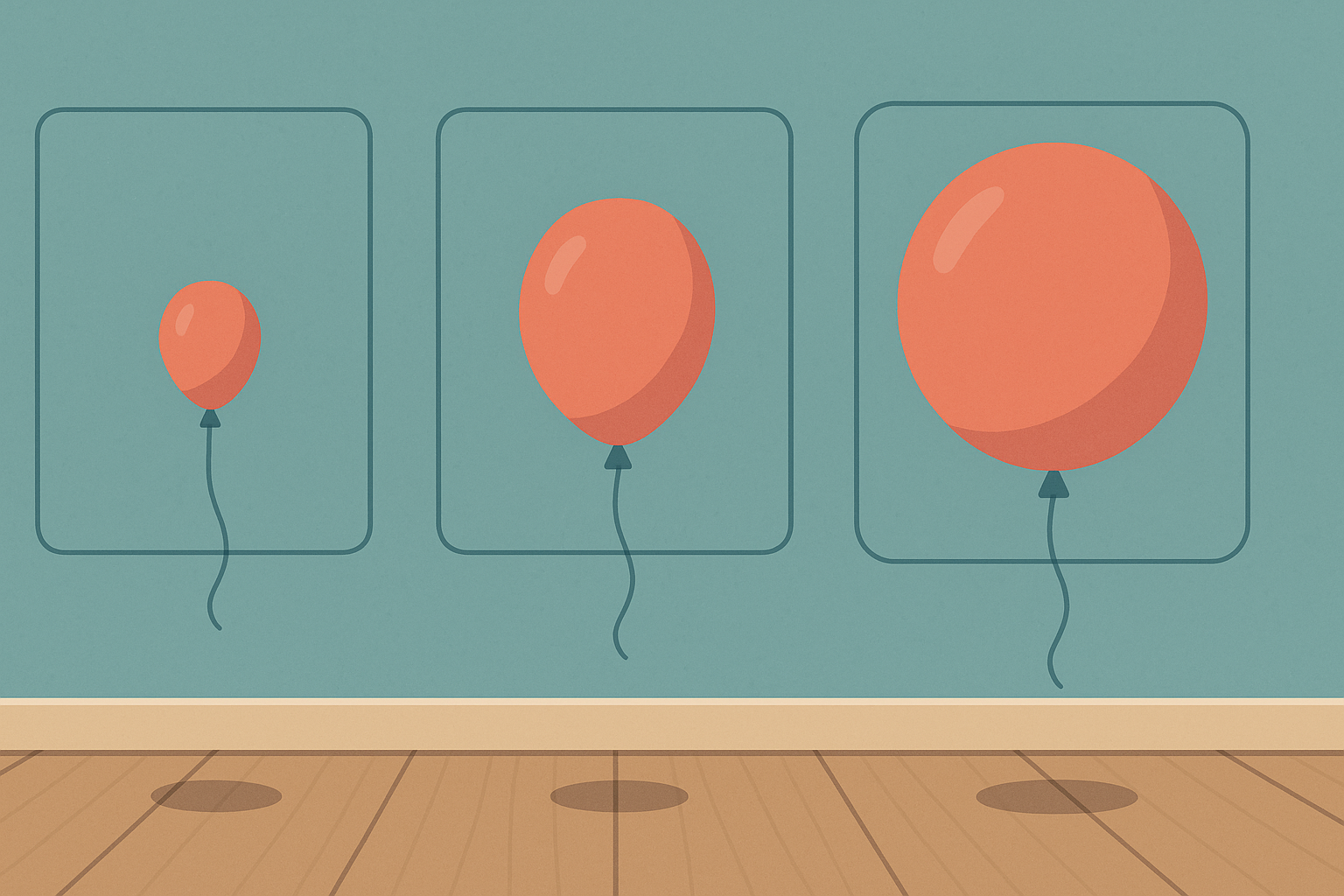
Resizing from a fixed point
Unlike a translation, rotation, or reflection, a dilation is not a rigid motion — it deliberately changes size. A dilation is defined by two things: a fixed centre point and a scale factor k. Every point of the figure moves directly toward or away from the centre, landing at a distance k times its original distance from the centre.
Because every point moves by the same factor k, the resized figure keeps exactly the same proportions as the original — just bigger or smaller.
Lengths (sides, distances from the centre) are multiplied by k.
Angles are completely unchanged — a dilation never distorts an angle's measure.
Area is multiplied by k², exactly as with the scale drawings you met in Grade 7: since both the length and width of any region scale by k, area scales by k × k.
Similarity: what a dilation produces
A figure formed by dilating another figure — optionally followed by a translation, rotation, or reflection to reposition it — is called similar to the original. Similar figures always satisfy two matched conditions at once:
- Corresponding angles are equal.
- Corresponding sides are proportional (all in the same ratio, k).
Both conditions must hold. A figure with equal angles but non-proportional sides is not similar, and neither is one with proportional sides but mismatched angles.
Reading the scale factor
The value of k tells you exactly what happens: when k > 1, the figure enlarges, moving further from the centre. When 0 < k < 1, the figure shrinks, moving closer to the centre. A negative k sends every point straight through the centre to the opposite side, producing a figure that is also rotated 180° about the centre as it resizes.
- Lengths scale by k = 1.5: sides become \( 6\times1.5=9,\ 8\times1.5=12,\ 10\times1.5=15 \).
- Area scales by k² = 1.5² = 2.25.
- New area \( = 24 \times 2.25 = 54 \).
- Apply the rule \( (x,y)\to(kx,ky) \) with k = −2.
- New x: \( 2\times(-2) = -4 \). New y: \( -3\times(-2) = 6 \).
- Because k is negative, the image lands on the opposite side of the centre from the original point, in addition to being twice as far away.
Grade 7's scale-drawings lesson already established that area scales by k², never by k itself — a dilation with k = 3 makes lengths 3× longer but area 9× larger, not 3×. That rule carries over unchanged here.
Second trap: for 0 < k < 1 the figure shrinks (many students expect any dilation to enlarge). And for negative k, every point passes straight through the centre to the opposite side — the image is not just resized, it appears on the far side of the centre point.
Check your understanding
- A dilation resizes a figure from a fixed centre by scale factor k: every length is multiplied by k.
- Angles are unchanged by a dilation; only size changes — the image is similar, not congruent, to the original (unless k = 1).
- Area scales by k², the same rule established for scale drawings in Grade 7 — not by k itself.
- k > 1 enlarges, 0 < k < 1 shrinks, and a negative k sends points through the centre to the opposite side.
- Similar figures require both corresponding angles equal AND corresponding sides proportional; rigid motions give congruence, dilations give similarity.
🎓 Go deeper: external courses & trusted references
External sites are listed for reference only. This course is independent and has no affiliation with, or endorsement from, the institutions named.