
Square Completer: Completing the Square
Every near-square shape is missing exactly one corner tile — add it back, and the trinomial becomes a perfect square.
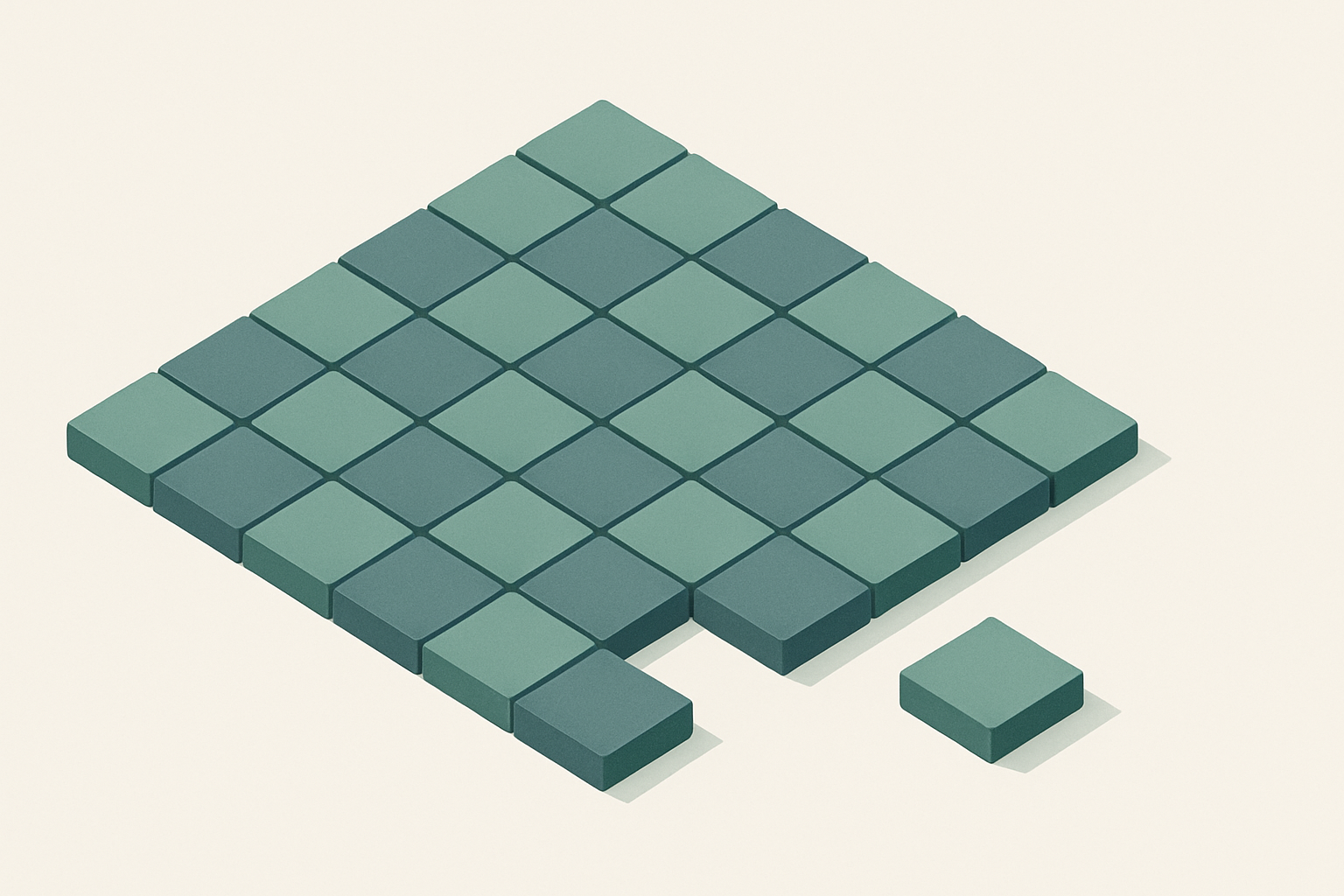
A square missing one corner
Take x² + bx and build it out of tiles: one big x-by-x square, and b thin x-by-1 strips laid along two of its sides. Arrange the strips evenly along the top and the right side, and you get something that is almost a bigger square — except for one small gap in the corner.
That missing corner has a precise size: (b÷2) by (b÷2). Add that one small tile in, and the whole shape becomes a genuine square with side length x + b÷2.
From standard form to vertex form
To rewrite y = x² + bx + c in vertex form, complete the square on the x² + bx part. Since you cannot add a number to one side of an equation without balancing it, you add (b÷2)² and then immediately subtract it again, so the value of the expression never actually changes.
- Take half of 6: 6 ÷ 2 = 3.
- Square it: 3² = 9.
- Add 9: x² + 6x + 9 factors as a perfect square.
- Half of 8 is 4, and 4² = 16, so add and subtract 16: y = x² + 8x + 16 − 16 + 10.
- The first three terms form a perfect square: x² + 8x + 16 = (x + 4)².
- Combine the remaining constants: −16 + 10 = −6.
Why bother completing the square?
Once a quadratic is in vertex form, its vertex — the maximum or minimum point — is visible immediately, without graphing a single point. That is often exactly the information a problem is really asking for.
Check your understanding
- x² + bx is an almost-square missing one corner tile of size (b÷2) by (b÷2).
- Adding (b÷2)² completes the square: x² + bx + (b÷2)² = (x + b÷2)².
- To convert standard form to vertex form, add and immediately subtract (b÷2)² so the value stays the same.
- Once in vertex form (x − h)² + k, the vertex (h, k) is visible directly — no graphing required.
- Completing the square on ax² + bx + c = 0 is exactly how the quadratic formula is derived.
🎓 Go deeper: external courses & trusted references
External sites are listed for reference only. This course is independent and has no affiliation with, or endorsement from, the institutions named.