
Factors, Multiples & Prime Numbers: Arranging the Tiles
A factor is any number that tiles the rectangle perfectly. A prime number only tiles in one single row.
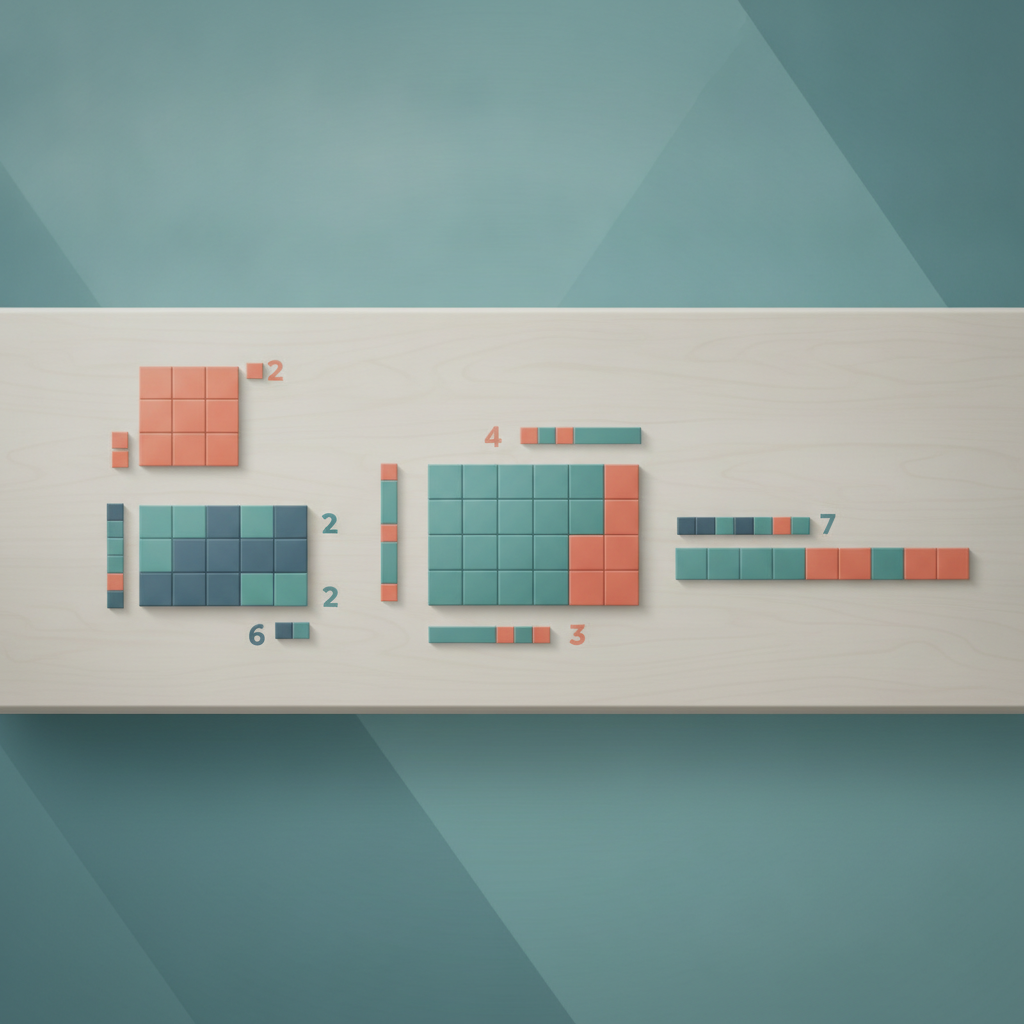
Factor pairs from rectangles
Take 12 square tiles and try every possible rectangle you can make without gaps or overlaps. You'll find: 1×12, 2×6, 3×4 (and their reverses 12×1, 6×2, 4×3). Each dimension used is a factor of 12. So the factors of 12 are: 1, 2, 3, 4, 6, 12.
To find factor pairs systematically, start at 1 and work up to the square root. Once your trial divisor exceeds √n, you've already found every unique pair (because beyond that point you'd just be repeating them in reverse).
- Prime: exactly 2 factors — 1 and itself. Examples: 2, 3, 5, 7, 11, 13. Only one rectangle is possible (a single row).
- Composite: more than 2 factors. Examples: 4, 6, 8, 9, 12. Multiple rectangles exist.
- Special case: 1 has only 1 factor (itself) — it is neither prime nor composite.
Factors are smaller (or equal) — they divide INTO the number. 3 is a factor of 12 because 12 ÷ 3 = 4 (no remainder).
Multiples are larger (or equal) — the number divides INTO them. 12 is a multiple of 3 because 3 × 4 = 12. The multiples of 3 are: 3, 6, 9, 12, 15, 18, …
Memory hook: Factors are Few (at most n of them), Multiples are Many (infinitely many).
- Test divisors from 1 up to √24 ≈ 4.9 (so up to 4).
- 1: 24 ÷ 1 = 24 ✓ → pair (1, 24)
- 2: 24 ÷ 2 = 12 ✓ → pair (2, 12)
- 3: 24 ÷ 3 = 8 ✓ → pair (3, 8)
- 4: 24 ÷ 4 = 6 ✓ → pair (4, 6)
- 5: 24 ÷ 5 = 4.8 ✗ (not whole)
- Factors: 1, 2, 3, 4, 6, 8, 12, 24 — 8 factors.
- √37 ≈ 6.1, so test divisors 2, 3, 4, 5, 6.
- 37 ÷ 2 = 18.5 ✗
- 37 ÷ 3 = 12.33... ✗
- 37 ÷ 4 = 9.25 ✗
- 37 ÷ 5 = 7.4 ✗
- 37 ÷ 6 = 6.16... ✗
- No divisor works up to √37 — only factors are 1 and 37.
Check your understanding
- A factor divides into a number with no remainder; factors come in pairs (a × b = n).
- Find all factor pairs by testing divisors from 1 up to the square root of the number.
- A prime number has exactly 2 factors (1 and itself); a composite number has more than 2.
- The number 1 is neither prime nor composite — it's a special case.
- Multiples are what you get by multiplying: multiples of 4 are 4, 8, 12, 16, … — infinitely many.
🎓 Go deeper: external courses & trusted references
External sites are listed for reference only. This course is independent and has no affiliation with, or endorsement from, the institutions named.