
Elastic Invariance: The Inscribed Angle Theorem
Slide a point anywhere along the same arc, and the angle it sees on a fixed chord never changes.
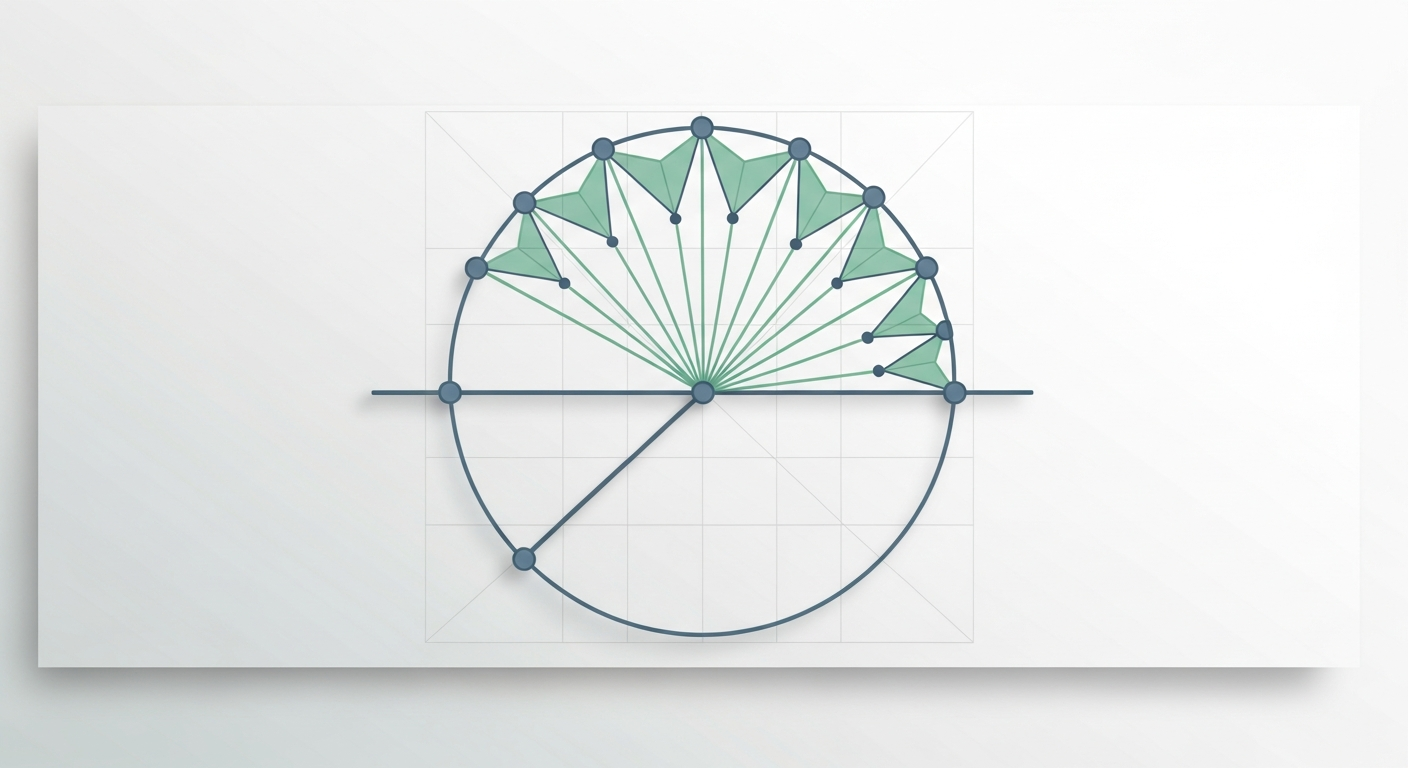
One chord, many angles
Draw a chord AB inside a circle, then pick any point C on the larger arc and connect it to both A and B. The angle ∠ACB you get is called an inscribed angle. Now slide C anywhere else along that same arc — the triangle changes shape completely, but something remarkable stays fixed: the angle at C.
That invariance is not a coincidence. It follows from comparing every inscribed angle to the one angle that never moves: the angle at the center.
Why the halving happens
Join the center O to A, B, and C. Triangles OAC and OBC are each isosceles, because two of their sides are radii. In an isosceles triangle the base angles are equal, and a short chase of the angle sum around the diagram shows the angle at C always comes out to exactly half the central angle — no matter where C sits on that arc. Move C, and both isosceles triangles reshape together, but the halving relationship survives.
- The inscribed angle is half the central angle subtending the same arc.
- ∠ACB = 100° ÷ 2.
- D and E subtend the same chord AB from the same (major) arc.
- Angles in the same segment are equal, so ∠AEB = ∠ADB.
Check your understanding
- An inscribed angle is the angle a point on a circle makes looking at a fixed chord.
- The inscribed angle theorem: the central angle on an arc is always twice any inscribed angle on that same arc.
- Because the central angle is fixed, every inscribed angle on the same arc is equal — an elastic invariant.
- A special case: any angle inscribed in a semicircle (subtending a diameter) is exactly 90°.
- Angles from the same arc are equal; angles from opposite arcs on the same chord are supplementary instead.
🎓 Go deeper: external courses & trusted references
External sites are listed for reference only. This course is independent and has no affiliation with, or endorsement from, the institutions named.