
Fractions: Breaking the Unit
Cut a whole into equal slices, and a fraction just counts how many you have.
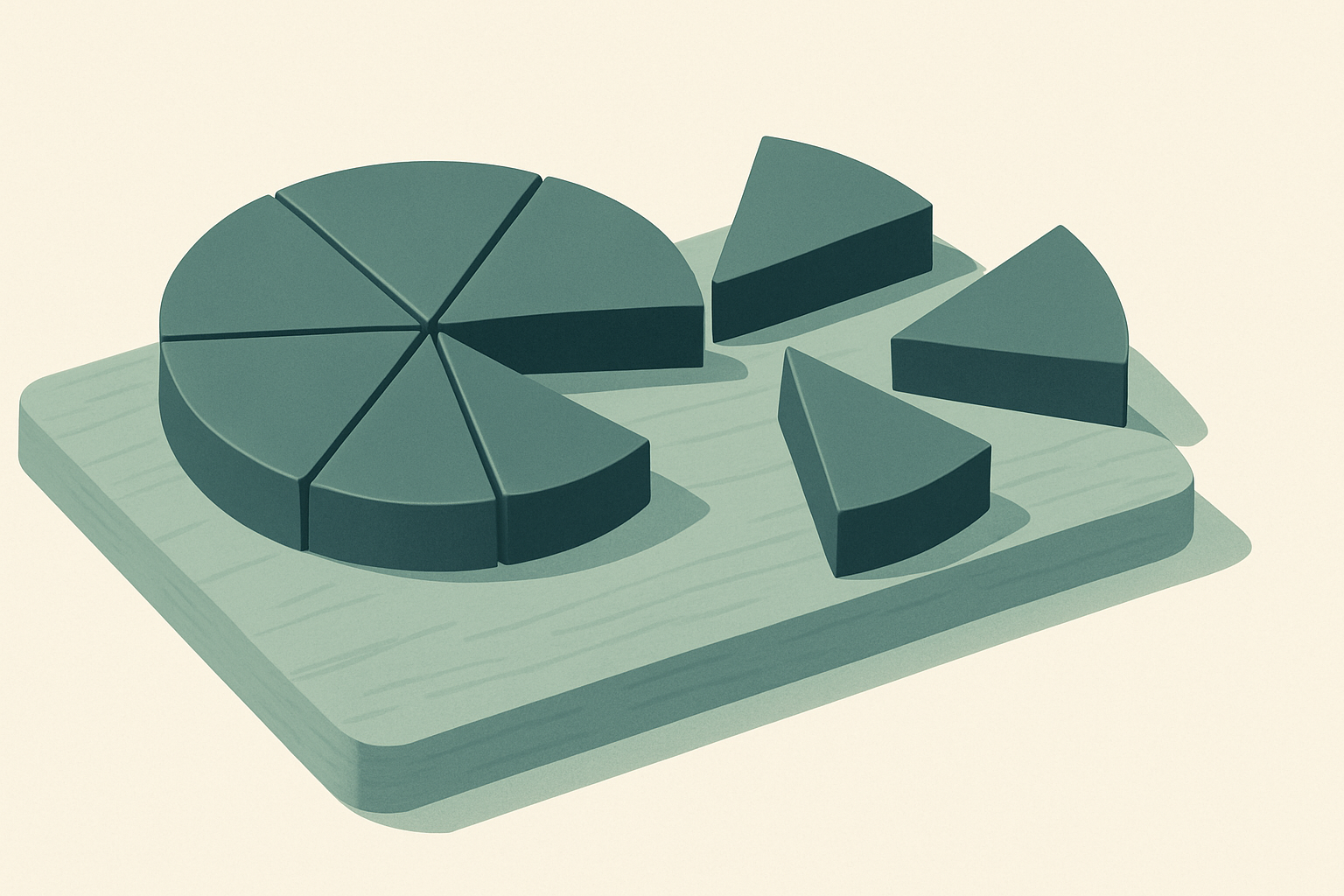
Fair slices of one whole
Imagine a chocolate bar shared fairly among friends. If you cut it into 4 equal pieces and hand out 3 of them, you have given away three-fourths of the bar. A fraction is just a compact way of writing that: how many equal slices the whole was cut into, and how many of those slices you are talking about.
More slices means smaller pieces
Here is the part that surprises many people at first: cutting a whole into more pieces makes each piece smaller, not bigger. A pizza cut into 8 slices has smaller slices than the same pizza cut into 4 slices, even though 8 is the larger number.
- Cutting the pizza into 4 pieces makes bigger slices than cutting it into 8 pieces.
- 1/4 is one of only 4 big slices; 1/8 is one of 8 small slices.
- The bigger the denominator, the smaller each single piece is.
Comparing fractions with the same denominator
When two fractions already share the same denominator, the slices are already the same size, so comparing them is easy: just compare the numerators. Whichever fraction is counting more of those equal-size slices is the bigger fraction.
- Both fractions have denominator 8, so the bar is cut into 8 equal-size pieces in each case.
- 3/8 counts 3 of those pieces; 5/8 counts 5 of the same-size pieces.
- Compare the numerators: 5 is more than 3.
Check your understanding
- A fraction describes equal parts of a whole: the denominator names how many equal parts, the numerator counts how many you have.
- The bigger the denominator, the smaller each individual piece is, since the whole gets sliced more finely.
- Fractions with the same denominator can be compared by just comparing their numerators.
- You can only compare numerators directly once the denominators (the slice sizes) match.
- A fraction bar is a helpful picture: slice the whole, then shade the parts you are counting.
🎓 Go deeper: external courses & trusted references
External sites are listed for reference only. This course is independent and has no affiliation with, or endorsement from, the institutions named.