
☰ Course contents
Mathematics 📐 Grade 8 The Pythagorean Theorem: Squares on a Right Triangle
📐 Grade 8 · Lesson 7 of 15

The Pythagorean Theorem: Squares on a Right Triangle

In any right triangle, the squares built on the two legs always add up to the square built on the hypotenuse.
Grade 8Pre-Algebra / Algebra 1
The Pythagorean Theorem: Squares on a Right Triangle — illustration
💡
The big idea: A right triangle hides a beautiful fact: if you build a square on each of its three sides, the areas of the two smaller squares always add up exactly to the area of the biggest one. That relationship — a² + b² = c² — lets you find any missing side of a right triangle as long as you know the other two, and it works every single time, no matter the size of the triangle.
🎯 By the end, you'll be able to
  • State the Pythagorean theorem and identify the legs and hypotenuse of a right triangle
  • See why the theorem is true using the areas of squares built on each side
  • Find a missing hypotenuse or leg given the other two sides
  • Use the converse of the theorem to test whether a triangle is a right triangle
📎 You should already know
  • Square roots
  • Naming the sides of a right triangle

The special sides of a right triangle

Every right triangle has one 90° angle. The two sides that form that right angle are called the legs, and the side opposite the right angle — always the longest side — is called the hypotenuse.

These three sides are not independent: once you fix the two legs, the hypotenuse is locked in. The rule connecting them is one of the most famous results in all of mathematics.

🔑 The Pythagorean theorem
In any right triangle with legs a and b and hypotenuse c: the square of one leg plus the square of the other leg equals the square of the hypotenuse. This holds for every right triangle, no matter its size or proportions.
\[ a^2 + b^2 = c^2 \]
a and b are the legs (the two sides meeting at the right angle); c is the hypotenuse (the longest side, opposite the right angle).

Why it works: squares that fit together

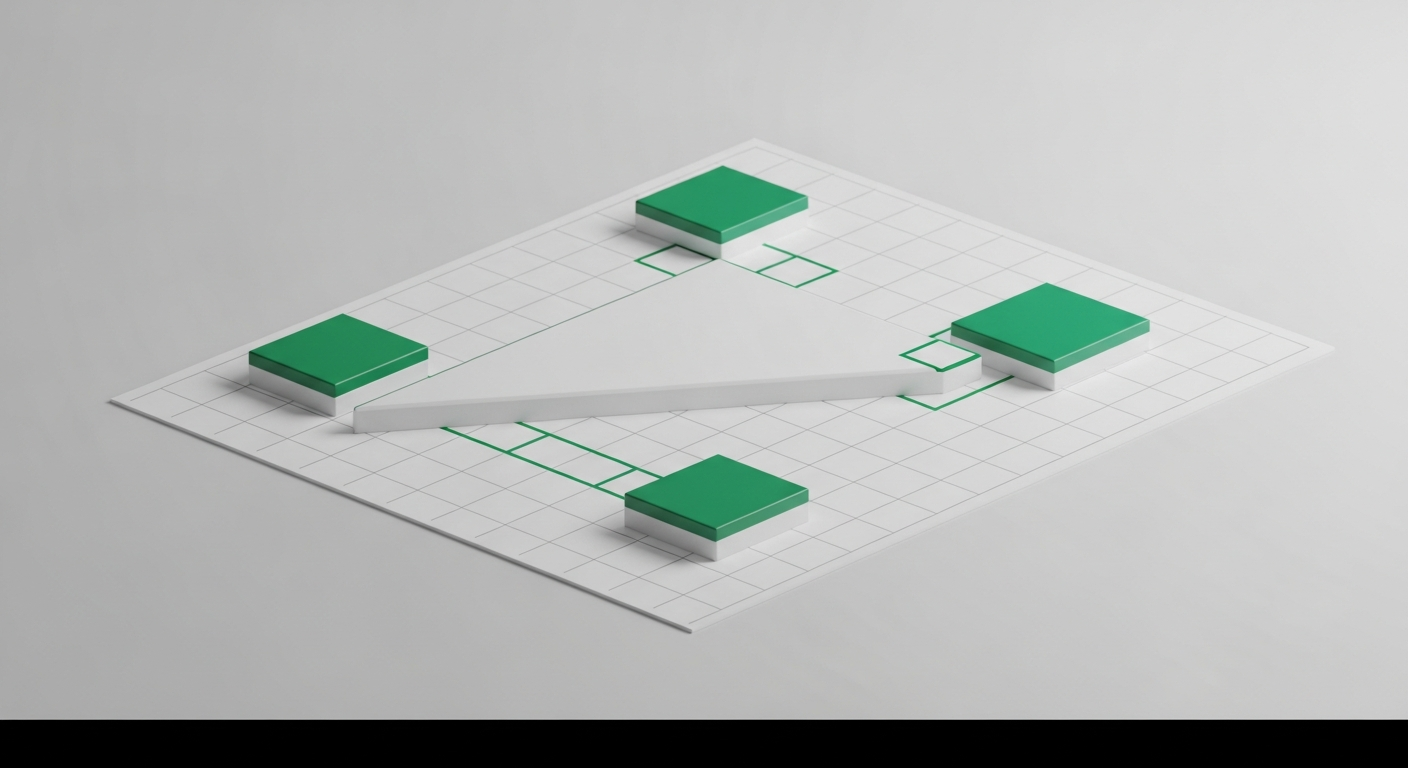
Here is the idea made visible: draw a square directly on each side of the right triangle. The theorem says the areas of the two smaller squares (built on the legs) add up to exactly the area of the largest square (built on the hypotenuse) — not approximately, exactly, for any right triangle you draw.

🎮 Pythagorean Prover LIVE
Resize the right triangle and watch the squares on the two legs exactly fill the square on the hypotenuse.

Finding a missing side

Because a² + b² = c² connects all three sides, knowing any two of them lets you find the third. If you need the hypotenuse, add the squares of the legs and take the square root. If you need a leg, subtract the known leg's square from the hypotenuse's square, then take the square root.

📝 Worked example: A right triangle has legs of 3 and 4. Find the hypotenuse.
  1. Apply the theorem: c² = a² + b² = 3² + 4².
  2. 3² = 9 and 4² = 16, so c² = 9 + 16 = 25.
  3. Take the square root: c = √25.
✓ The hypotenuse is <strong>5</strong> — the classic 3&ndash;4&ndash;5 right triangle.
📝 Worked example: A right triangle has a hypotenuse of 13 and one leg of 5. Find the other leg.
  1. Rearrange the theorem to solve for the missing leg: b² = c² − a² = 13² − 5².
  2. 13² = 169 and 5² = 25, so b² = 169 − 25 = 144.
  3. Take the square root: b = √144.
✓ The missing leg is <strong>12</strong> — this is the 5&ndash;12&ndash;13 right triangle.
✨ Testing a triangle with the converse
The theorem also runs backward: if a triangle's three sides make a² + b² = c² true (with c the longest side), the triangle must have a right angle, even if you never measured one directly. For sides 9, 12, 15: 9² + 12² = 81 + 144 = 225, and 15² = 225 — they match, so this is a right triangle.
⚠️ Always square the longest side alone
The hypotenuse (c) is always the longest side and always sits by itself on one side of the equation. A common mistake is plugging the longest side in as a leg instead — always identify the hypotenuse first, since it is opposite the right angle.

Check your understanding

1. In a right triangle, which side is the hypotenuse?
The hypotenuse is defined as the side opposite the 90° angle, and it is always the longest side of the triangle.
2. A right triangle has legs of 6 and 8. What is the hypotenuse?
6² + 8² = 36 + 64 = 100, and √100 = 10.
3. A right triangle has a hypotenuse of 13 and one leg of 5. What is the other leg?
13² − 5² = 169 − 25 = 144, and √144 = 12.
4. A triangle has sides 8, 10, and 12, with 12 the longest side. Is it a right triangle?
The converse of the theorem requires a² + b² = c² exactly. Here 8² + 10² = 164, but 12² = 144 — they don't match, so it is not a right triangle.
5. A 13-foot ladder leans against a wall with its base 5 feet from the wall. How high up the wall does it reach?
The ladder is the hypotenuse (13) and the base distance is one leg (5). The height is the other leg: 13² − 5² = 169 − 25 = 144, and √144 = 12 feet.
✅ Key takeaways
  • In a right triangle, the legs meet at the 90° angle and the hypotenuse is the longest side, opposite that angle.
  • The Pythagorean theorem states a² + b² = c², where c is the hypotenuse.
  • Squares built on the two legs have combined area exactly equal to the square built on the hypotenuse.
  • Knowing any two sides lets you find the third: add squares and take a square root for the hypotenuse; subtract and take a square root for a leg.
  • The converse works too: if a² + b² = c² holds for a triangle's sides, that triangle must have a right angle.