
Multiplication: The Elastic Area Model
Stretch a rectangle into tens and ones, and multiplication turns into simple addition.
Multiplication builds a rectangle
You already know multiplication as repeated addition: 4 × 3 means 4 groups of 3, or 3 + 3 + 3 + 3. There is another way to picture the exact same thing: draw a rectangle that is 4 squares tall and 3 squares wide. Count the squares inside, and you get the product.
This rectangle picture is called the area model, and it turns out to be the secret behind multiplying much bigger numbers too.
Splitting one number by place value
To multiply a bigger number like 23 by a single digit such as 6, split 23 by place value first: 23 = 20 + 3. Now build two smaller rectangles instead of one big one: one that is 6 tall and 20 wide, and one that is 6 tall and 3 wide. Then add their two areas together.
- Split 23 into 20 + 3.
- First rectangle: 6 × 20 = 120.
- Second rectangle: 6 × 3 = 18.
- Add the two areas: 120 + 18.
Two two-digit numbers: four rectangles
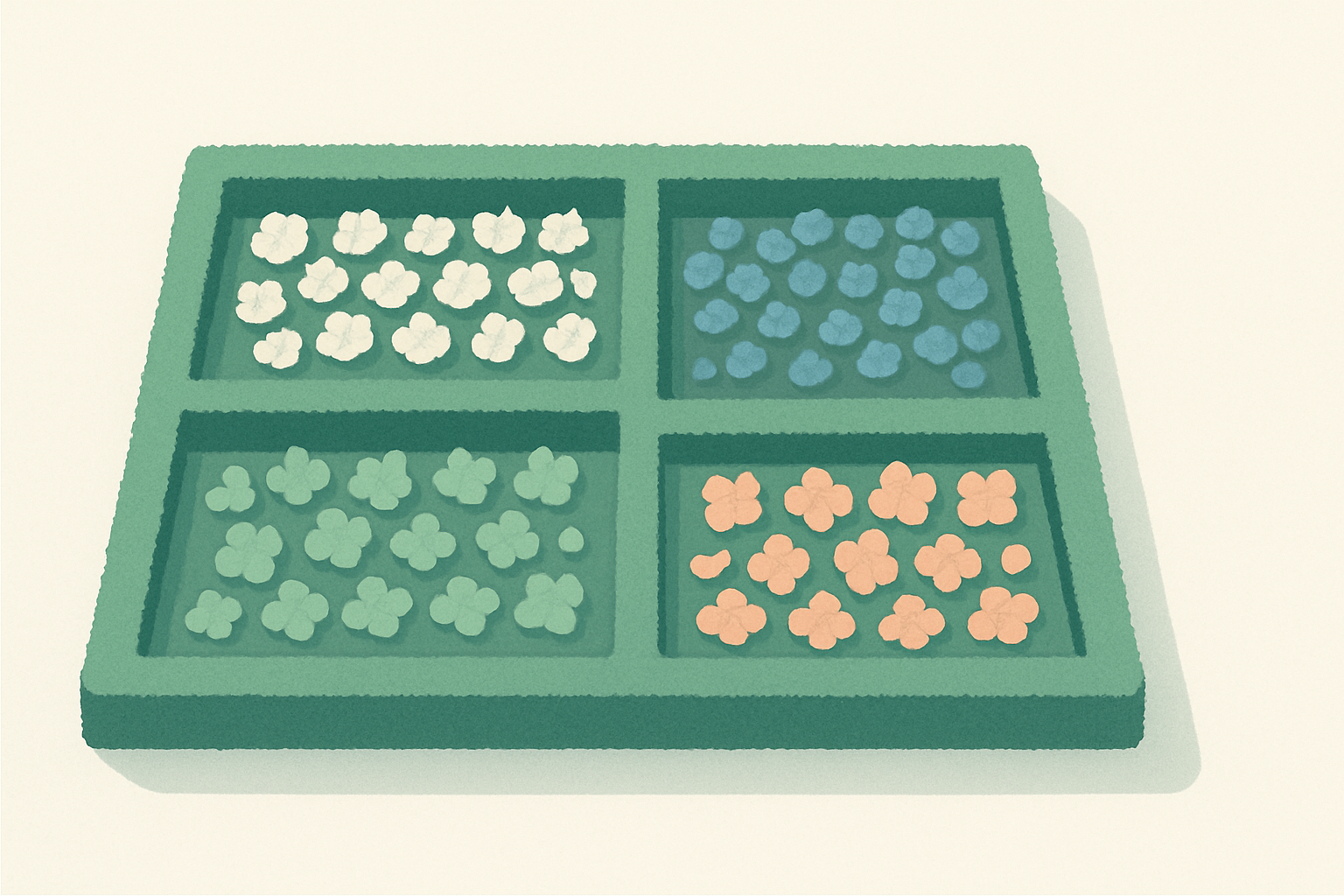
When both numbers have tens and ones, split them both. Multiplying 23 × 14 means splitting 23 into 20 + 3 and 14 into 10 + 4, then building four smaller rectangles: tens × tens, tens × ones, ones × tens, and ones × ones. Add all four areas for the final answer.
- Split 23 into 20 + 3, and 14 into 10 + 4.
- Tens × tens: 20 × 10 = 200.
- Tens × ones: 20 × 4 = 80.
- Ones × tens: 3 × 10 = 30.
- Ones × ones: 3 × 4 = 12.
- Add all four: 200 + 80 + 30 + 12.
Check your understanding
- Multiplication is the area of a rectangle: length times width.
- Split a factor by place value (e.g. 23 = 20 + 3) to turn a hard multiplication into easier pieces.
- Splitting a factor and adding the pieces is the distributive property in action: 6 × 23 = 6 × 20 + 6 × 3.
- Multiplying two two-digit numbers needs four partial products: tens×tens, tens×ones, ones×tens, ones×ones.
- Add every partial product; forgetting one is the most common mistake.
🎓 Go deeper: external courses & trusted references
External sites are listed for reference only. This course is independent and has no affiliation with, or endorsement from, the institutions named.