
☰ Course contents
Mathematics 🌆 Grade 9 The Ghost Graph: Transformations of y = a(x−h)² + k
🌆 Grade 9 · Lesson 4 of 12

The Ghost Graph: Transformations of y = a(x−h)² + k

One parabola, moved, stretched, and flipped — vertex form shows you exactly where it went and why.
Grade 9Algebra 1
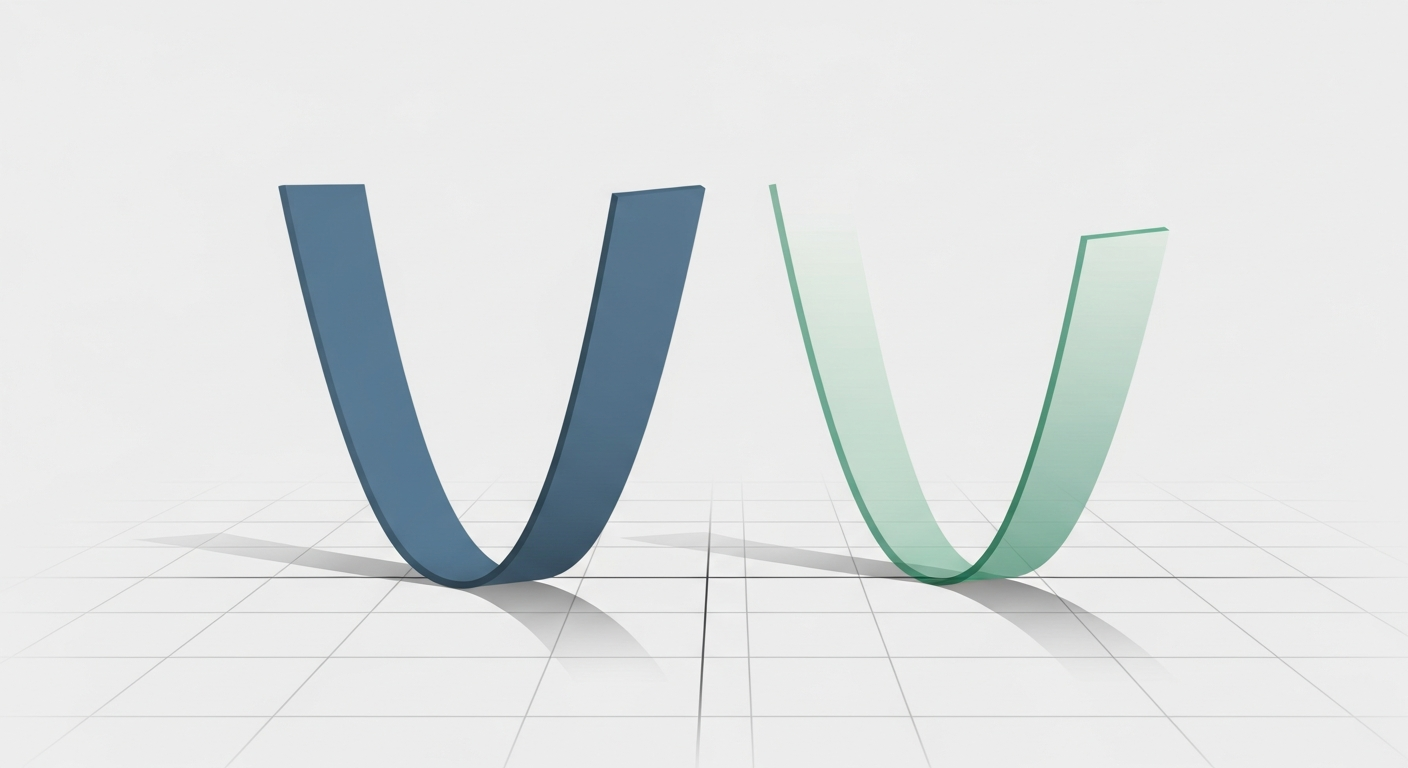
The Ghost Graph: Transformations of y = a(x−h)² + k — illustration
💡
The big idea: Every parabola written as y = a(x − h)² + k is the same basic shape as y = x², just relocated and reshaped. The vertex sits at (h, k), and the number a controls whether the parabola opens up or down and whether it looks narrow or wide. Learning to read a, h, and k lets you sketch a parabola without plotting a single extra point.
🎯 By the end, you'll be able to
  • Identify the vertex (h, k) directly from vertex form
  • Describe how h and k slide the parabola horizontally and vertically
  • Describe how a stretches, compresses, or flips the parabola
  • Sketch or describe a transformed parabola from its equation, and write an equation from a description
📎 You should already know
  • Graphing y = x²
  • Function notation (f(x))

A parabola in disguise

Every parabola you will meet in Algebra 1 is a transformed version of the same basic shape: y = x². Slide it, stretch it, flip it — the underlying “ghost” of that original U-shape is always there. Vertex form writes down exactly which transformations were applied, so you can read the new parabola's location and shape straight from the equation.

🔑 Vertex form reveals the vertex directly
In y = a(x − h)² + k, the point (h, k) is the vertex of the parabola — its turning point. No expanding or graphing required: h and k are sitting right in the equation.
\[ y = a(x-h)^2 + k \]
Vertex form. The vertex is (h, k); a controls the parabola's direction and width.
🎮 The Ghost Graph LIVE
Slide a, h and k in y = a(x-h)^2 + k and watch the parabola stretch, shift and flip.

Sliding the vertex: h and k

The value k slides the whole parabola up (if k is positive) or down (if k is negative) — exactly as you would expect. The value h slides it left or right, but with a twist: because the equation subtracts h, a positive h moves the vertex to the right, and a negative h (which shows up as a plus sign, like (x + 3)) moves it to the left.

⚠️ The sign of h is opposite what it looks like
In (x − 3)², the vertex's x-coordinate is +3, not −3. In (x + 3)², rewrite it as (x − (−3))² to see that h = −3, so the vertex shifts left. Always rewrite a plus sign as subtracting a negative before reading h.

Stretching, compressing, and flipping: the role of a

The number a controls the parabola's shape. If a is positive, the parabola opens upward, like a smile; if a is negative, it opens downward, like a frown — a flip across the vertex. The size of a controls width: when |a| > 1 the parabola is pulled narrower than y = x²; when 0 < |a| < 1 it is pushed wider.

📝 Worked example: Describe the parabola y = 2(x &minus; 3)&sup2; + 4.
  1. Compare to y = a(x − h)² + k: a = 2, h = 3, k = 4.
  2. The vertex is (3, 4).
  3. Since a = 2 is positive, the parabola opens upward; since |a| > 1, it is narrower than y = x².
✓ Vertex <strong>(3, 4)</strong>, opens <strong>upward</strong>, and is <strong>narrower</strong> than the basic parabola.
📝 Worked example: Describe the parabola y = &minus;0.5(x + 2)&sup2; &minus; 1.
  1. Rewrite (x + 2) as (x − (−2)) to see h = −2; also k = −1 and a = −0.5.
  2. The vertex is (−2, −1).
  3. Since a = −0.5 is negative, the parabola opens downward; since |a| = 0.5 < 1, it is wider than y = x².
✓ Vertex <strong>(&minus;2, &minus;1)</strong>, opens <strong>downward</strong>, and is <strong>wider</strong> than the basic parabola.

Check your understanding

1. What is the vertex of y = (x &minus; 5)&sup2; + 2?
Comparing to y = a(x − h)² + k, h = 5 and k = 2, so the vertex is (5, 2).
2. What is the vertex of y = 3(x + 1)&sup2; &minus; 6?
Rewrite (x + 1) as (x − (−1)), so h = −1 and k = −6, giving vertex (−1, −6).
3. Which value of a makes a parabola open downward AND narrower than y = x&sup2;?
Negative a opens the parabola downward, and |a| > 1 makes it narrower than the basic parabola. a = −3 satisfies both.
4. Between y = (x &minus; 2)&sup2; and y = (x + 2)&sup2;, which one shifts the basic parabola to the LEFT?
y = (x + 2)² has h = −2, which moves the vertex left by 2. y = (x − 2)² has h = 2, moving it right instead.
5. In y = a(x &minus; h)&sup2; + k, increasing k by 3 (with a and h unchanged) does what to the parabola?
k controls vertical position only. Increasing k moves the whole parabola straight up by that amount.
✅ Key takeaways
  • Vertex form y = a(x − h)² + k puts the vertex (h, k) directly in the equation — no graphing needed.
  • k slides the parabola up (positive) or down (negative); h slides it right (positive) or left (negative) — remember the sign flips because of the subtraction.
  • Positive a opens upward, negative a opens downward — a sign flip across the vertex.
  • |a| > 1 makes the parabola narrower than y = x²; 0 < |a| < 1 makes it wider.
  • Every parabola is the same 'ghost' shape as y = x², just relocated and reshaped by a, h, and k.