
Borrowing Next Door: Subtraction with Regrouping
When a column doesn't have enough, you borrow a bundle of ten from your neighbour.
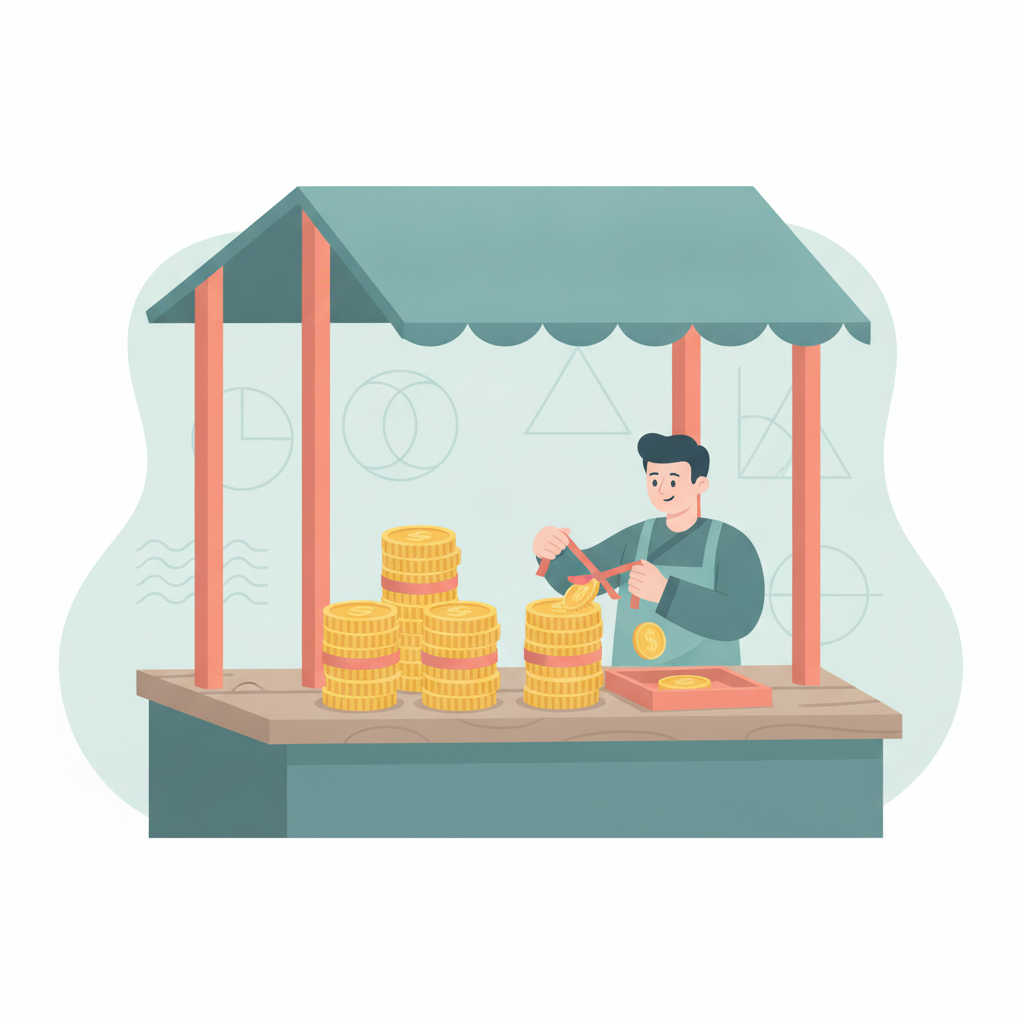
The borrowing rule — one trade at a time
Imagine the digits in each column as a stack of coins. When the top stack (minuend digit) is too small to give away the bottom amount (subtrahend digit), you reach over to the next column, take one bundle (1 ten = 10 ones, 1 hundred = 10 tens, etc.) and break it open into ten individual coins of the current size.
Example: 53 − 28. In the ones column, 3 − 8 is impossible, so we borrow 1 ten from the tens column. That ten becomes 10 extra ones, making the ones digit 13. We subtract: 13 − 8 = 5. The tens column shrinks by 1 (5 becomes 4), then 4 − 2 = 2. Answer: 25.
300 − 148 looks scary because there are nothing in the tens or ones columns to borrow from. The fix: work left until you find a non-zero digit. Borrow 1 hundred → it becomes 10 tens. Then borrow 1 of those tens → it becomes 10 ones. Now the ones column has 10, the tens column has 9, and hundreds has 2.
Chain: 300 → (borrow 1 hundred) → 2 hundreds, 10 tens → (borrow 1 ten) → 2 hundreds, 9 tens, 10 ones. Now subtract column by column.
After any subtraction, verify: answer + subtrahend = minuend. If 300 − 148 = 152, then 152 + 148 should equal 300. Addition and subtraction are inverse operations — this check costs 30 seconds and catches carry errors instantly.
- Ones: 3 − 7 is impossible. Need to borrow, but the tens digit is 0.
- Chain trade: borrow 1 hundred → 3 hundreds becomes 2 hundreds, 10 tens.
- Then borrow 1 ten → 10 tens becomes 9 tens, 10 ones.
- Now ones: 10 + 3 = 13 ones. 13 − 7 = 6.
- Tens: 9 − 5 = 4.
- Hundreds: 2 − 2 = 0.
- Answer: 146. Check: 146 + 257 = 403. ✓
- All lower columns are zero — chain trade from thousands.
- 6 thousands → 5 thousands, 10 hundreds → 5 thousands, 9 hundreds, 10 tens → 5 thousands, 9 hundreds, 9 tens, 10 ones.
- Ones: 10 − 6 = 4.
- Tens: 9 − 5 = 4.
- Hundreds: 9 − 4 = 5.
- Thousands: 5 − 3 = 2.
- Answer: 2,544. Check: 2,544 + 3,456 = 6,000. ✓
Check your understanding
- Regrouping (borrowing) trades one unit of a higher place for ten units of the current place.
- When a column has a zero, chain-trade leftward until you find a non-zero digit.
- Always check subtraction by adding the answer and the subtrahend — the result should equal the minuend.
- The number of ones/tens/hundreds does not change the total value — only how it's grouped.
- Carry out one column at a time, right to left, and mark crossed-out digits clearly.
🎓 Go deeper: external courses & trusted references
External sites are listed for reference only. This course is independent and has no affiliation with, or endorsement from, the institutions named.