
Prism Factory: Finding Volume by Stacking Unit Cubes
Fill a box with identical unit cubes, and the count of cubes is its volume — length times width times height.
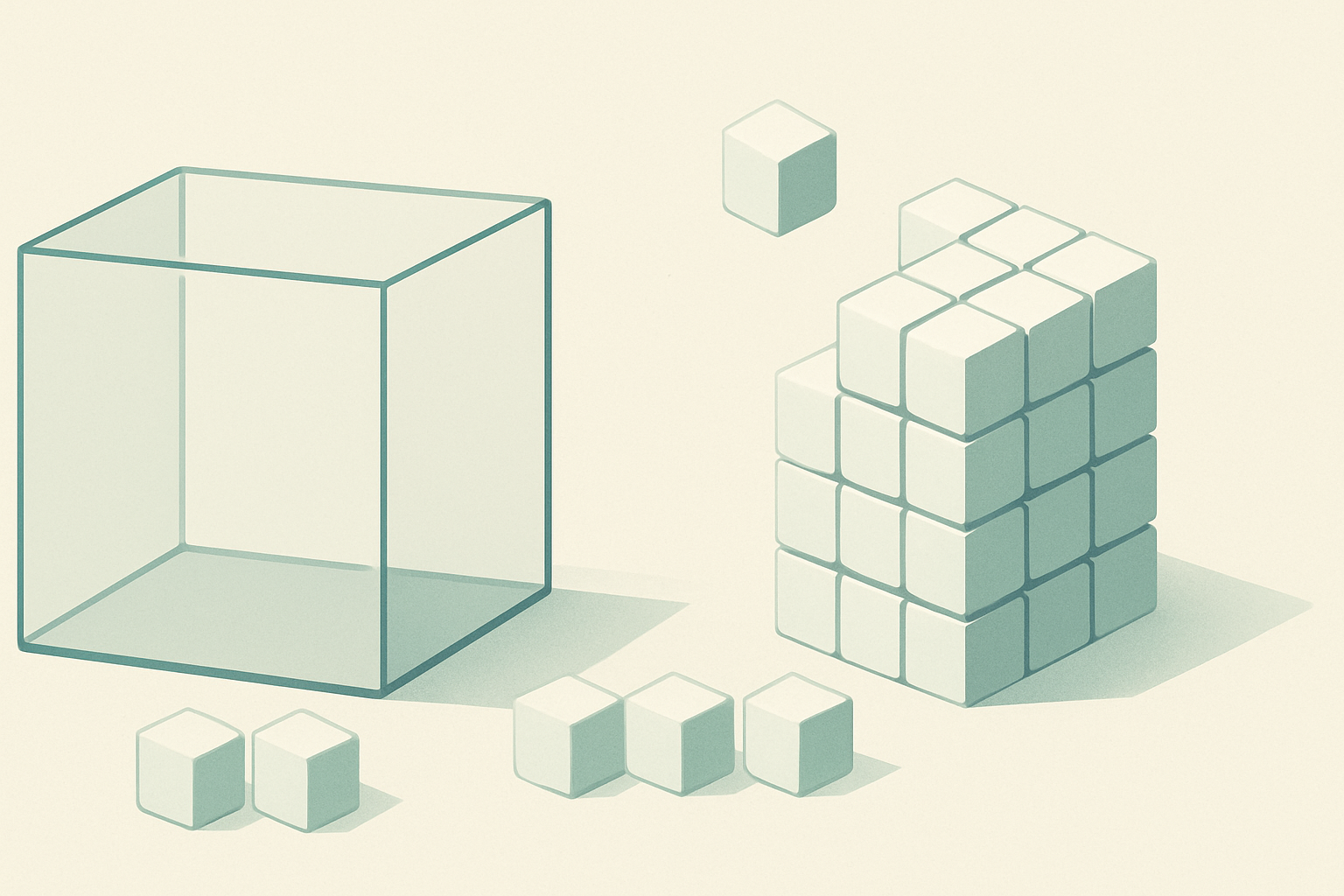
Filling a box, one cube at a time
Picture a shipping box. How much space is inside it? One way to answer is to pack the box with small identical cubes — no gaps, no overlaps — until it is completely full, then count the cubes. That count is the box's volume, measured in cubic units.
One layer at a time
Build the box from the bottom up. The bottom layer covers the floor of the box: its cube count is length × width, exactly like finding the area of a rectangle. Stack identical layers on top until you reach the box's height, and the total cube count is the cubes in one layer multiplied by the number of layers.
Why length times width times height works
The bottom layer has l × w cubes — the same count as the area of the base. Stacking h identical layers on top means the total is that base count repeated h times, which is exactly l × w × h. Area for the floor, then multiplied up through every level.
- Find the cubes in the bottom layer: 4 × 3 = 12 cubes.
- The box is 2 layers tall, so stack two identical layers: 12 × 2 = 24.
- Find the cubes in the bottom layer: 5 × 2 = 10 cubes.
- The tank is 6 layers tall, so stack six identical layers: 10 × 6 = 60.
Check your understanding
- Volume is the number of identical unit cubes that exactly fill a solid, measured in cubic units.
- For a rectangular prism, find the cubes in one layer (length times width), then multiply by the number of layers (height).
- The formula V = length times width times height gives the volume directly, without counting cube by cube.
- Volume uses cubic units (like cm cubed), unlike area, which uses square units.
- Forgetting to multiply by the height only gives the area of the base, not the full volume.
🎓 Go deeper: external courses & trusted references
External sites are listed for reference only. This course is independent and has no affiliation with, or endorsement from, the institutions named.