
🔍 Grade 10 · Lesson 12 of 12
Shrinking Universe: Conditional Probability
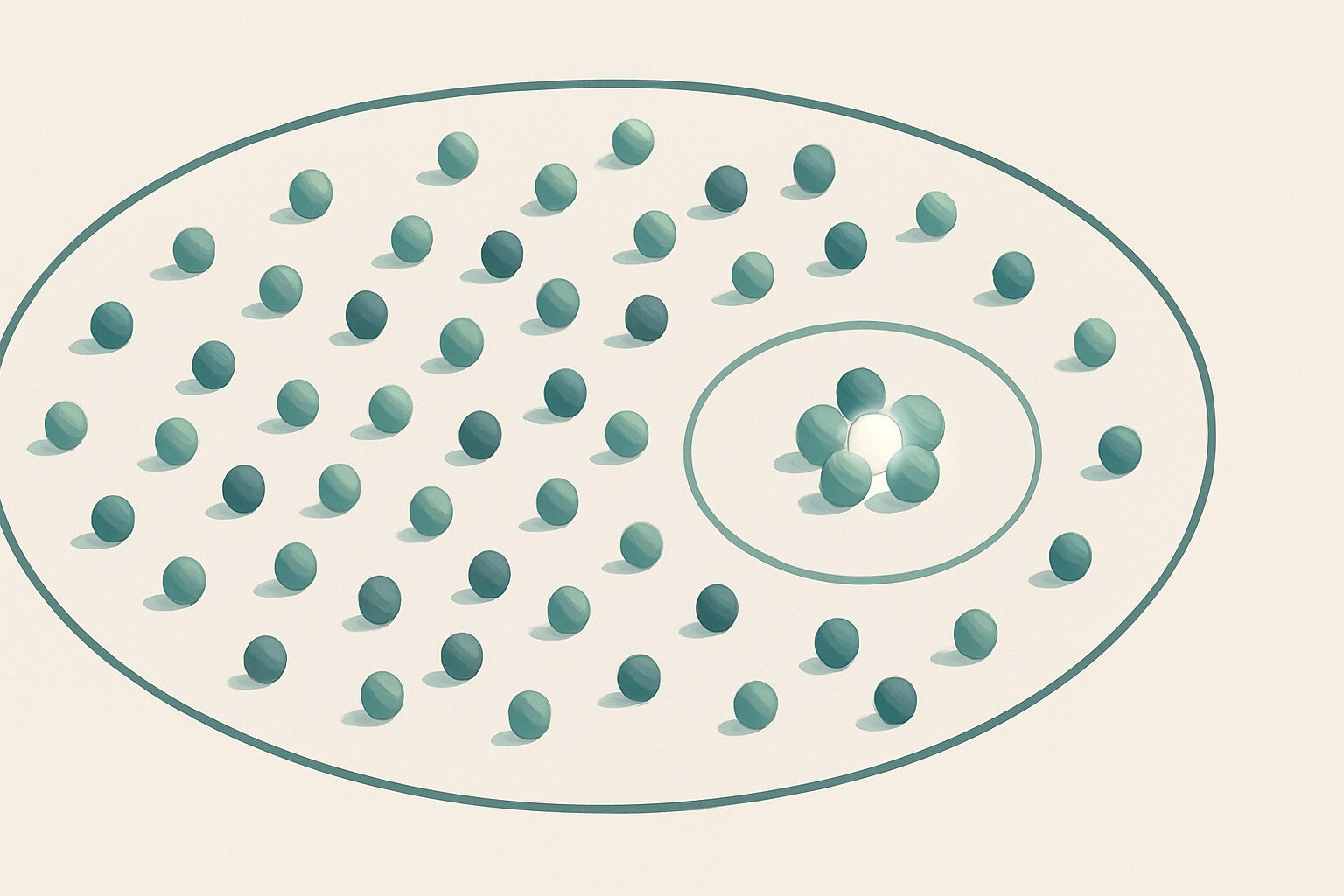
The moment you're told an event already happened, the entire universe of possibilities shrinks to fit it.
💡
The big idea: Conditional probability asks: given that event B has already happened, what's the chance A also happened? Instead of considering every possible outcome, you now only look inside B — the sample space shrinks — and ask what fraction of that smaller universe also satisfies A.
Probability with a condition attached
Ordinary probability asks “what fraction of all outcomes satisfy A?” Conditional probability asks a narrower question: “given that B has already happened, what fraction of those outcomes also satisfy A?” The word given changes everything — you are no longer looking at the whole universe of possibilities, only the slice of it where B is true.
🔑
The universe shrinks to fit the condition
P(A | B), read “the probability of A given B,” restricts your sample space down to just the outcomes inside B. Within that smaller universe, you ask what proportion also lies inside A.
\[ P(A \mid B) = \dfrac{P(A \text{ and } B)}{P(B)} \]
Conditional probability: the chance of both A and B happening, rescaled by how likely B is on its own.
🎮 Shrinking Universe LIVE
Given information shrinks the sample space; watch conditional probability update.
A simple shrink: rolling a die
Roll one fair die. Before any information, P(roll is 4) = 1⁄6 out of all six faces. But suppose you're told the roll came up even. Now the universe shrinks from {1,2,3,4,5,6} down to just {2,4,6} — three equally likely outcomes — and you ask what fraction of those is a 4.
📝 Worked example: A fair die is rolled. Given that the roll is even, what is the probability it is a 4?
- The condition B = “roll is even” shrinks the sample space to {2, 4, 6}, so P(B) = 3⁄6 = ½.
- A = “roll is 4” is already inside B, so P(A and B) = P(roll = 4) = 1⁄6.
- P(A | B) = P(A and B) ÷ P(B) = (1⁄6) ÷ (3⁄6) = 1⁄3.
✓ P(4 | even) = <strong>1⁄3</strong> — one out of the three even outcomes is a 4.
📝 Worked example: Out of 100 days on record, 40 were cloudy, and on 20 of those cloudy days it also rained. Find P(rain | cloudy).
- P(cloudy) = 40⁄100 = 0.4.
- P(rain and cloudy) = 20⁄100 = 0.2.
- P(rain | cloudy) = P(rain and cloudy) ÷ P(cloudy) = 0.2 ÷ 0.4.
✓ P(rain | cloudy) = <strong>0.5</strong> — equivalently, just look inside the 40 cloudy days directly: 20 out of 40 also had rain, which is 0.5.
✨
Independence: when the shrink changes nothing
If P(A | B) = P(A), then knowing B happened gives you no new information about A — the two events are called independent. Shrinking the universe down to B didn't change the proportion of A at all.
⚠️
P(A | B) is not the same as P(B | A)
Order matters. P(rain | cloudy) asks about rain given that it's cloudy; P(cloudy | rain) asks about clouds given that it's raining — a different question with, in general, a different answer. Always be sure which event is the condition (after the bar) and which is the one you're asking about.
Check your understanding
1. Conditional probability P(A|B) asks:
The condition B restricts the sample space, and P(A|B) is the fraction of that restricted space that also satisfies A.
2. Rolling a fair die, what is P(roll is 4 | roll is even)?
Given the roll is even, the sample space shrinks to {2,4,6}; one of those three outcomes is a 4, so the probability is 1/3.
3. In a record of 100 days, 40 are cloudy and 20 of those are both cloudy and rainy. What is P(rain | cloudy)?
P(rain|cloudy) = P(rain and cloudy)/P(cloudy) = 0.2/0.4 = 0.5, matching 20 out of the 40 cloudy days.
4. If P(A|B) = P(A), what does that tell you about events A and B?
When conditioning on B doesn't change the probability of A, the two events are independent by definition.
5. What is the key difference between P(A|B) and P(B|A)?
P(A|B) restricts to the B-universe and asks about A; P(B|A) restricts to the A-universe and asks about B — these are different questions with generally different answers.
✅ Key takeaways
- Conditional probability P(A|B) restricts the sample space to just the outcomes where B happens.
- The formula: P(A|B) = P(A and B) / P(B).
- You can often compute it directly by looking only inside the smaller, 'given' group.
- Independence means P(A|B) = P(A): knowing B happened changes nothing about A's likelihood.
- P(A|B) and P(B|A) are generally different questions with different answers — order matters.