
🎓 University Year 1 · Lesson 6 of 15
Divergence: Measuring Sources and Sinks in a Flow
At each point of a vector field, one number tells you whether fluid is being created, swallowed, or merely passing through.
💡
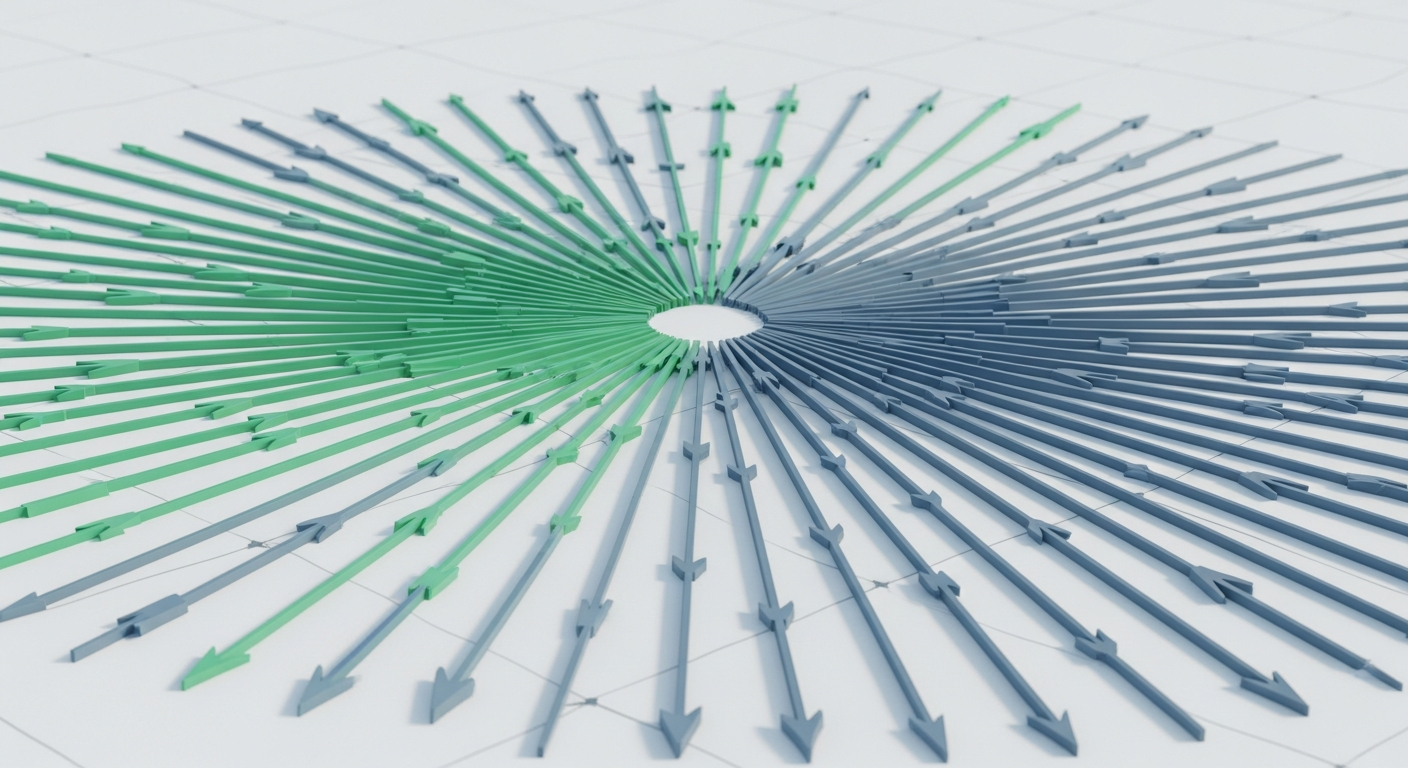
The big idea: Picture a vector field as the velocity of a flowing fluid. The <strong>divergence</strong> at a point measures the net rate at which fluid flows <em>out</em> of a tiny region around it. Positive divergence is a <strong>source</strong> (fluid appearing), negative is a <strong>sink</strong> (fluid disappearing), and zero means whatever flows in also flows out — the flow is incompressible there. It converts a whole field of arrows into a single scalar at every point.
Is fluid being made here?
Think of a vector field F = (P, Q) as the velocity of a fluid at each point. Draw a tiny box anywhere in the flow. Some fluid streams in through its sides; some streams out. The divergence asks: is there a net outflow? If more leaves than enters, fluid must be appearing inside — a source. If more enters than leaves, it is vanishing — a sink.
🔑
Divergence = net outflow per unit area
The divergence ∇·F is the outflow rate of the field at a point, per unit area (in 2D) or volume (in 3D). It is a single number at each point: positive = source, negative = sink, zero = balanced (incompressible).
\[ \operatorname{div}\mathbf F=\nabla\cdot\mathbf F=\frac{\partial P}{\partial x}+\frac{\partial Q}{\partial y}\quad\left(+\ \frac{\partial R}{\partial z}\ \text{in 3D}\right) \]
Divergence of F = (P, Q, R): add the partial derivative of each component in its own direction.
Why a dot product of ∇ with F
The notation ∇·F treats the operator ∇ = (∂/∂x, ∂/∂y) as a vector and “dots” it with F. The dot product pairs each component of ∇ with the matching component of F: ∂/∂x hits P, ∂/∂y hits Q, and you add. That is why divergence, like any dot product, produces a scalar.
🎮 Divergence Flow LIVE
Positive divergence is a source, negative is a sink — measure the outflow.
📝 Worked example: Find the divergence of the outward field F = (x, y).
- Here P = x and Q = y.
- Compute the partials: \( \partial P/\partial x = 1 \) and \( \partial Q/\partial y = 1 \).
- Add them: \( \nabla\cdot\mathbf F = 1 + 1 \).
✓ div F = <strong>2</strong> everywhere — a positive, constant source: this field spreads outward from every point.
📝 Worked example: Find the divergence of F = (x, −y).
- P = x gives \( \partial P/\partial x = 1 \).
- Q = −y gives \( \partial Q/\partial y = -1 \).
- Add: \( 1 + (-1) = 0 \).
✓ div F = <strong>0</strong> — even though the flow stretches out along x, it compresses equally along y, so nothing is net created. The flow is incompressible.
✨
Divergence connects to flux (the Divergence Theorem)
Divergence is the local version of total outflow. Add up (integrate) the divergence over a whole region and you get the net flux through its boundary — the total fluid crossing the outer surface. This is the Divergence Theorem: ∫∫∫ (∇·F) dV equals the flux through the enclosing surface. Sources and sinks inside are exactly what the boundary flow reports.
⚠️
Divergence is a scalar; don't confuse it with the field
The output of divergence is a number at each point, not another vector field. And do not confuse it with curl: divergence measures spreading out (expansion), while curl measures rotation. A field can have one without the other — F = (−y, x) swirls with zero divergence, while F = (x, y) spreads with zero curl.
Check your understanding
1. The divergence of F = (P, Q) in two dimensions is:
Divergence adds each component's partial in its own direction: ∂P/∂x + ∂Q/∂y. (∂Q/∂x − ∂P/∂y is the curl.)
2. A point where the divergence of a flow is positive is a…
Positive divergence means net outflow — fluid is effectively being created there, which is a source. Negative divergence is a sink.
3. What is the divergence of F = (x, y)?
∂(x)/∂x + ∂(y)/∂y = 1 + 1 = 2, a constant positive divergence everywhere.
4. The output of the divergence operation is:
Divergence is ∇ · F, a dot product, so it yields a scalar at each point — not a vector.
5. The field F = (−y, x) rotates around the origin. What is its divergence?
∂(−y)/∂x + ∂(x)/∂y = 0 + 0 = 0. Pure rotation has zero divergence — it swirls but does not spread out.
✅ Key takeaways
- Divergence ∇·F = ∂P/∂x + ∂Q/∂y (+ ∂R/∂z) measures the net outflow of a field per unit area/volume.
- Positive divergence is a source, negative is a sink, and zero means incompressible (balanced) flow.
- It is written as a dot product ∇·F, so the result is always a scalar, not a vector.
- F = (x, y) has divergence 2 (a source); F = (x, −y) has divergence 0 (incompressible).
- The Divergence Theorem links integrated divergence to total flux through the region's boundary.