
☰ Course contents
Mathematics 🔬 Grade 12 The Implicit Surfer: Slopes on Curves That Aren't Functions
🔬 Grade 12 · Lesson 3 of 13

The Implicit Surfer: Slopes on Curves That Aren't Functions

A circle fails the vertical-line test, yet it still has a tangent slope at every point — implicit differentiation finds it without solving for y.
Grade 12Calculus / AP level
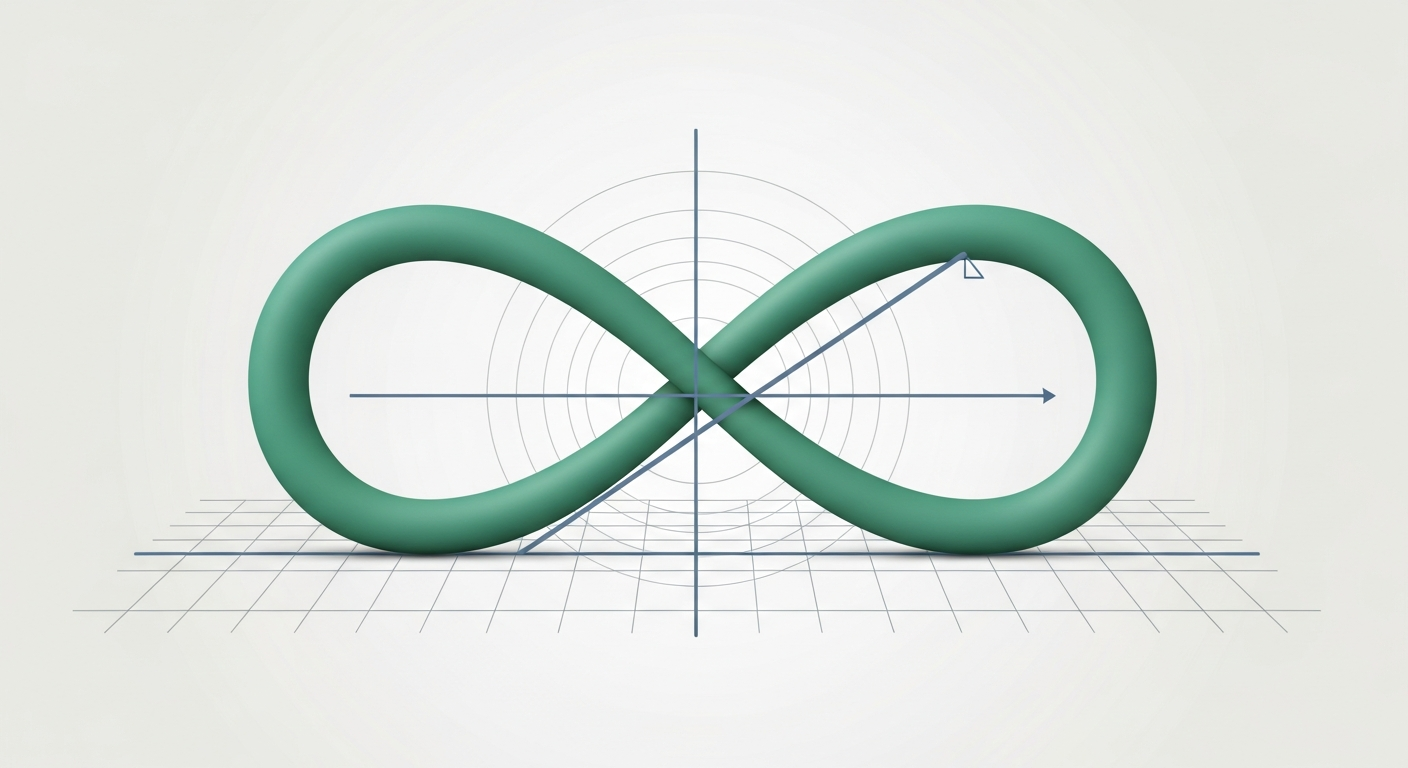
The Implicit Surfer: Slopes on Curves That Aren't Functions — illustration
💡
The big idea: Many curves — circles, ellipses, tangled loops — are defined by an equation linking x and y rather than by y = f(x). You often cannot (or would not want to) solve for y. Implicit differentiation sidesteps that: differentiate every term with respect to x, treating y as an unknown function of x so that each y-term picks up a dy/dx factor via the chain rule, then solve algebraically for dy/dx.
🎯 By the end, you'll be able to
  • Explain why some relations cannot be written as a single function y = f(x)
  • Differentiate both sides of an equation with respect to x, treating y as y(x)
  • Solve the resulting equation algebraically for dy/dx
  • Find the slope and tangent line at a point on an implicitly defined curve
📎 You should already know
  • The chain rule
  • Basic derivative rules and the product rule

Curves that fail the vertical-line test

The circle x² + y² = 25 is a perfectly good curve, but it is not a function: most vertical lines cross it twice, once on the top half and once on the bottom. You could split it into y = +√(25 − x²) and y = −√(25 − x²), but that is clumsy — and for a curve like x² + xy + y² = 3 you cannot cleanly isolate y at all.

Yet the circle clearly has a well-defined tangent line at every point. We want its slope without untangling y.

The key move: y is secretly a function of x

Along any smooth piece of the curve, y really does depend on x — we just have not written the formula. So when we differentiate a term containing y, we apply the chain rule: the derivative of y² with respect to x is 2y times the derivative of y, namely dy/dx. That extra dy/dx factor is the whole trick.

🔑 Treat y as y(x)
Differentiate both sides of the equation with respect to x. Terms in x behave normally; every term in y gets an extra dy/dx factor from the chain rule. Then collect the dy/dx terms and solve algebraically for dy/dx.
\[ \frac{d}{dx}\left(y^2\right) = 2y\,\frac{dy}{dx} \]
The chain rule in action: y is a function of x, so differentiating y-squared brings down a dy/dx.
🎮 Implicit Surfer LIVE
On a circle or ellipse, find the tangent slope where y isn't a function of x.

The procedure

Three steps, every time: (1) differentiate both sides term by term with respect to x, attaching dy/dx to each y-term; (2) gather all dy/dx terms on one side, everything else on the other; (3) factor out dy/dx and divide. The answer usually contains both x and y — that is expected, because the slope depends on which point of the curve you are at.

📝 Worked example: Find dy/dx for the circle x² + y² = 25, and the slope at the point (3, 4).
  1. Differentiate both sides with respect to x: \( 2x + 2y\,\dfrac{dy}{dx} = 0 \).
  2. Isolate the derivative term: \( 2y\,\dfrac{dy}{dx} = -2x \).
  3. Solve: \( \dfrac{dy}{dx} = -\dfrac{x}{y} \).
  4. At (3, 4): \( \dfrac{dy}{dx} = -\dfrac{3}{4} \).
✓ dy/dx = <strong>&minus;x/y</strong>, so the slope at (3, 4) is <strong>&minus;3/4</strong>. (Notice it is perpendicular to the radius, as geometry predicts.)
\[ x^2 + y^2 = 25 \;\Longrightarrow\; \frac{dy}{dx} = -\frac{x}{y} \]
The slope depends on the point (x, y): the same curve has different slopes on its top and bottom halves.
📝 Worked example: Find the slope of the curve x² + xy + y² = 3 at the point (1, 1).
  1. Differentiate each term. The middle term xy needs the product rule: \( \dfrac{d}{dx}(xy) = y + x\,\dfrac{dy}{dx} \).
  2. Full derivative: \( 2x + y + x\,\dfrac{dy}{dx} + 2y\,\dfrac{dy}{dx} = 0 \).
  3. Group the dy/dx terms: \( \dfrac{dy}{dx}(x + 2y) = -(2x + y) \).
  4. Solve: \( \dfrac{dy}{dx} = -\dfrac{2x + y}{x + 2y} \), then substitute (1, 1): \( -\dfrac{2 + 1}{1 + 2} = -1 \).
✓ The slope at (1, 1) is <strong>&minus;1</strong>.
⚠️ Every y-term needs its dy/dx
The commonest error is differentiating a y-term as if y were a constant — writing the derivative of y² as 2y instead of 2y·(dy/dx). And do not forget the product rule on mixed terms like xy: it is y + x(dy/dx), not simply dy/dx. Miss either factor and the answer is wrong.
✨ Vertical and horizontal tangents
Because dy/dx = −x/y on the circle, the tangent is horizontal where the numerator is 0 (at (0, ±5), the top and bottom) and vertical where the denominator is 0 (at (±5, 0), the left and right edges). Implicit differentiation reads off both directly.

Check your understanding

1. Differentiating y³ with respect to x gives:
By the chain rule, since y is a function of x, d/dx(y³) = 3y² · dy/dx. The dy/dx factor is essential.
2. For the circle x² + y² = 25, dy/dx equals:
Differentiating gives 2x + 2y·dy/dx = 0, so dy/dx = −x/y.
3. What is the slope of x² + y² = 25 at the point (3, 4)?
Using dy/dx = −x/y at (3, 4) gives −3/4.
4. Why use implicit differentiation instead of solving for y first?
Many relations can't be solved for y as a single function; implicit differentiation handles the whole curve, both branches, without isolating y.
5. Differentiating both sides of x² + y² = 25 with respect to x gives which equation?
The x-term gives 2x; the y-term gives 2y·dy/dx by the chain rule; the constant 25 differentiates to 0.
✅ Key takeaways
  • Some relations (circles, ellipses, loops) can't be written as a single y = f(x), yet still have tangent slopes.
  • Implicit differentiation: differentiate both sides with respect to x, treating y as a function of x.
  • By the chain rule each y-term gains a dy/dx factor; mixed terms like xy also need the product rule.
  • Collect the dy/dx terms, factor, and solve — the result usually depends on both x and y.
  • For x² + y² = 25, dy/dx = −x/y, giving slope −3/4 at (3, 4).
  • Horizontal tangents occur where the numerator is zero; vertical tangents where the denominator is zero.