
Surface Area: Unfold the Solid, Add Up the Skin
Flatten a 3D solid into its net, then add up the area of every flat piece — that total is the surface area.
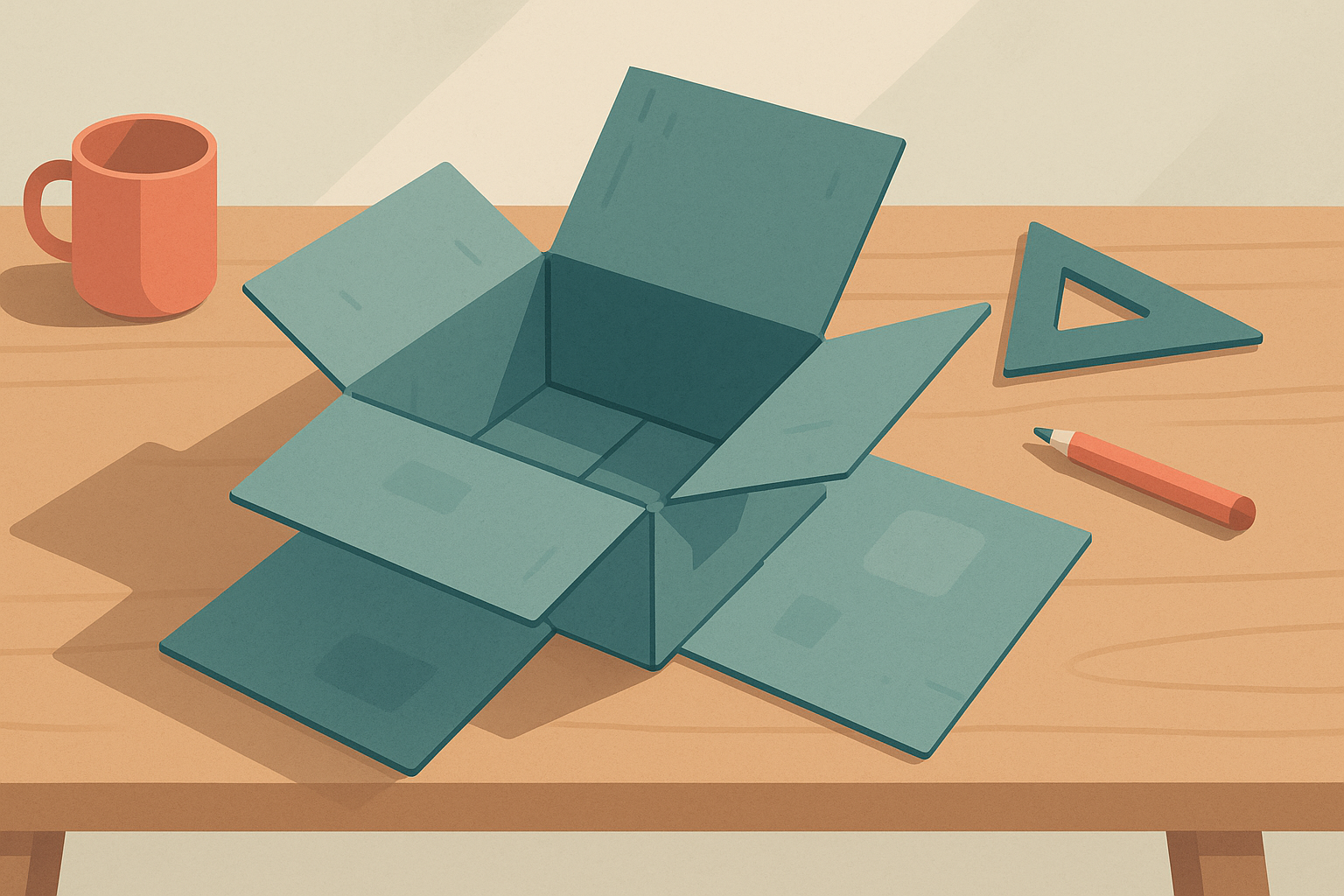
Flatten the box — surface area is just the skin
Picture breaking down a cardboard shipping box for recycling. You pull the tape, and the box collapses flat into one connected shape made of rectangles. That flat shape is called the box's net. Fold it back along the crease lines and you rebuild the exact same box.
Here's the key idea: the amount of cardboard in that flat net is exactly the same as the amount of cardboard covering the 3D box. So instead of imagining a tricky 3D surface, you just add up the area of every flat piece in the net. That total is the surface area — literally the area of the solid's outer skin.
A net is the two-dimensional shape you get by unfolding a three-dimensional solid so every face lies flat, with no overlaps and no gaps. Nets of the solids in this lesson are built entirely from two shapes you already know how to measure: rectangles and triangles.
Different solids unfold into different nets — but the rule for finding surface area never changes: surface area = sum of the areas of every piece in the net.
Net of a rectangular prism — six rectangles in three matching pairs
Unfold a rectangular prism (a box) with length l, width w, and height h, and you get 6 rectangles — but they come in 3 congruent pairs, because opposite faces of a box are always identical:
- Top and bottom: two l × w rectangles
- Front and back: two l × h rectangles
- Left and right: two w × h rectangles
Add up the three pairs and you get the surface area formula:
SA = 2(lw + lh + wh)
Face-by-face (matches the net directly): find the area of each of the 6 rectangles in the net and add them all up.
Formula shortcut: compute the three different face areas once — lw, lh, wh — add them, then double the sum: 2(lw + lh + wh). This works because each face area appears exactly twice in the net (once for each face in its matching pair).
Net of a triangular prism — two triangles, three rectangles
A triangular prism has two identical triangular ends (the bases) connected by three rectangular sides — one rectangle per edge of the triangle. Unfolded, the net shows the two triangles plus three rectangles laid flat, each rectangle's width matching one side of the triangle and its length matching the prism's length.
SA = 2 × (area of triangular base) + (perimeter of triangle) × (prism length)
The perimeter × length term is really just the three rectangles added together in one step, since their combined width is the triangle's perimeter.
Net of a square pyramid — one square, four triangles
A square pyramid has one square base and four triangular faces meeting at the apex. Unfold it and the net looks like a square with a triangle flapped open on each of its four sides — like a pinwheel or a paper crown.
Each triangular face has a base equal to the side of the square, s, and a height called the slant height, l (measured along the face, from the middle of a base edge up to the apex — not the same as the pyramid's straight-up height).
SA = s² + 4 × (½ × s × l) = s² + 2sl
Surface area measures the skin (square units — cm², in², etc.); volume measures the space inside (cubic units — cm³, in³). A box holding more stuff (bigger volume) doesn't automatically need more wrapping paper (surface area) than a different box — the shapes matter, not just the size.
Also watch for missing faces in real problems: an open-top crate or a room being painted (no ceiling painted, say) has fewer faces than the full net — always re-check which faces the problem actually wants.
- Unfold into 3 pairs of rectangles: top/bottom (5×3), front/back (5×4), left/right (3×4).
- Area of each pair: 5×3 = 15, 5×4 = 20, 3×4 = 12.
- Add the three areas: 15 + 20 + 12 = 47.
- Double it, since each face has a matching partner: 2 × 47 = 94.
- This is a real-world surface area problem: wrapping paper covers every face of the net.
- Compute the three face areas: lw = 30×20 = 600, lh = 30×10 = 300, wh = 20×10 = 200.
- Add them: 600 + 300 + 200 = 1100.
- Double it: 2 × 1100 = 2200.
- Base area: s² = 6² = 36.
- One triangular face: ½ × s × l = ½ × 6 × 5 = 15.
- Four triangular faces: 4 × 15 = 60.
- Total: base + four triangles = 36 + 60 = 96.
Check your understanding
- A net is the flat shape you get by unfolding a 3D solid — surface area is just the total area of every piece in that net.
- A rectangular prism unfolds into 6 rectangles (3 congruent pairs): SA = 2(lw + lh + wh).
- A triangular prism unfolds into 2 triangles + 3 rectangles: SA = 2 × (triangle area) + (perimeter × length).
- A square pyramid unfolds into 1 square + 4 triangles: SA = s² + 2sl, using the slant height.
- Surface area (square units, the skin) is a different quantity from volume (cubic units, the space inside) — don't mix them up.
🎓 Go deeper: external courses & trusted references
External sites are listed for reference only. This course is independent and has no affiliation with, or endorsement from, the institutions named.