
Vector Shadow: The Dot Product and Projections
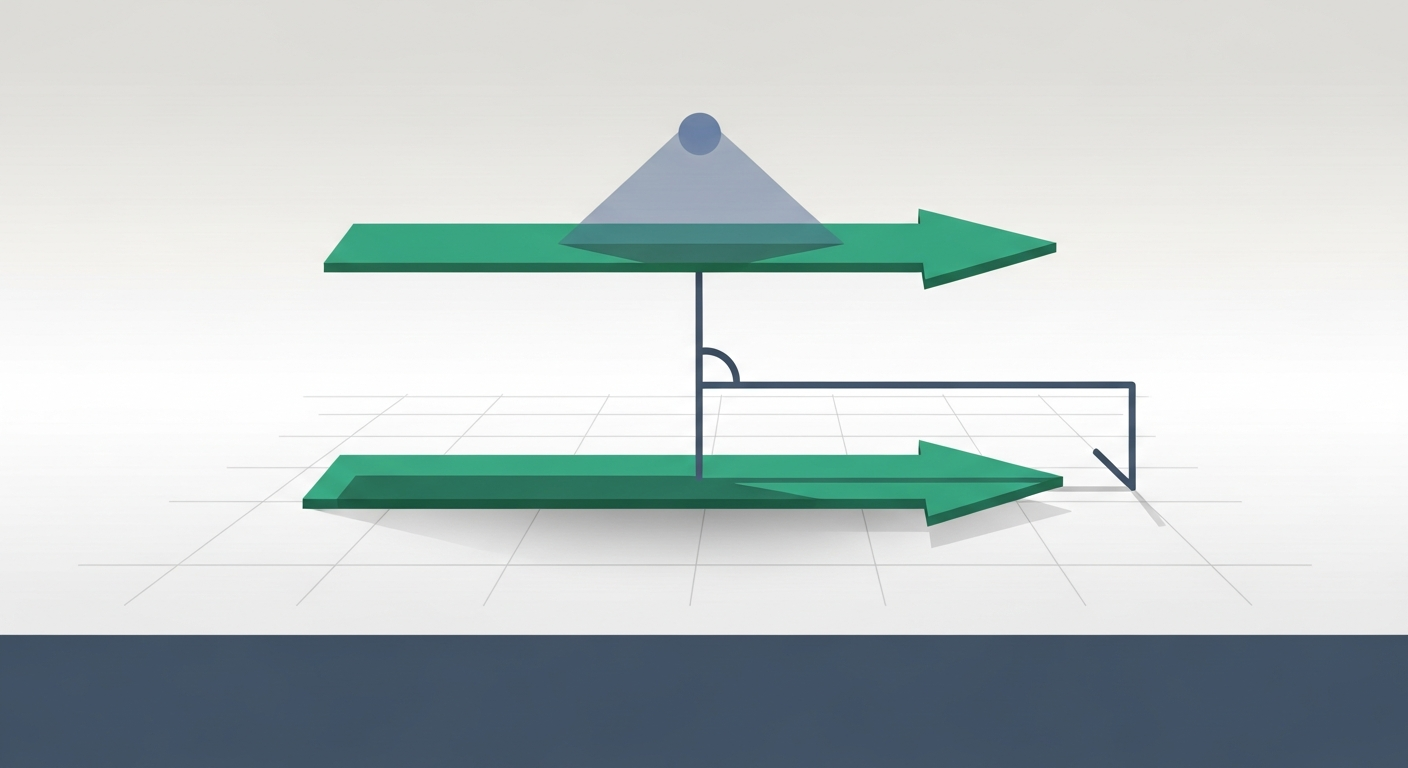
Shine a light straight down onto one vector and the length of the shadow another vector casts is exactly what the dot product measures.
Two vectors, one number
You already know how to add vectors and scale them. The dot product does something different: it combines two vectors into a single ordinary number (a scalar), and that number tells you how aligned the two vectors are.
Point them the same way and the dot product is large and positive. Make them perpendicular and it collapses to exactly zero. Point them in opposing directions and it goes negative. In one stroke it measures “how much of this vector lies along that one.”
The shadow picture
Imagine light shining straight down onto vector a. Vector b casts a shadow along the line of a. The length of that shadow is |b| cos θ — it shrinks as the angle opens up, and reverses direction once the angle passes 90°.
Multiply that shadow length by |a| and you get the dot product. So a · b is really “the length of one vector times the shadow the other casts on it.”
- Dot product: \( \vec{a}\cdot\vec{b} = 2\cdot 3 + 1\cdot 4 = 6 + 4 = 10 \).
- Lengths: \( |\vec{a}| = \sqrt{2^2+1^2} = \sqrt{5} \) and \( |\vec{b}| = \sqrt{3^2+4^2} = 5 \).
- So \( \cos\theta = \dfrac{10}{\sqrt{5}\cdot 5} = \dfrac{10}{5\sqrt{5}} = \dfrac{2}{\sqrt{5}} \approx 0.894 \).
- Take the inverse cosine: \( \theta = \cos^{-1}(0.894) \).
From shadow length to shadow vector
The scalar projection of b onto a is the signed shadow length, comp = (a · b) / |a|. To turn that length back into an actual vector lying along a, multiply by the unit vector in the direction of a. The result is the vector projection.
- Dot product: \( \vec{a}\cdot\vec{b} = 2\cdot 3 + 1\cdot 4 = 10 \).
- Squared length of a: \( |\vec{a}|^2 = 2^2 + 1^2 = 5 \).
- Scale a by the ratio: \( \operatorname{proj}_{\vec{a}}\vec{b} = \dfrac{10}{5}(2,1) = 2\,(2,1) \).
Check your understanding
- The dot product turns two vectors into one scalar: multiply matching components and add.
- Geometrically, a·b = |a||b|cosθ, a length times the shadow the other vector casts.
- The sign of the dot product classifies the angle: positive = acute, zero = right, negative = obtuse.
- The scalar projection (a·b)/|a| is the shadow length; the vector projection puts that shadow back along a.
- Two nonzero vectors are perpendicular exactly when their dot product is 0.
🎓 Go deeper: external courses & trusted references
External sites are listed for reference only. This course is independent and has no affiliation with, or endorsement from, the institutions named.