
Decay Lab: Half-Lives and Horizontal Asymptotes
Cut a quantity in half, then in half again — it keeps shrinking forever, always approaching zero but never quite touching it.
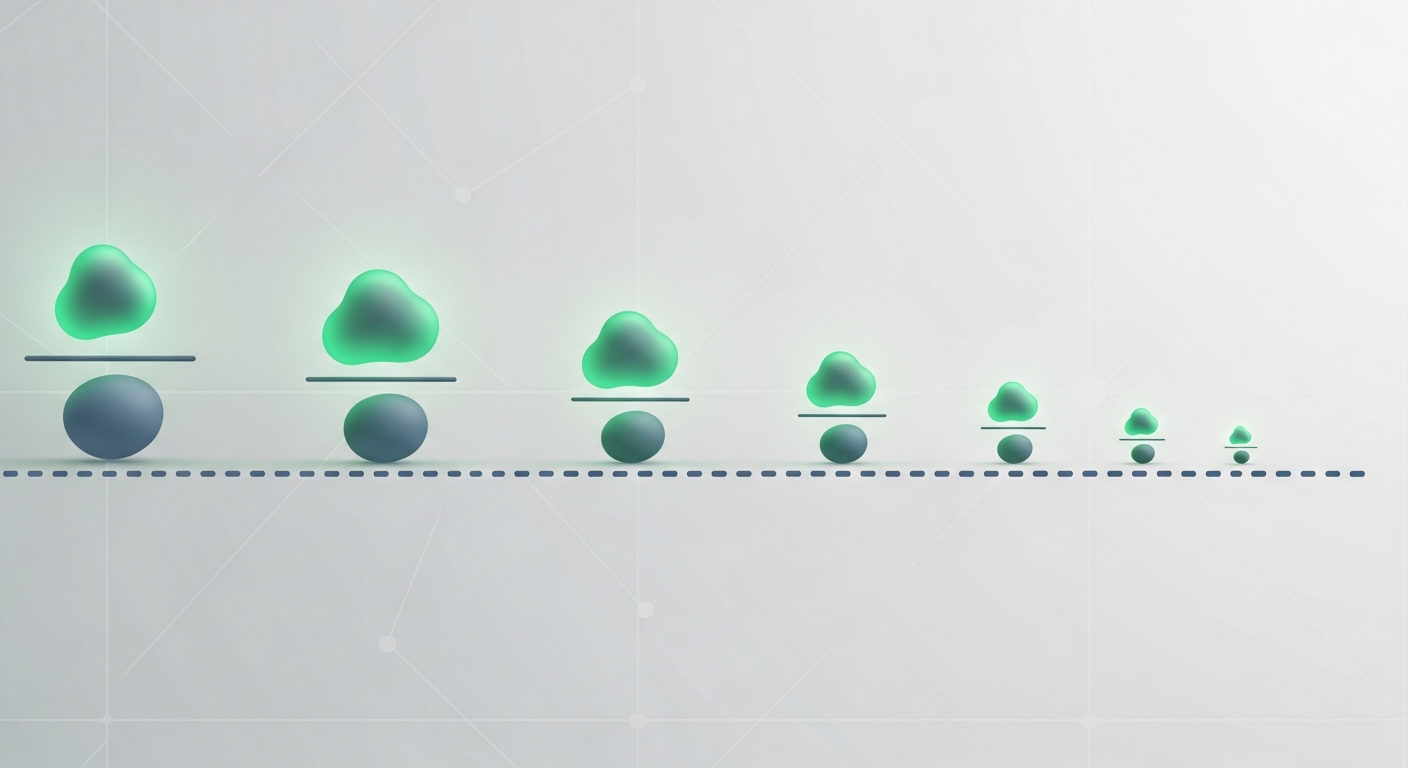
Shrinking, forever
A dose of medicine leaves the bloodstream a little at a time. A radioactive sample loses a fraction of its atoms as time passes. Both are examples of exponential decay: a quantity that is multiplied by the same shrinking factor over and over, getting smaller and smaller but never disappearing completely.
Half-life: cutting in half, again and again
A substance's half-life is the fixed amount of time it takes for exactly half of it to remain. Whatever amount you start with, after one half-life you have half of it; after two half-lives you have half of that (a quarter of the original); after three, an eighth — the fraction remaining is always (1⁄2) raised to the number of half-lives that have passed.
- 12 hours is 12 ÷ 4 = 3 half-lives.
- Remaining fraction = (1⁄2)³ = 1⁄8.
- Remaining amount = 80 × (1⁄8).
- Substitute t = 5: y = 200(0.9)^5.
- Compute (0.9)^5 ≈ 0.590.
- Multiply: y ≈ 200 × 0.590.
Check your understanding
- Exponential decay multiplies a quantity by a fixed factor b, where 0 < b < 1, shrinking it each period.
- Half-life is the fixed time it takes a quantity to reduce to exactly half its previous amount.
- After n half-lives, the remaining fraction is (1/2)ⁿ.
- The horizontal asymptote y = 0 is the boundary a decay curve approaches endlessly but never touches.
- Mathematically, exponential decay never reaches exactly zero, no matter how much time passes.
🎓 Go deeper: external courses & trusted references
External sites are listed for reference only. This course is independent and has no affiliation with, or endorsement from, the institutions named.