
Angles: Measuring the World
Every turn, corner, and swing has a number hiding inside it, measured in degrees.
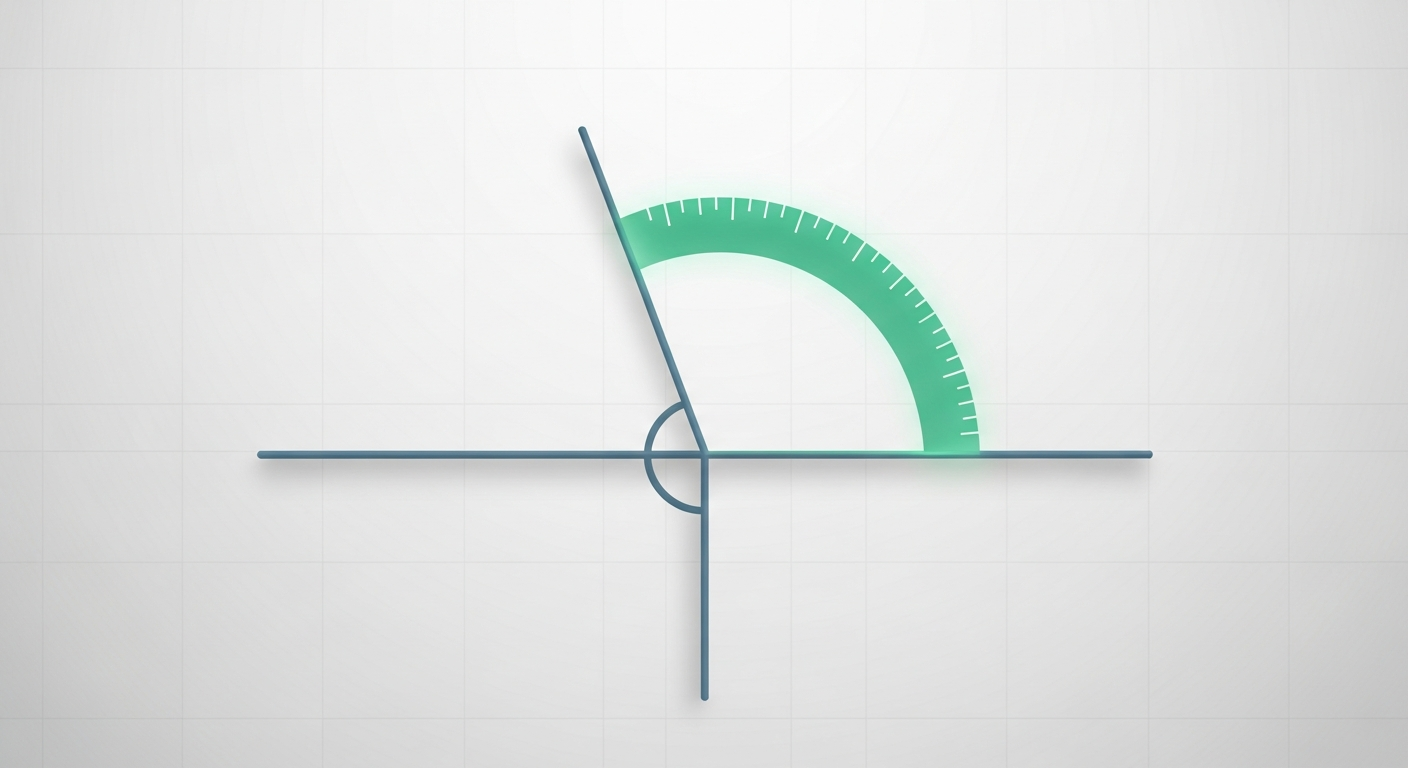
An angle is an amount of turning
Open a door a little, and then open it wide. Both times, the door swings around the same hinge, but it turns through a different amount. That amount of turning is exactly what an angle measures.
Every angle is made of two rays (straight parts that start at a point and go on forever in one direction) that share a starting point called the vertex. The angle is the amount you would have to turn one ray to land it on the other.
Four families of angles
Once you can measure a turn in degrees, every angle sorts into one of four families. An acute angle is smaller than a right angle (less than 90°): a narrow, sharp turn. A right angle is exactly 90°, the crisp corner of a square piece of paper. An obtuse angle is bigger than a right angle but smaller than a straight one (between 90° and 180°). A straight angle is exactly 180° and looks like a straight line.
- 130° is more than 90° (a right angle).
- 130° is less than 180° (a straight angle).
- Any angle strictly between 90° and 180° belongs to one family.
Bigger turn, bigger angle: ray length does not matter
It is tempting to think that an angle drawn with long rays must be bigger than one drawn with short rays, but that is not true. The length of the rays you draw is just how far you happened to draw the lines; it says nothing about the angle. Only the amount of turning between the rays decides the angle's size.
- Ignore how long the rays were drawn; ray length does not affect the angle measure.
- Compare the actual degree measures: 70° versus 50°.
- 70° is greater than 50°.
Check your understanding
- An angle measures the amount of turning between two rays that share a vertex.
- We measure angles in degrees; a full turn all the way around is 360°.
- Angles sort into four families: acute (under 90°), right (90°), obtuse (between 90° and 180°), and straight (180°).
- A right angle (90°) is a handy benchmark for judging whether another angle looks tighter or wider.
- The length of the rays you draw never affects the angle's size; only the amount of turn does.
🎓 Go deeper: external courses & trusted references
External sites are listed for reference only. This course is independent and has no affiliation with, or endorsement from, the institutions named.