
☰ Course contents
Mathematics 🌌 Grade 11 Inverse Mirror: Function Inverses and Reflections
🌌 Grade 11 · Lesson 4 of 12

Inverse Mirror: Function Inverses and Reflections

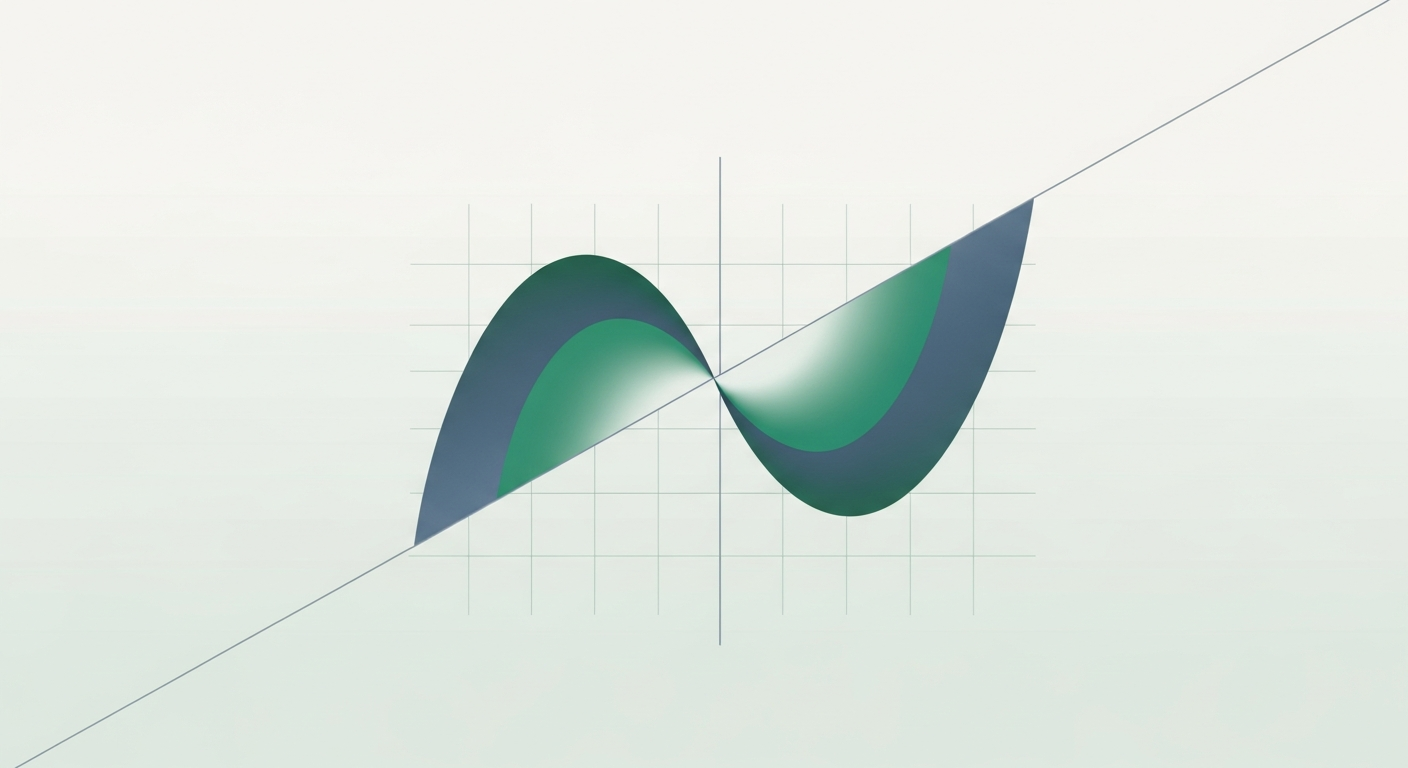
An inverse function runs the machine backwards — and its graph is just the original reflected across the line y = x, swapping every input with its output.
Grade 11Algebra 2 / Pre-Calculus
Inverse Mirror: Function Inverses and Reflections — illustration
💡
The big idea: If a function turns inputs into outputs, its inverse turns those outputs back into the original inputs — it undoes the work. Geometrically, swapping x and y reflects the graph across the diagonal line y = x. But undoing only works cleanly when the function never sends two different inputs to the same output; otherwise the reflection fails the vertical line test and the inverse is not a function.
🎯 By the end, you'll be able to
  • Explain an inverse function as the operation that undoes the original
  • Find an inverse algebraically by swapping x and y and solving
  • Recognize that the graph of an inverse is the reflection across the line y = x
  • Use the one-to-one (horizontal line test) condition to decide when an inverse function exists
📎 You should already know
  • Function notation and evaluation
  • Domain and range of functions

Undoing a function

Think of a function f as a machine: put in x, get out f(x). The inverse function, written f−1, is the machine that runs the process in reverse — feed it an output and it hands back the input that produced it.

If f adds 3, then f−1 subtracts 3. If f multiplies by 2, then f−1 divides by 2. Doing one and then the other lands you right back where you started.

⚠️ That −1 is not an exponent
The notation f−1(x) means the inverse function, not a reciprocal. It does not mean 1 ÷ f(x). It is unfortunate shorthand, but it is standard — read it as “f inverse.”
\[ f^{-1}\big(f(x)\big) = x \qquad \text{and} \qquad f\big(f^{-1}(x)\big) = x \]
The defining property: composing a function with its inverse (in either order) returns the original input untouched.

The reflection across y = x

The inverse swaps the roles of input and output: every point (a, b) on the graph of f becomes the point (b, a) on the graph of f−1. Swapping a point's coordinates is exactly what a reflection across the diagonal line y = x does.

So the two graphs are mirror images in that diagonal. Whatever the domain of f is becomes the range of f−1, and vice versa — the mirror swaps the axes' roles too.

🎮 Inverse Mirror LIVE
Reflect a function across y = x to build its inverse; see where it fails to be one-to-one.

When does an inverse function exist?

Reflecting a graph across y = x always produces some curve, but it is only an inverse function if it passes the vertical line test. That happens exactly when the original f is one-to-one: no two different inputs share an output.

You can check this on the original graph with the horizontal line test: if any horizontal line hits the graph more than once, f is not one-to-one, and its reflection will fail the vertical line test.

✨ Why y = x² needs a restricted domain
The parabola y = x2 is not one-to-one — both x = 3 and x = −3 give 9. Its reflection is a sideways parabola that fails the vertical line test. To get a genuine inverse (the square root), we restrict the domain to x ≥ 0, making that half one-to-one.
📝 Worked example: Find the inverse of f(x) = 2x − 6.
  1. Write \( y = 2x - 6 \), then swap x and y to reverse the roles: \( x = 2y - 6 \).
  2. Solve for y: add 6 to both sides to get \( x + 6 = 2y \).
  3. Divide by 2: \( y = \dfrac{x + 6}{2} \).
✓ <strong>f<sup>&minus;1</sup>(x) = (x + 6) / 2</strong> — it adds 6 then halves, undoing &ldquo;double then subtract 6.&rdquo;
📝 Worked example: Verify that g(x) = x³ and h(x) = ∛x are inverses by composing them.
  1. Compose one way: \( g(h(x)) = (\sqrt[3]{x})^3 = x \).
  2. Compose the other way: \( h(g(x)) = \sqrt[3]{x^3} = x \).
  3. Both compositions return x, matching the defining property of inverses.
✓ Yes — since both compositions simplify to <strong>x</strong>, the cube and cube-root functions are inverses.
🔑 The recipe for an inverse
To find an inverse algebraically: (1) replace f(x) with y, (2) swap x and y, (3) solve for the new y, and (4) rename it f−1(x). The swap is the heart of it — it encodes “reflect across y = x.”

Check your understanding

1. What does f⁻¹(x) mean?
f⁻¹ denotes the inverse function; the −1 is notation, not an exponent, so it is not 1/f(x).
2. The graph of an inverse function is the original graph reflected across which line?
Swapping x and y coordinates reflects each point across the diagonal y = x.
3. A function has an inverse function exactly when it is…
Only one-to-one functions can be reversed unambiguously; the horizontal line test checks this.
4. If (4, 7) is a point on the graph of f, which point must be on the graph of f⁻¹?
The inverse swaps coordinates, so (4, 7) becomes (7, 4).
5. Why must we restrict f(x) = x² to x ≥ 0 to give it an inverse function?
x and −x give the same square, so the full parabola isn't one-to-one; restricting to x ≥ 0 fixes that.
✅ Key takeaways
  • An inverse function f⁻¹ undoes f: it maps each output back to the input that produced it.
  • The notation f⁻¹ means 'inverse function,' not the reciprocal 1/f(x).
  • Composing a function with its inverse in either order returns x.
  • The graph of f⁻¹ is the reflection of f across the line y = x, swapping domain and range.
  • An inverse function exists only when f is one-to-one (passes the horizontal line test); otherwise restrict the domain.