
☰ Course contents
Mathematics 🔄 Grade 7 Area of Circles and Sectors
🔄 Grade 7 · Lesson 9 of 14

Area of Circles and Sectors

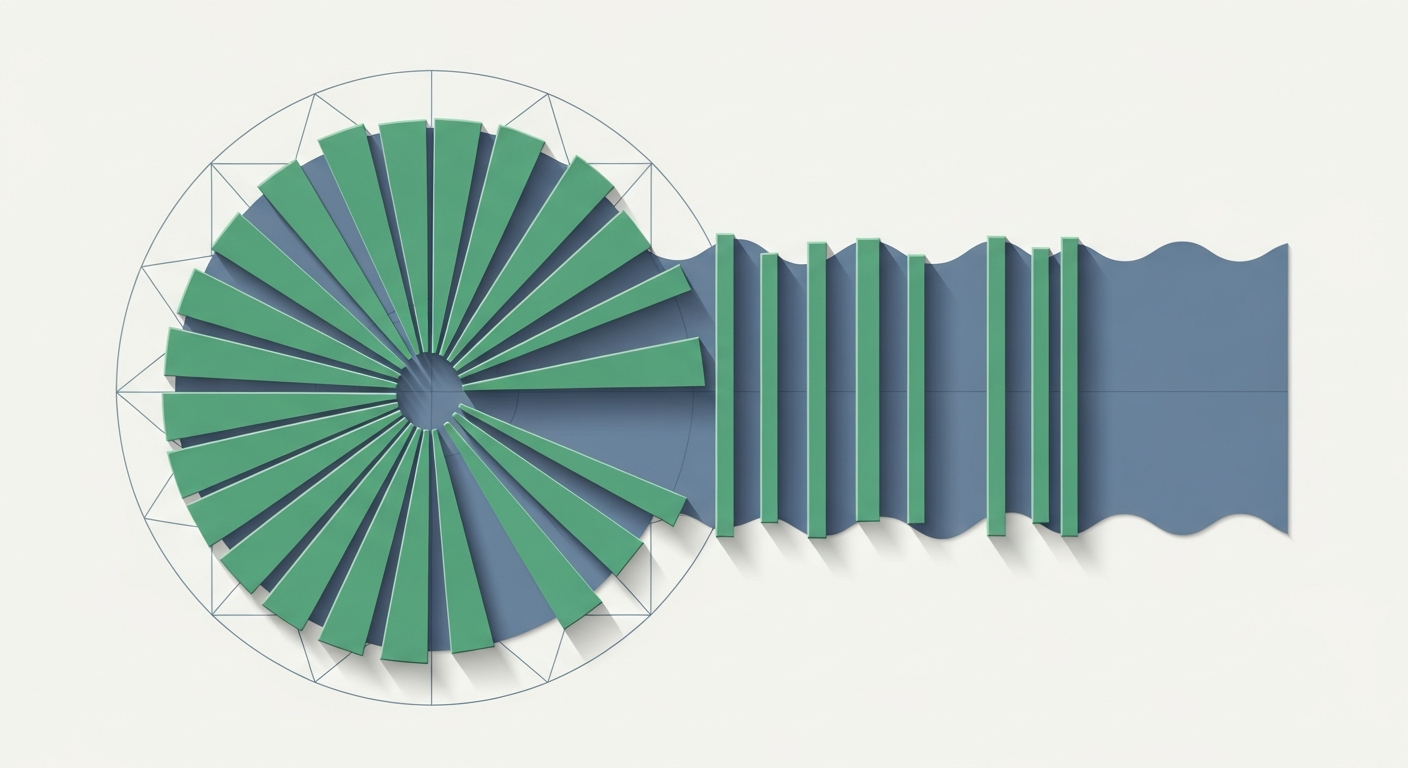
Slice a circle into thin wedges, lay them flat, and they almost form a rectangle — that's where pi r squared comes from.
Grade 7Middle school
Area of Circles and Sectors — illustration
💡
The big idea: The area of a circle is pi times its radius squared. You can see why by cutting the circle into many thin, pie-shaped wedges and rearranging them into a shape that looks almost like a rectangle: its height is the radius, and its base is half the circle's circumference, which is pi times the radius. Multiply those together and you get pi r squared. A sector — a pie-slice piece of the circle — simply takes that fraction of the whole area based on its central angle.
🎯 By the end, you'll be able to
  • Explain why the area of a circle equals pi times the radius squared
  • Compute the area of a circle given its radius or diameter
  • Find the area of a sector as a fraction of the full circle's area
  • Solve real-world problems involving circular area
📎 You should already know
  • Circumference of a circle
  • Working with fractions of a whole

A circle's hidden rectangle

Pizza, coins, wheels, clock faces — circles are everywhere, and so is the need to measure how much surface they cover. The formula for the area of a circle looks simple, but it's worth seeing why it works rather than just memorizing it.

🔑 Area = pi r squared
The area of a circle with radius r is πr² — pi times the radius, squared. Because π is a fixed number (about 3.14), this formula scales perfectly with the size of the circle.
\[ A = \pi r^2 \]
The area of a circle depends only on its radius r.

Where the formula comes from: wedges

Cut a circle into many thin, pie-shaped wedges and lay them flat, alternating point-up and point-down. The wedges interlock into a shape that looks almost like a rectangle. Its height is the circle's radius, r. Its base is made of half the wedges' curved edges, which together add up to half the circle's circumference — that is, πr.

\[ \text{base} \approx \pi r, \quad \text{height} = r \quad \Rightarrow \quad A \approx \pi r \times r = \pi r^2 \]
The more wedges you cut, the closer the rearranged shape gets to a perfect rectangle with area πr × r.
🎮 Wedge Rearranger LIVE
Cut a circle into thin wedges and rearrange them into a rectangle to see area = pi r squared.

Sectors: a fraction of the whole circle

A sector is a pie-slice-shaped piece of a circle, bounded by two radii and an arc. Since a full circle sweeps through 360°, a sector's area is simply that same fraction of the full circle's area — whatever fraction its central angle is of 360°.

\[ A_{\text{sector}} = \dfrac{\theta}{360^{\circ}} \times \pi r^2 \]
θ is the sector's central angle in degrees; the sector gets that fraction of the full circle's area.
📝 Worked example: Find the area of a circle with radius 5 units.
  1. Use A = πr² with r = 5.
  2. A = π × 5² = π × 25.
  3. Using π ≈ 3.14: A ≈ 25 × 3.14.
✓ The area is about <strong>78.5 square units</strong>.
📝 Worked example: A sector has a central angle of 90&deg; and the circle has radius 6 units. Find the sector's area.
  1. First find the full circle's area: A = π × 6² = 36π ≈ 113.1 square units.
  2. The sector is 90°/360° = 1/4 of the full circle.
  3. Sector area = 1/4 × 113.1.
✓ The sector's area is about <strong>28.3 square units</strong>.
⚠️ Radius, not diameter
The formula πr² uses the radius, not the diameter. If a problem gives you the diameter, divide it by 2 first to get the radius before squaring. Squaring the diameter directly gives an answer four times too large.

Check your understanding

1. What is the area of a circle with radius 4?
A = πr² = π × 16 ≈ 50.3 square units.
2. A circle has a diameter of 10 cm. What is its area?
Radius = diameter ÷ 2 = 5 cm. Area = π × 5² ≈ 78.5 cm².
3. What fraction of a circle's area does a 60° sector represent?
60° ÷ 360° = 1/6 of the full circle.
4. A sector has a central angle of 180° and radius 3. What is its area?
Full circle area = π × 9 ≈ 28.3. A 180° sector is half the circle: 28.3 ÷ 2 ≈ 14.1.
5. Why is the area formula πr² rather than πd²?
The wedge-rearrangement shows the shape's height is the radius and its base is half the circumference (πr), giving A = πr × r = πr².
✅ Key takeaways
  • The area of a circle is A = πr², where r is the radius.
  • Cutting a circle into thin wedges and rearranging them gives a near-rectangle with height r and base πr, explaining the formula.
  • A sector's area is the fraction (central angle ÷ 360°) of the full circle's area.
  • Always use the radius in the formula — divide a given diameter by 2 first.
  • Doubling the radius quadruples the area, since the radius is squared in the formula.