
The Potion Mixer: Understanding Ratios and Proportions
A magical recipe only works if its ingredients stay in the same ratio — scale it up or down and the potion still brews true.
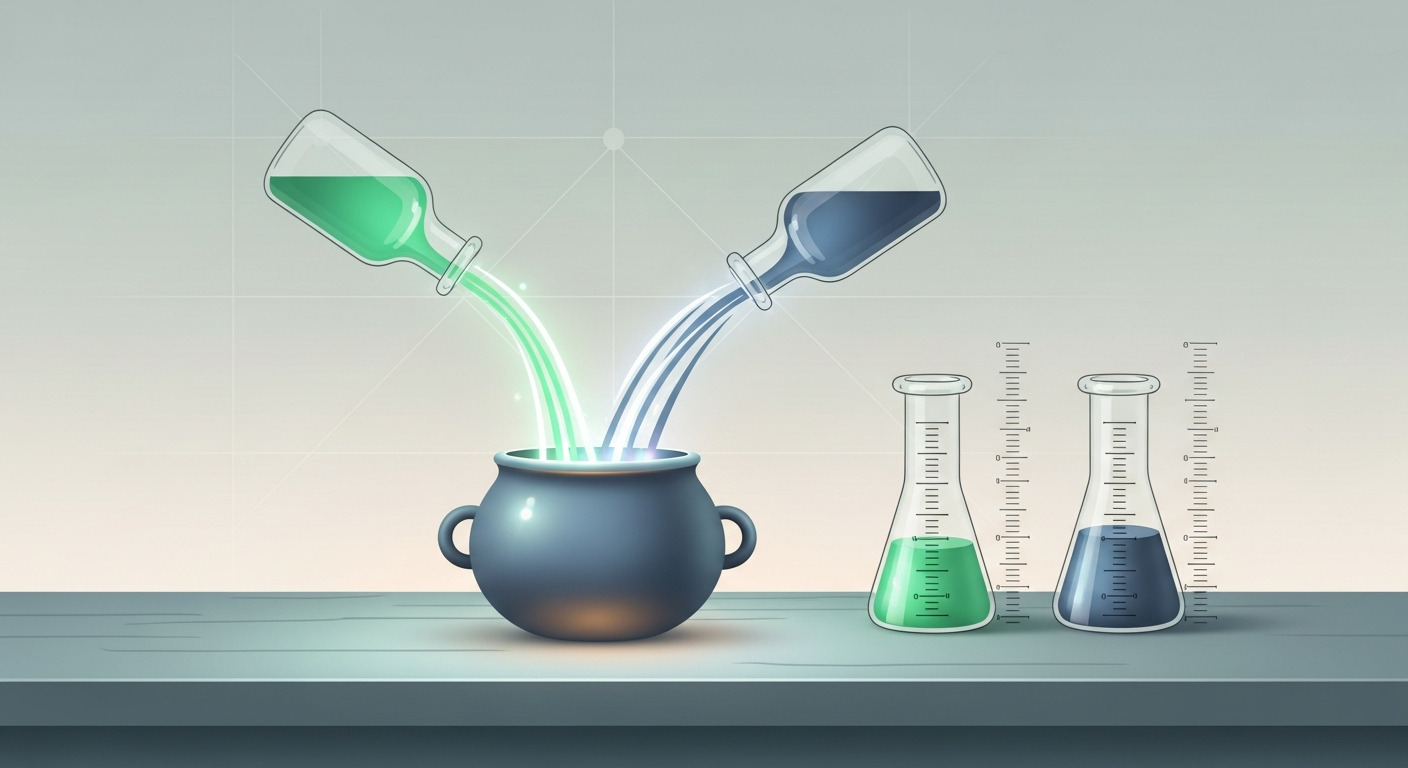
A recipe that must stay balanced
Every potion recipe is really a ratio: a fixed comparison between two ingredients. A shrinking potion might call for 2 parts moonwater to 3 parts starflower petals — written 2:3. Brew a tiny vial or a bathtub-sized batch, and as long as moonwater and starflower petals stay in that same 2:3 relationship, the potion works.
A ratio is just a way of comparing two quantities by division. It shows up everywhere outside the potion shop too: miles per gallon, students per teacher, red paint to white paint.
Finding an unknown amount
Often you know a ratio and one actual amount, and need to find the matching amount of the other ingredient. Line the ratio up with the real quantities and ask: what did I multiply the known part by to get my actual amount? Multiply the other part of the ratio by that same number.
- The ratio 2:3 means for every 2 cups of moonwater, you need 3 cups of petals.
- 8 cups of moonwater is 2 × 4, so the recipe has been scaled by a factor of 4.
- Scale the petals by the same factor: 3 × 4 = 12.
- Set up equal ratios: 5/8 = x/24, where x is the cups of fizzroot.
- Cross-multiply: 8 × x = 5 × 24, so 8x = 120.
- Divide both sides by 8: x = 120 ÷ 8.
Check your understanding
- A ratio a:b compares two quantities and can be written as the fraction a/b.
- Multiplying (or dividing) both parts of a ratio by the same number gives an equivalent ratio.
- To find an unknown amount, figure out the scale factor between a known part and its match, then apply that factor to the other part.
- Cross-multiplication (a/b = c/d means a×d = b×c) solves proportions when the scale factor isn't obvious.
- Simplify a ratio by dividing both parts by their greatest common factor, just like simplifying a fraction.
🎓 Go deeper: external courses & trusted references
External sites are listed for reference only. This course is independent and has no affiliation with, or endorsement from, the institutions named.