
☰ Course contents
Mathematics ⚡ Grade 6 The Algebra Balance: Solving One-Step Equations
⚡ Grade 6 · Lesson 9 of 14

The Algebra Balance: Solving One-Step Equations

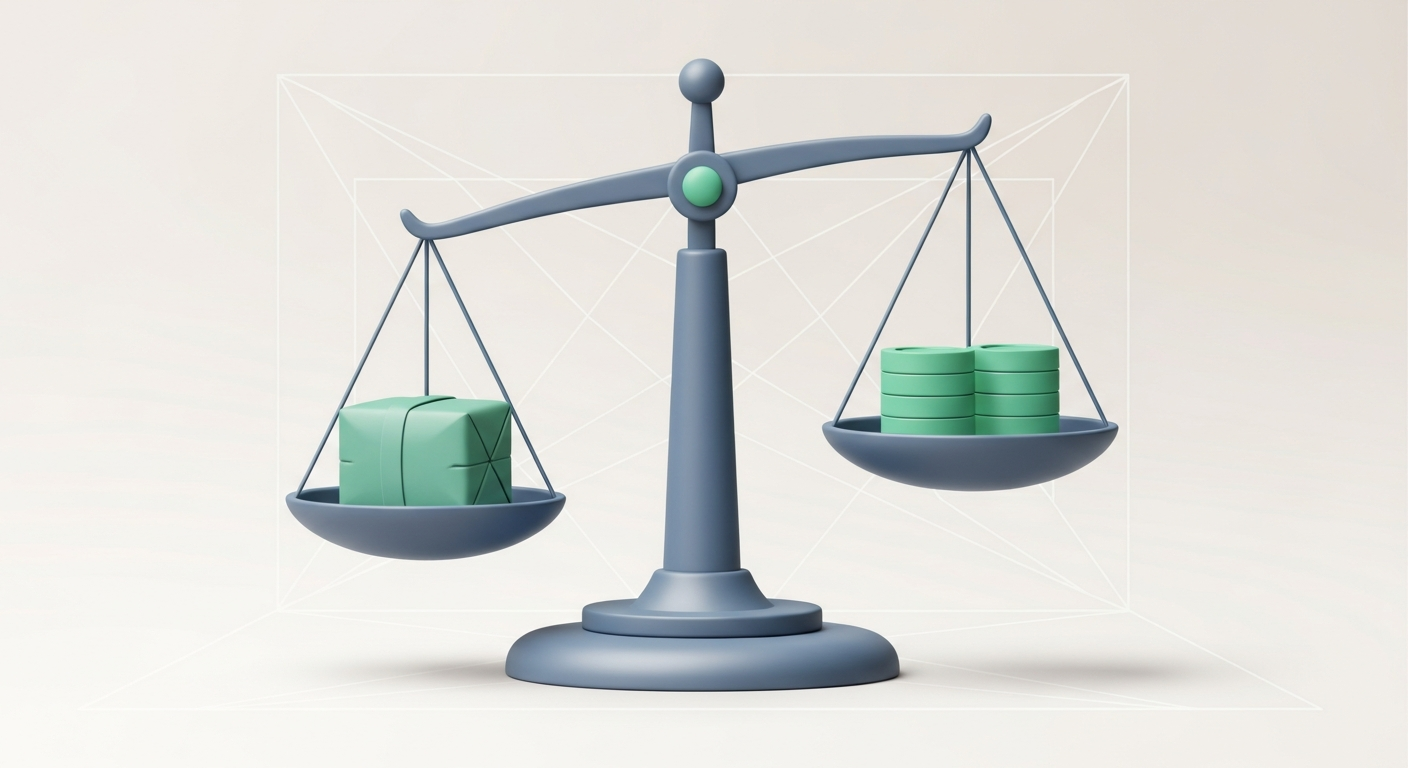
An equation is a scale that must stay level — do the same thing to both pans and x reveals itself.
Grade 6Middle school
The Algebra Balance: Solving One-Step Equations — illustration
💡
The big idea: An equation is like a balance scale: both sides must always weigh the same. Solving for a variable means performing the same operation on both sides until the variable stands alone, and every step keeps the scale perfectly level.
🎯 By the end, you'll be able to
  • Interpret an equation as a balanced scale with equal sides
  • Solve one-step addition and subtraction equations using inverse operations
  • Solve one-step multiplication and division equations using inverse operations
  • Check a solution by substituting it back into the original equation
📎 You should already know
  • Inverse operations (addition/subtraction, multiplication/division)
  • Evaluating simple expressions with a variable

An equation is a balanced scale

Picture a balance scale with two pans. An equation like x + 5 = 12 says the same thing: whatever is on the left side weighs exactly the same as whatever is on the right. The scale is level, and it has to stay level no matter what you do next.

🔑 Whatever you do to one side, do to the other
If you add, subtract, multiply, or divide one side of an equation by some amount, you must do the exact same thing to the other side. Otherwise the scale tips and the equation is no longer true.
\[ x + 5 = 12 \quad\Longrightarrow\quad x + 5 - 5 = 12 - 5 \quad\Longrightarrow\quad x = 7 \]
Subtracting 5 from both sides removes it from the left, isolating x, and keeps the equation balanced.
🎮 Algebra Balance LIVE
Add or remove the same amount from both pans to isolate x and keep the scale level.

Undo with the opposite operation

To isolate x, undo whatever is being done to it using the inverse operation: undo addition with subtraction, undo subtraction with addition, undo multiplication with division, and undo division with multiplication. Apply that inverse operation to both sides.

\[ 4x = 28 \quad\Longrightarrow\quad \dfrac{4x}{4} = \dfrac{28}{4} \quad\Longrightarrow\quad x = 7 \]
Dividing both sides by 4 undoes the multiplication and isolates x.
📝 Worked example: Solve for x: x + 9 = 16.
  1. The variable has 9 added to it, so undo that with subtraction.
  2. Subtract 9 from both sides: x + 9 − 9 = 16 − 9.
  3. This leaves x = 16 − 9.
✓ <strong>x = 7</strong>. Check: 7 + 9 = 16. &#10003;
📝 Worked example: Solve for x: x/3 = 6.
  1. The variable is divided by 3, so undo that with multiplication.
  2. Multiply both sides by 3: (x/3) × 3 = 6 × 3.
  3. This leaves x = 18.
✓ <strong>x = 18</strong>. Check: 18/3 = 6. &#10003;
⚠️ Change both sides, not just one
A common mistake is performing the operation on only the side with the variable. If you subtract 9 from the left side but forget to subtract it from the right, the two sides are no longer equal and the scale — and the equation — is out of balance.
✨ Always check your answer
After solving, substitute your value for x back into the original equation. If both sides come out equal, your answer is correct. This habit catches almost every mistake before it counts.

Check your understanding

1. Solve for x: x + 4 = 11.
Subtract 4 from both sides: x = 11 − 4 = 7.
2. Solve for x: x − 6 = 10.
Add 6 to both sides: x = 10 + 6 = 16.
3. Solve for x: 5x = 35.
Divide both sides by 5: x = 35 ÷ 5 = 7.
4. Solve for x: x/4 = 9.
Multiply both sides by 4: x = 9 × 4 = 36.
5. To solve 3x = 21, what operation should you perform on both sides?
The variable is multiplied by 3, so the inverse operation — dividing both sides by 3 — isolates x.
✅ Key takeaways
  • An equation is a balance scale: both sides must always be equal.
  • Whatever operation you perform on one side, you must perform on the other side too.
  • Undo addition with subtraction, and undo subtraction with addition.
  • Undo multiplication with division, and undo division with multiplication.
  • Always check a solution by substituting it back into the original equation.