
The Thrust Equation & Propulsive Efficiency
Momentum exchange and the efficiency of converting power to thrust
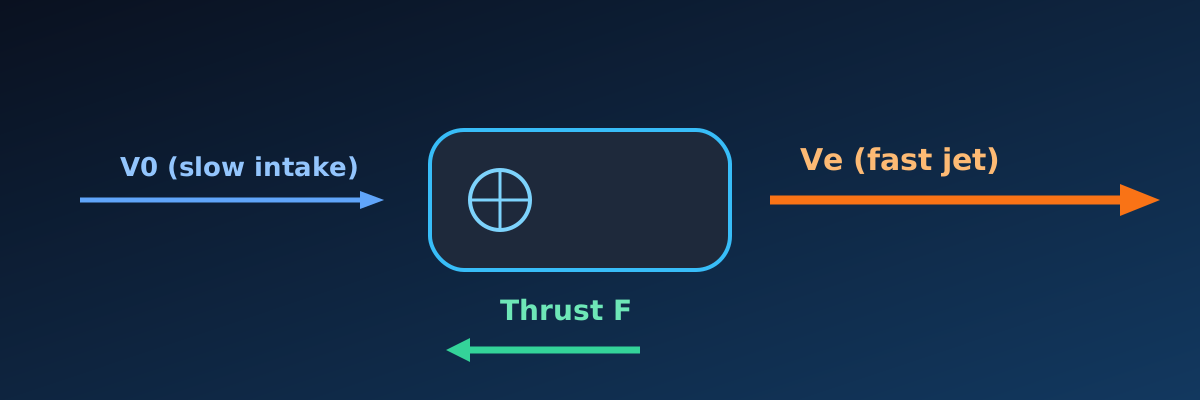
How do jet engines generate thrust? It all comes down to Newton's second law applied to a moving fluid.
The Momentum Principle
Air-breathing engines produce thrust by taking in air at velocity \(V_0\) and expelling it at a higher exhaust velocity \(V_e\). By Newton's second law, the net force is proportional to the change in momentum of the airflow.
Propulsive Efficiency
Not all generated power goes into useful thrust; some is wasted as kinetic energy in the exhaust slipstream. The ratio of useful propulsive power to total mechanical power is the propulsive efficiency \(\eta_p\).
To maximize \(\eta_p\), the exhaust velocity \(V_e\) should be as close as possible to the freestream velocity \(V_0\). However, this reduces thrust unless mass flow \(\dot m\) is increased.
- 1. Calculate thrust: \(F = \dot m(V_e - V_0) = 50 \times (400 - 200) = 10,000\) N = 10 kN.
- 2. Calculate efficiency: \(\eta_p = 2V_0 / (V_0 + V_e) = 2(200) / (200 + 400) = 400 / 600 = 0.667\).
- Hint: Use the formula \(\eta_p = 2V_0 / (V_0 + V_e)\).
- Answer: 0.667 (66.7%)
Check your understanding
- Thrust is the rate of change of momentum: \(F = \dot m(V_e - V_0)\).
- Propulsive efficiency \(\eta_p = 2V_0 / (V_0 + V_e)\).
- High efficiency requires large mass flow and small velocity change.