
Airfoil Geometry & Nomenclature
Chord, camber, thickness, and NACA 4-digit series
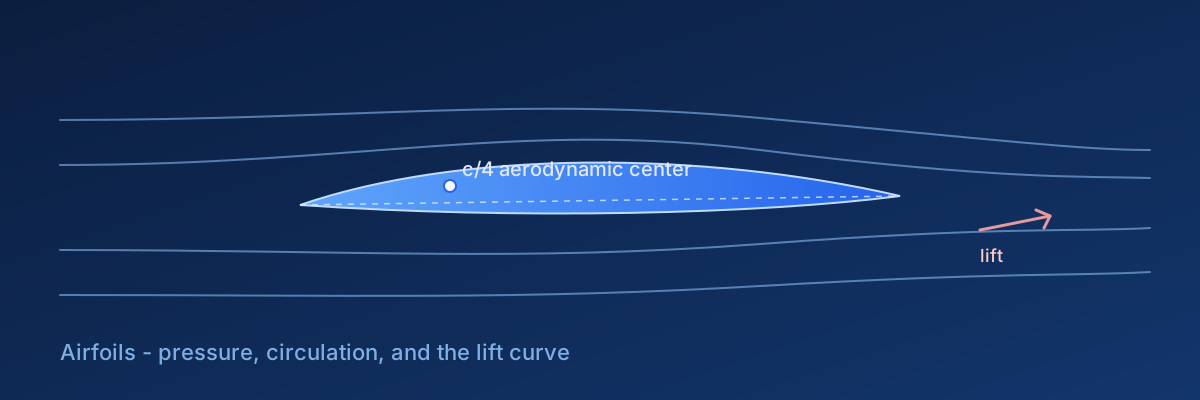
An airfoil is the fundamental shape that generates lift. Understanding its geometry is the first step in aerodynamics.
Airfoil Anatomy
An airfoil is a 2D cross-section of a wing. Key geometric features include the leading edge (LE), trailing edge (TE), chord line (straight line from LE to TE), and chord length (c). The mean camber line is the locus of points halfway between the upper and lower surfaces. Camber is the max distance between the chord line and camber line. Thickness is the distance between upper and lower surfaces.
The angle of attack (alpha) is the angle between the chord line and the freestream velocity vector (V_inf). It is a primary control of lift.
NACA 4-Digit Series
The NACA 4-digit series describes airfoil geometry. For a NACA XYZZ: X is max camber as % of chord, Y is position of max camber in tenths of chord, and ZZ is max thickness as % of chord.
- 1. Camber: 2% of chord = 0.02 * 1.5 m = 0.030 m.
- 2. Position: 4 tenths of chord = 0.4 * 1.5 m = 0.60 m aft of LE.
- 3. Thickness: 12% of chord = 0.12 * 1.5 m = 0.18 m.
- Hint: Leading two digits are zero => no camber.
- Answer: Symmetric airfoil (0% camber), 12% thick.
Check your understanding
- Airfoil geometry is defined by chord, camber, and thickness.
- NACA 4-digit series encodes camber, position of max camber, and thickness.
- Symmetric airfoils have zero camber.
🎓 Go deeper: external courses & trusted references
External sites are listed for reference only. This course is independent and has no affiliation with, or endorsement from, the institutions named.