
Conic Sections & Vis-Viva
Orbit Geometry and the Energy Equation
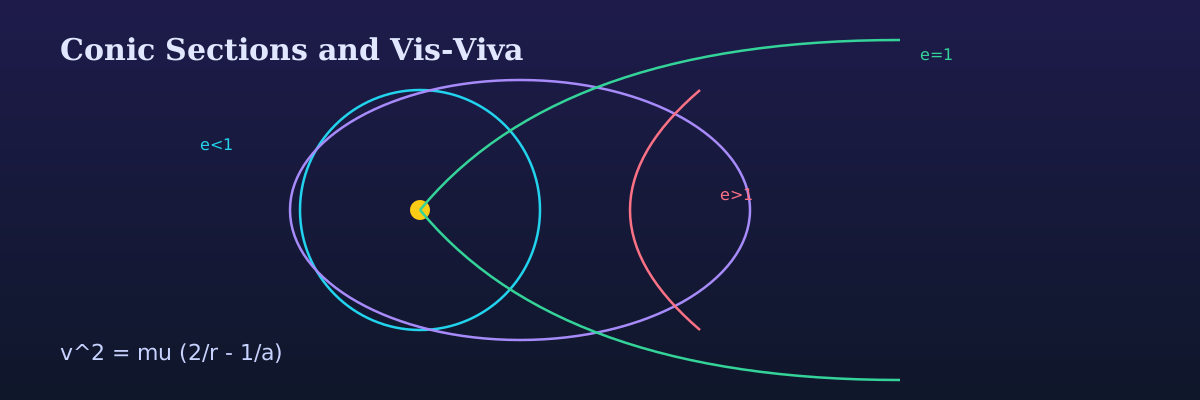
How can a single, elegant equation tell you the exact speed of a satellite at any point along its orbit?
Orbits as Conic Sections
The solutions to the two-body equation of motion are conic sections. The shape of the orbit is determined by its eccentricity \(e\). A circle has \(e = 0\), an ellipse has \(0 < e < 1\), a parabola has \(e = 1\), and a hyperbola has \(e > 1\).
Specific Orbital Energy
Specific orbital energy \(\varepsilon\) is the sum of kinetic and potential energy per unit mass. It is a constant for an orbit and is directly related to the semi-major axis \(a\).
The Vis-Viva Equation
By equating the specific orbital energy at any point in the orbit to its definition, we derive the vis-viva equation. This is one of the most useful formulas in orbital mechanics, allowing us to calculate the speed \(v\) at any distance \(r\) given the semi-major axis \(a\).
Vis-viva is essentially a statement of conservation of energy. As a satellite falls closer to the primary body (decreasing \(r\)), its velocity \(v\) must increase to keep the total orbital energy constant.
- 1. Identify parameters: \(\mu = 398600\) km\(^3\)/s\(^2\), \(a = 10000\) km, \(r = 8000\) km.
- 2. Plug into vis-viva: \(v = \sqrt{398600 \times (2/8000 - 1/10000)}\).
- 3. Simplify the bracket: \((2/8000 - 1/10000) = 0.00025 - 0.0001 = 0.00015 = 1.5 \times 10^{-4}\).
- 4. Calculate \(v = \sqrt{398600 \times 1.5 \times 10^{-4}} = \sqrt{59.79} = 7.732\) km/s.
- Hint: Plug the values directly into the vis-viva equation: v = sqrt(mu*(2/r - 1/a)).
- Answer: v = 8.342 km/s.
Check your understanding
- Orbits are categorized by eccentricity into circles, ellipses, parabolas, and hyperbolas.
- Specific orbital energy depends only on the semi-major axis.
- The vis-viva equation allows computation of speed at any point in the orbit.