
RC Natural Response
What happens when a charged capacitor is left to discharge through a resistor — and why the decay follows a universal exponential curve.
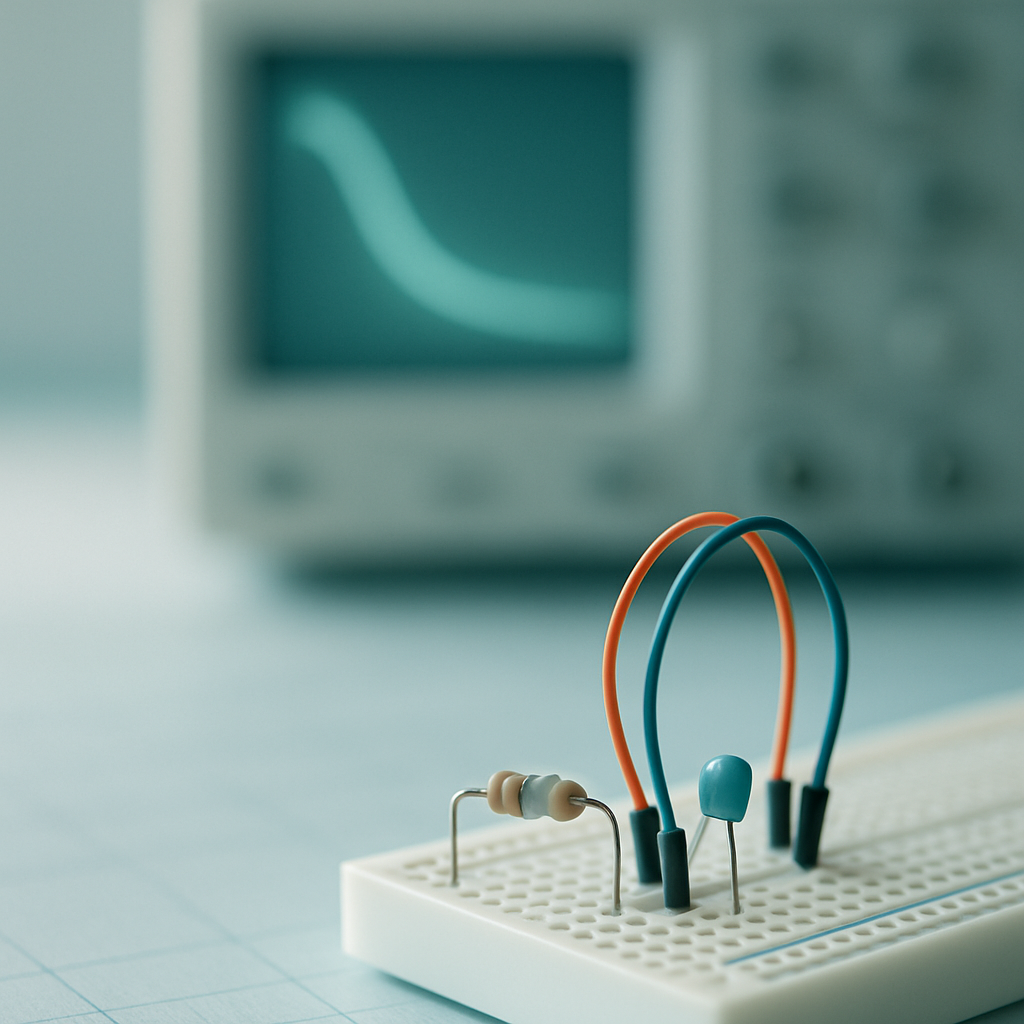
You charge a capacitor, disconnect the source, and connect it across a resistor. The voltage doesn't drop to zero instantly — it fades in a curve that every engineer eventually learns to sketch from memory.
The source-free RC circuit
Imagine a capacitor that has been charged to some initial voltage V0. At t = 0, we disconnect the charging source and connect the capacitor across a resistor R. There are no independent sources in the resulting circuit — just C and R forming a closed loop. We call this a source-free or natural-response configuration: the circuit's behavior is driven entirely by the energy already stored in the capacitor.
The capacitor begins to discharge, pushing current through the resistor. As charge leaves the capacitor, its voltage drops. As the voltage drops, the current decreases. The result is a self-reinforcing decay — not linear, but exponential.
Deriving the differential equation
We start with Kirchhoff's Current Law at the top node of the RC loop. The resistor current is v/R (Ohm's law), and the capacitor current is C·dv/dt (the capacitor's i–v relationship). Since there is no external source feeding the node, these two currents must sum to zero:
Solving for v(t)
This is a separable differential equation. We rewrite it as dv/v = −dt/(RC) and integrate both sides. The initial condition is v(0) = V0 — the capacitor's voltage at the instant the source is removed. After integrating and applying the initial condition, the solution is:
The time constant τ = RC
The product RC has units of seconds (Ω · F = s) and is called the time constant, denoted τ. It is the single parameter that controls how fast the circuit decays. After one time constant (t = τ), the voltage has fallen to:
The 5τ rule of thumb
Because the exponential never truly reaches zero, engineers need a practical cutoff for "the transient is over." After 5τ, the voltage has decayed to e⁻⁵ ≈ 0.67% of its initial value — less than 1%. This is universally taken as the settling time, and the rule of thumb is: a first-order transient is effectively complete after five time constants.
For quick estimation: at t = 2τ the voltage is about 13.5% of V0, at t = 3τ about 5%, and at t = 4τ about 1.8%.
Where does the energy go?
The capacitor starts with stored energy W = ½CV0². As it discharges through the resistor, all of that energy is converted to heat in the resistor. We can verify this by integrating the instantaneous power p(t) = i²(t)R over all time:
- Compute τ = RC = (2000 Ω)(100 × 10⁻⁶ F) = 0.2 s.
- Write v(t) = V0 · e^(-t/RC) = 12 · e^(-t/0.2) = 12 · e^(-5t) V.
- Evaluate at t = τ = 0.2 s: v(0.2) = 12 · e^(-1) = 12 · 0.3679 ≈ 4.41 V.
- As a check, the initial energy stored is ½CV0² = ½(100 × 10⁻⁶)(12²) = 7.2 mJ, all of which will be dissipated in the resistor.
- Compute τ = RC = (2000 Ω)(50 × 10⁻⁶ F) = 0.1 s.
- Evaluate v(t) = 10 · e^(-t/0.1) at t = 0.1: v(0.1) = 10 · e^(-0.1/0.1) = 10 · e^(-1).
- e^(-1) ≈ 0.3679, so v(0.1) ≈ 10 × 0.3679 ≈ 3.68 V.
Check your understanding
- A source-free RC circuit contains no independent sources — only a capacitor (initially charged to V0) and a resistor in a closed loop.
- Applying KCL yields the first-order ODE dv/dt + v/(RC) = 0, whose solution is v(t) = V0·e^(-t/RC).
- The time constant τ = RC (in seconds) governs the decay rate; at t = τ the voltage has fallen to ≈36.8% of V0.
- The 5τ rule: after five time constants the transient is practically complete (less than 1% remaining).
- All initial energy ½CV0² stored in the capacitor is dissipated as heat in the resistor.