
Inductor Fundamentals & V-I Relationship
The dual of the capacitor: it fights current change and stores energy in a magnetic field.
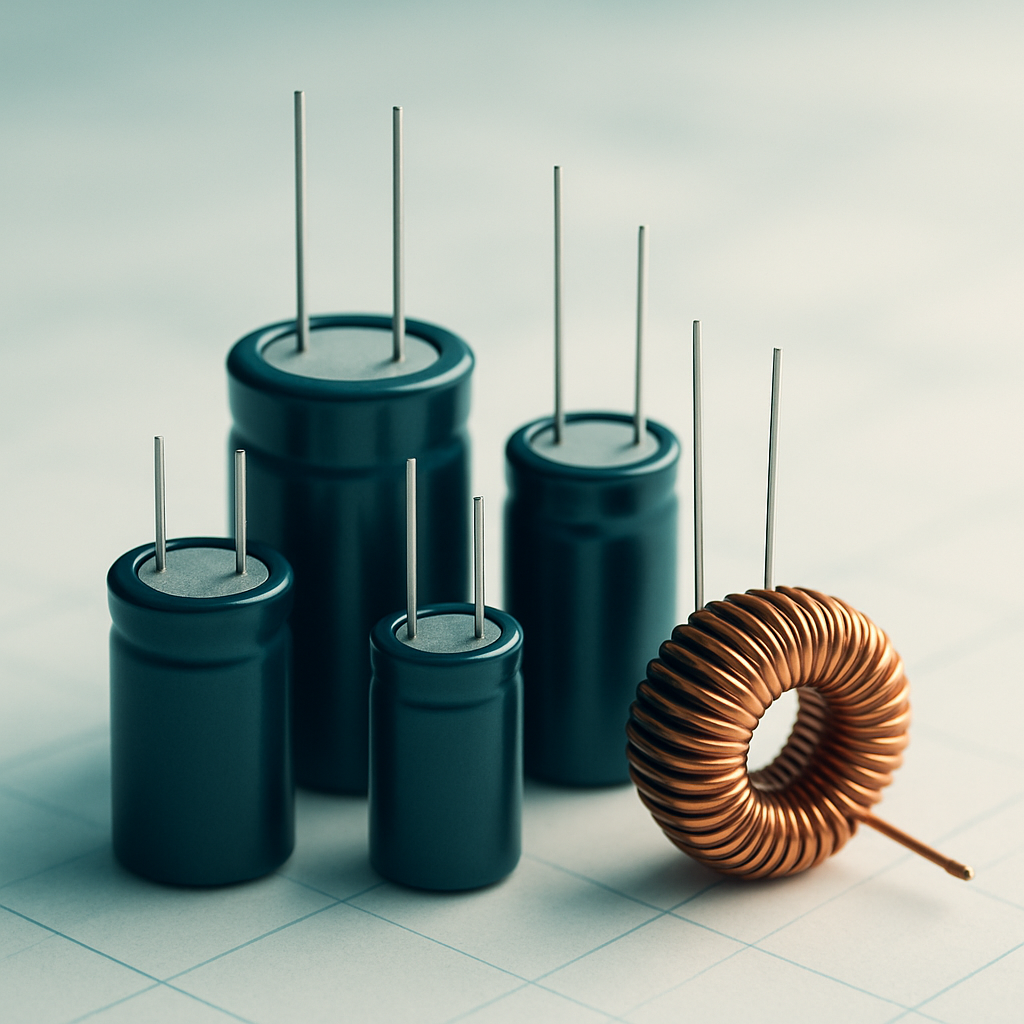
Try to suddenly cut the current through an inductor and it will generate whatever voltage is necessary to keep that current flowing — the mirror image of the capacitor's voltage stubbornness.
What Is an Inductor?
An inductor is a two-terminal device that stores energy in a magnetic field. Its simplest form is a coil of wire — when current flows through the coil, a magnetic field is established around and within it, and that field stores energy. The inductance L, measured in henries (H), quantifies how much magnetic flux linkage is produced per ampere of current.
The Defining V-I Relationship
By Faraday's law of induction, a changing magnetic flux induces a voltage. Since the flux is proportional to current, the induced voltage is proportional to the rate of change of current:
Just as a capacitor's current depends on dv/dt (not v), an inductor's voltage depends on di/dt (not i). An inductor carrying 100 A of steady DC current has zero voltage across it; an inductor carrying 0 A whose current is rising rapidly can have a large voltage.
Current Cannot Change Instantaneously
If the inductor current were to jump instantaneously, di/dt would be infinite, requiring infinite voltage — a physical impossibility. Therefore:
An inductor's current cannot change instantaneously. If i(0−) = 3 A just before a switching event, then i(0+) = 3 A immediately after. This is the exact dual of the capacitor's voltage-continuity rule and is equally central to transient analysis.
The Integral Form
When you know the voltage history and need the current, integrate the defining equation:
DC Steady State: The Short-Circuit Analogy
In DC steady state, all currents are constant, so di/dt = 0 and therefore v = L di/dt = 0. An inductor with zero voltage across it behaves like a short circuit. To analyze inductors in DC steady-state circuits, replace them with a wire and solve the remaining network.
An inductor acts as a short circuit only when all transients have settled and every current is truly constant. During a transient — while di/dt is nonzero — voltage appears across the inductor and it is actively storing or releasing energy.
Duality: Capacitor vs. Inductor
The capacitor and inductor are duals: every property of one maps to a property of the other with voltage and current roles swapped. Once you understand one, you understand the other — just swap V with I and C with L.
Capacitor: stores energy in an electric field; i = C dv/dt; voltage is continuous; acts as an open circuit at DC.
Inductor: stores energy in a magnetic field; v = L di/dt; current is continuous; acts as a short circuit at DC.
- Start with the defining relationship: v = L di/dt.
- Differentiate i(t) = 2 sin(200t): di/dt = 2×200 cos(200t) = 400 cos(200t) A/s.
- Multiply by L = 50×10⁻³ H: v = 0.05×400 cos(200t) = 20 cos(200t) V.
- Since current changes linearly, di/dt = 50 A/s (constant).
- Apply v = L di/dt = 0.1×50 = 5 V.
Check your understanding
- An inductor stores energy in a magnetic field created by current flowing through a coil of wire.
- Inductance L (in henries) quantifies the flux linkage per ampere of current.
- The defining V-I relationship is v = L di/dt — voltage depends on the rate of current change, not current itself.
- Inductor current cannot change instantaneously because that would require infinite voltage.
- In DC steady state (di/dt = 0), an inductor acts as a short circuit.
- The integral form i(t) = (1/L)×∫v dt + i(0) recovers current from voltage history.
- Capacitors and inductors are duals: swap V with I and C with L to map one's behavior to the other's.