
Capacitor Fundamentals & V-I Relationship
The component that fights voltage change and stores energy in an electric field.
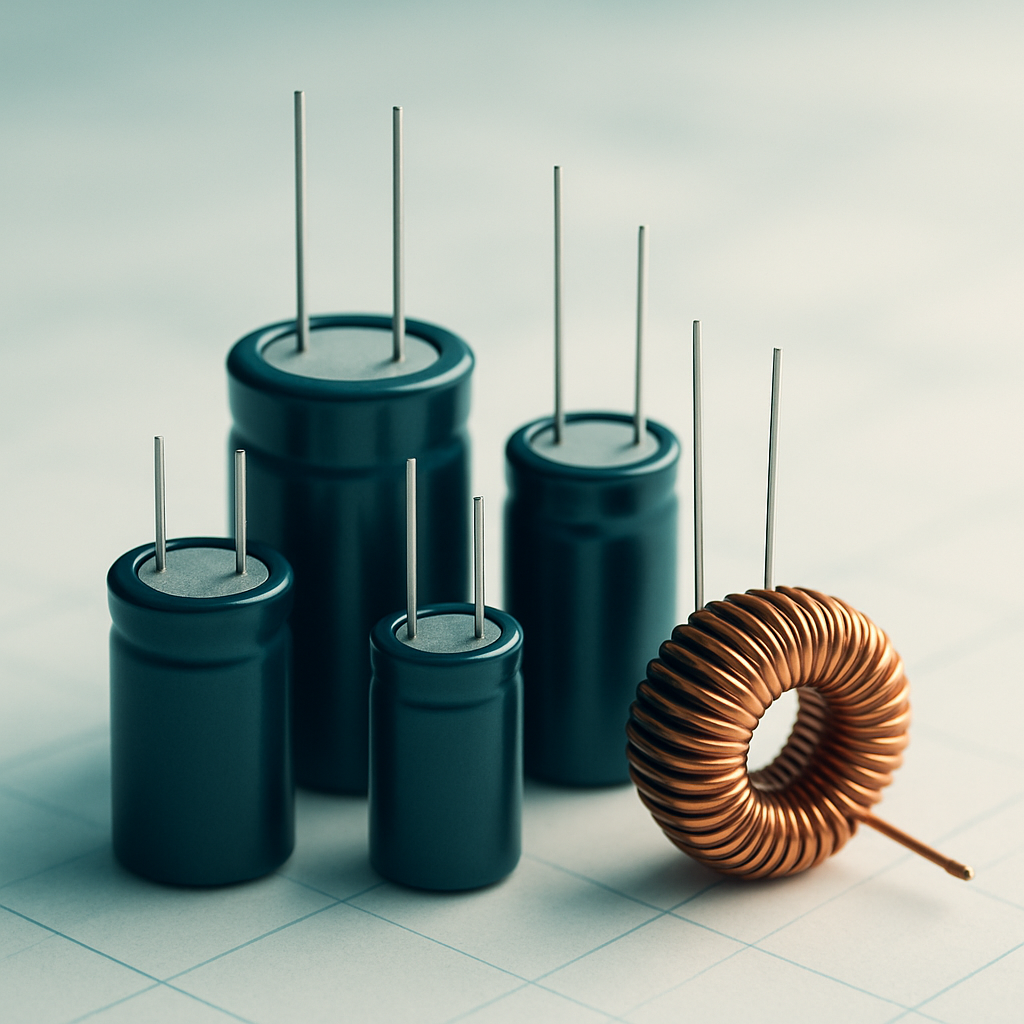
Flip a switch and a capacitor's voltage barely budges — it stubbornly resists sudden change. That single property shapes every transient you will ever analyze.
What Is a Capacitor?
A capacitor is a two-terminal device that stores energy in an electric field. Its physical structure is simple: two conductive plates separated by a thin insulating layer called a dielectric. When a voltage is applied across the plates, charge accumulates — positive on one plate, negative on the other — and the electric field between the plates stores energy.
The amount of charge Q stored per volt V applied defines the capacitance C, measured in farads (F):
The Defining V-I Relationship
Since current is the rate of flow of charge (i = dQ/dt) and Q = CV, differentiating gives the capacitor's defining equation:
This is the single most important difference between a capacitor and a resistor. A resistor's current depends on the voltage across it right now. A capacitor's current depends on how fast the voltage is changing. A capacitor sitting at 1000 V with no change draws zero current; a capacitor at 0 V whose voltage is rising rapidly can draw a large current.
Voltage Cannot Change Instantaneously
If the capacitor voltage were to jump instantaneously, dv/dt would be infinite, requiring infinite current — a physical impossibility. Therefore:
A capacitor's voltage cannot change instantaneously. If v(0−) = 5 V just before a switching event, then v(0+) = 5 V immediately after. This continuity condition is the foundation of all transient analysis with capacitors.
The Integral Form
Sometimes you know the current history and need the voltage. Rearranging i = C dv/dt and integrating gives:
DC Steady State: The Open-Circuit Analogy
In DC steady state, all voltages and currents are constant. If v is constant, then dv/dt = 0, and therefore i = C dv/dt = 0. A capacitor with zero current flowing through it behaves like an open circuit. This is how you analyze capacitors in DC steady-state circuits: replace them with an open and solve the remaining resistive network.
A capacitor acts as an open circuit only when all transients have died out and every voltage is truly constant. During a transient — while dv/dt is nonzero — current flows and the capacitor is very much active.
- Start with the defining relationship: i = C dv/dt.
- Differentiate v(t) = 5 sin(100t): dv/dt = 5×100 cos(100t) = 500 cos(100t) V/s.
- Multiply by C = 10×10⁻⁶ F: i = 10×10⁻⁶ × 500 cos(100t) = 0.005 cos(100t) A.
- Express in milliamperes: i(t) = 5 cos(100t) mA.
- Since voltage changes linearly, dv/dt = 500 V/s (constant).
- Apply i = C dv/dt = 20×10⁻⁶ × 500 = 0.01 A.
Check your understanding
- A capacitor stores energy in an electric field between two conductive plates separated by a dielectric.
- Capacitance C (in farads) relates charge to voltage: Q = CV.
- The defining V-I relationship is i = C dv/dt — current depends on the rate of voltage change, not voltage itself.
- Capacitor voltage cannot change instantaneously because that would require infinite current.
- In DC steady state (dv/dt = 0), a capacitor acts as an open circuit.
- The integral form v(t) = (1/C)×∫i dt + v(0) recovers voltage from current history.