
RMS Values
The DC-equivalent measure of AC quantities that turns messy peak-amplitude formulas into clean, practical power calculations.
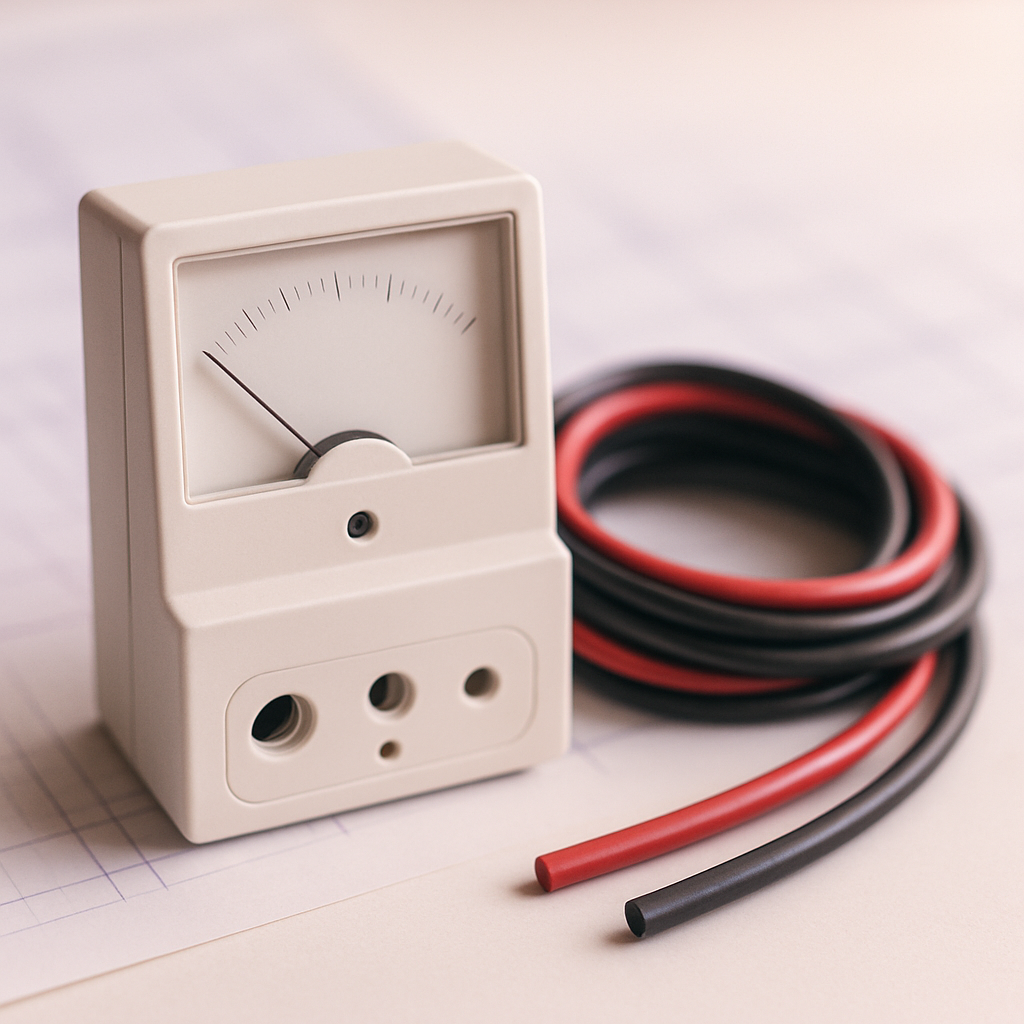
When a label says '120 volts' on a North American wall outlet, that's not the peak voltage — so what does it actually mean?
What RMS means
The root-mean-square (RMS) value of a time-varying signal answers a simple question: what constant DC value would deliver the same average power to a resistor? It is defined as the square root of the time-average of the squared signal:
Deriving RMS for a sinusoid
For a sinusoid x(t) = X_m cos(ωt + φ), the squared signal is X_m² cos²(ωt + φ). The key identity is that the average of cos² over a full period is 1/2 (since cos²θ = ½ + ½cos(2θ), and the cos(2θ) term averages to zero). Therefore X_rms² = X_m² / 2, and taking the square root gives:
RMS as the DC equivalent
The reason RMS matters is that it makes AC power formulas look exactly like DC power formulas. If you apply a DC voltage V_DC across a resistor R, the power is V_DC²/R. An AC source with RMS voltage V_rms delivers the same average power V_rms²/R to that same resistor. This is not a coincidence — it is the very definition of RMS.
Rewriting average power with RMS
Recall the average power formula using peak amplitudes: P = (Vm Im/2) cos(θv − θi). Since V_rms = Vm/√2 and I_rms = Im/√2, their product V_rms I_rms = Vm Im/2. Substituting gives the standard AC power formula:
Wall outlets are rated in RMS
This is a critical practical point: the voltage printed on wall outlets — whether 120 V in North America or 230 V in Europe — is an RMS value, not a peak amplitude. A North American 120 V RMS outlet actually produces a sinusoid with a peak voltage of Vm = 120 × √2 ≈ 169.7 V. The RMS rating is used because it directly tells you the equivalent DC voltage for power calculations.
- Peak voltage: Vm = V_rms × √2 = 120 × √2 ≈ 169.7 V.
- Average power (resistive load, cos(θv − θi) = 1): P = V_rms² / R = 120² / 60 = 14400 / 60 = 240 W.
- RMS current: I_rms = V_rms / R = 120 / 60 = 2 A.
- Verification: I_rms² × R = 2² × 60 = 4 × 60 = 240 W, which matches P = 240 W. ✓
- For a resistive load: P = V_rms² / R.
- P = 230² / 100 = 52900 / 100 = 529 W.
Check your understanding
- RMS is defined as the square root of the time-average of the squared signal — it gives the DC-equivalent value.
- For any sinusoid, X_rms = X_m / √2 ≈ 0.707 X_m, derived from the fact that the average of cos² over a period is 1/2.
- Using RMS values, average power becomes P = V_rms I_rms cos(θv − θi), and for a resistor P = V_rms²/R = I_rms² R.
- Wall outlet voltage ratings (120 V, 230 V) are RMS values — the actual peak is √2 times higher (≈ 169.7 V for 120 V RMS).