
Waves as Loads: A Bridge to Structural Design
How a moving wave reshapes the buoyancy distribution along a ship — the bridge from hydrostatics to the hull-girder structural loads that follow.
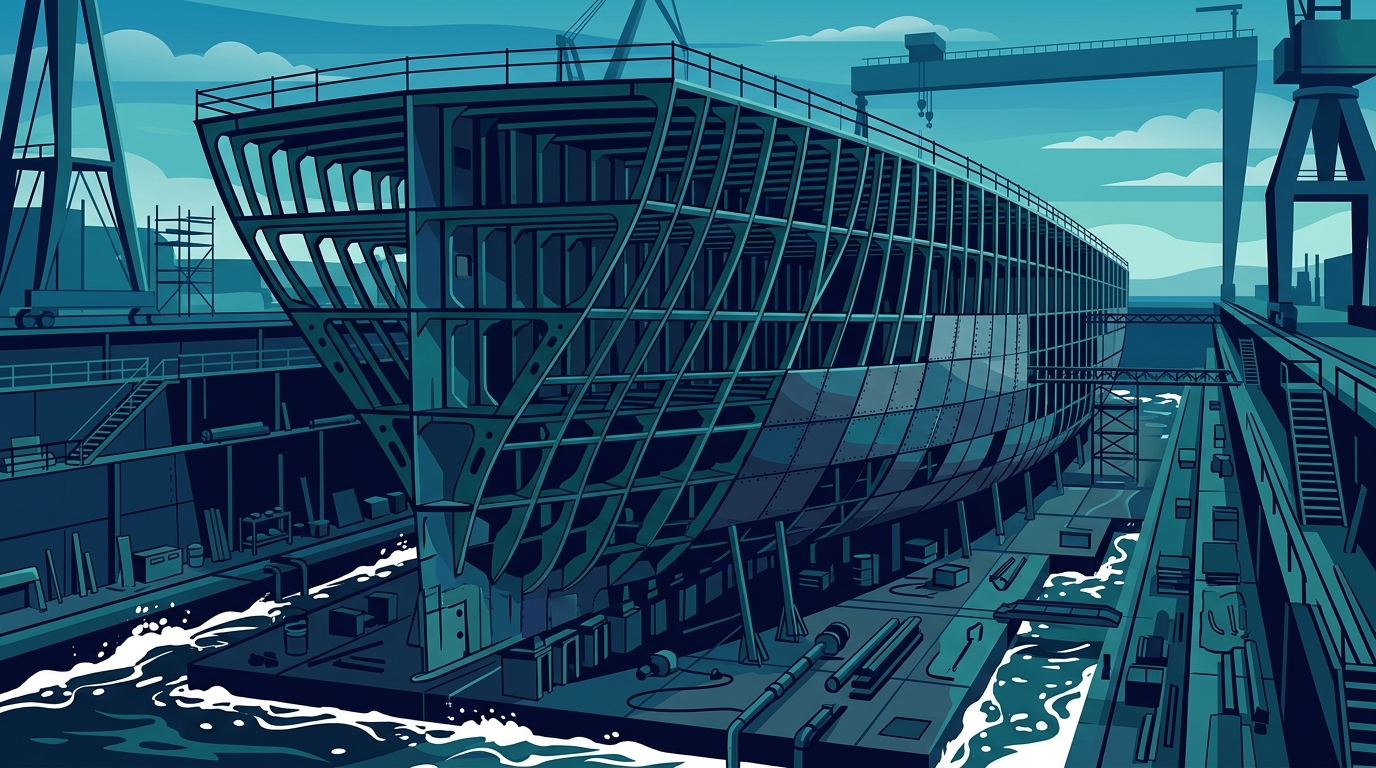
In still water a ship's weight and buoyancy more or less balance section by section. The moment a wave passes underneath, that balance is destroyed — and the hull girder begins to bend.
A Wave Reshapes the Buoyancy
In still water the ship's weight curve (how mass is distributed along its length) and its buoyancy curve (how the displaced-volume support is distributed) are roughly matched, and the small leftover mismatch produces a calm-water bending moment. This lesson is about what happens when a wave passes through.
A wave is, mechanically, a redistribution of water. Where there is a crest the waterline is locally higher, so the hull there is supported by more buoyancy; where there is a trough the waterline is locally lower, so the hull there loses buoyancy. The wave does not change the ship's weight — it changes the buoyancy curve superimposed on the still-water one. That altered buoyancy curve bends the hull girder.
- Crest amidships, troughs at the ends — buoyancy piles up in the middle and is lost at the ends, pushing the midships up relative to the ends. This is a hogging wave condition.
- Trough amidships, crests at the ends — buoyancy is lost amidships and piles up at the ends, letting the middle sag relative to the ends. This is a sagging wave condition.
As a wave train moves past a hull, the buoyancy curve shifts continuously, so the hull rocks between hogging and sagging in a cycle — the very effect the next lesson's simulator will let you watch.
For a first structural estimate the wave is usually treated as a fixed, static shape held against the hull rather than as a moving disturbance — a quasi-static assumption that captures the peak bending the girder must survive without needing the full dynamic seakeeping response (Module 11). Because the crest-amidships and trough-amidships positions produce bending in opposite directions, a designer checks both the hogging and the sagging extreme: they load the deck and bottom in opposite senses (one puts the deck in tension, the other in compression), and the larger of the two governs the longitudinal strength the hull girder must be built to carry.
Of all the wave shapes that could pass under a hull, the one that bends the hull girder the hardest is the one whose wavelength is about equal to the ship's own length: the whole ship then spans a single crest-and-trough, putting buoyancy exactly where it does the most damage amidships. Waves much shorter or much longer than the ship distribute their buoyancy more evenly and produce a smaller hull-girder moment. That is why the standard descriptive design wave takes the wavelength to be about the ship length — it is the worst-case alignment, not a fixed rule.
- h = λ/20 = 150/20
- = 7.5 m
- h = λ/20 = 180/20 = 9.0 m
Check your understanding
- A wave does not change a ship's weight; it changes the buoyancy curve, superimposing extra support under crests and removing it under troughs
- Crest amidships → hogging; trough amidships → sagging; the hull cycles between the two as waves pass
- The standard descriptive design wave takes wavelength ≈ ship length (worst-case alignment) and height ≈ length/20