
Buoyancy & Flotation: A Naval-Architecture View
How naval architects use displacement, and why the same ship sits deeper in freshwater than in seawater.
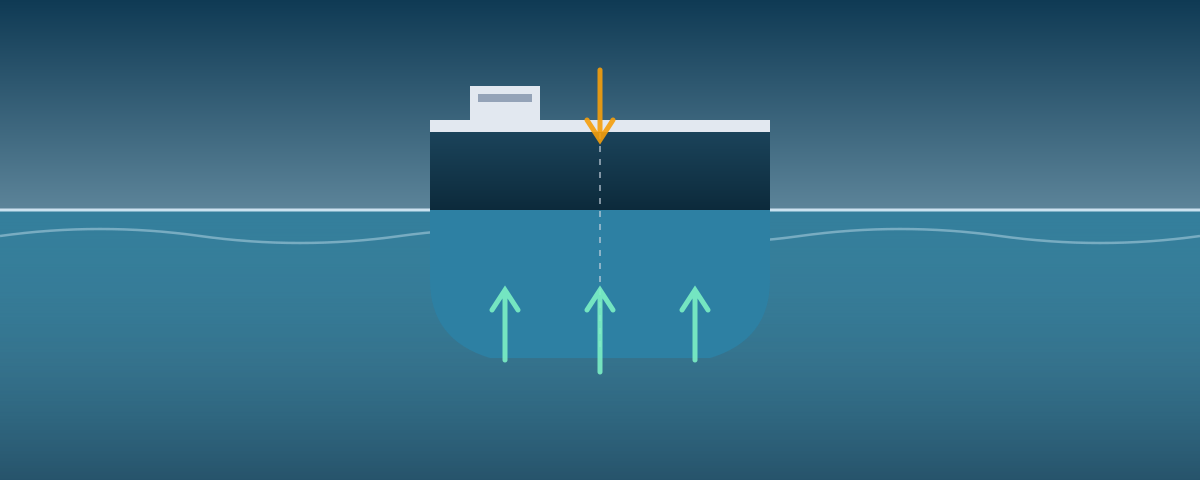
A 12,000-tonne cargo ship floats in both the open ocean and a freshwater canal — but it sits noticeably deeper in the canal. The ship hasn't changed weight; the water has changed density.
From Archimedes to Displacement
A floating body displaces a volume of fluid whose weight equals the body's own weight — for a ship in equilibrium, the upward buoyant force exactly balances the ship's weight. That's Archimedes' principle, already established in the Fluid Mechanics course. What matters here is how naval architects put it to work.
Naval architects rarely talk about ship size in newtons. Instead, they quote displacement Δ in tonnes — a mass figure that corresponds directly to the ship's weight and, by Archimedes, to the weight of water it displaces. The relationship is the single most important hydrostatic equation in naval architecture, linking loading condition directly to underwater hull volume:
Why the Same Ship Sits Differently in Different Water
Two densities dominate ship operations: seawater at roughly 1.025 t/m³, and fresh water at roughly 1.000 t/m³. Because Δ is fixed by the ship's actual loading at any moment, the displaced volume ∇ depends inversely on density. In denser seawater, the ship needs to displace less volume to generate the same buoyant force, so it sits higher. In less dense freshwater, it must displace more volume, so it sinks deeper. A ship moving from seawater into freshwater at constant displacement always increases its draft.
This is operationally significant: a vessel loaded to a specific draft in seawater will draw deeper on entering a river or freshwater port. Load-line regulations account for this through the Fresh Water Allowance — extra draft permitted in freshwater — but the physics underneath it is simply Δ = ρ∇. Displaced volume, together with hull geometry, is also what drives KB, BM, and KM — the stability quantities from the Ship Stability module.
- Seawater volume: ∇_sw = Δ/ρ_sw = 12,000/1.025 = 11,707.32 m³
- Freshwater volume: ∇_fw = Δ/ρ_fw = 12,000/1.000 = 12,000.00 m³
- Change: Δ∇ = 12,000.00 − 11,707.32 = 292.68 m³
- ∇_sw = 8500/1.025 = 8292.68 m³
- ∇_fw = 8500/1.000 = 8500.00 m³
- Δ∇ = 8500.00 − 8292.68 = 207.32 m³
Check your understanding
- Displacement Δ (tonnes) is naval architecture's primary size metric — the mass of water the ship displaces
- Δ = ρ∇ links displacement, water density, and displaced volume
- A ship sits deeper in freshwater (~1.000 t/m³) than seawater (~1.025 t/m³) at the same displacement