
KB, BM, KG & the Metacentre
The four vertical heights that set up every stability calculation that follows.
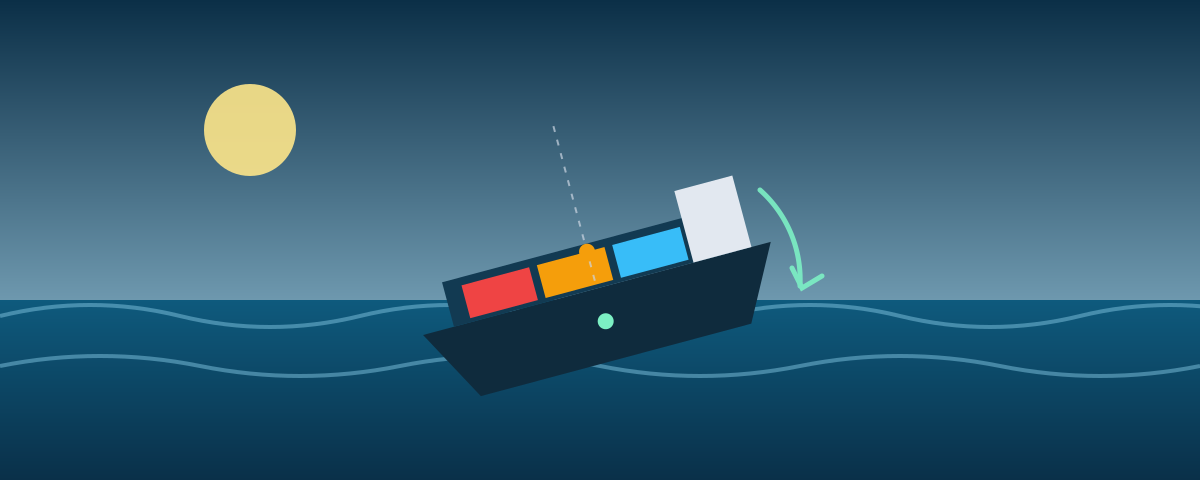
Every floating vessel has a hidden geometry of points — keel, centre of buoyancy, centre of gravity, and metacentre — whose relative heights decide whether it stays upright or capsizes.
Four Heights Above the Keel
You already know from fluid mechanics that a floating body experiences an upward buoyant force equal to the weight of fluid it displaces, acting through the centre of buoyancy B — the centroid of the submerged hull volume. Naval architecture takes this further: we care not just about whether the vessel floats, but about what happens when it heels.
Define four vertical measurements, all taken from the keel K:
- KB — height of the centre of buoyancy above the keel. For a box-shaped hull at draft T, symmetry gives KB = T/2. For a real ship-shaped hull, KB is read from hydrostatic tables.
- KG — height of the centre of gravity above the keel. This depends entirely on the loading condition — where cargo, fuel, ballast, and structure sit vertically. KG is the unknown in most stability problems, and it's determined experimentally (see the Inclining Experiment lesson).
- BM — the metacentric radius: the vertical distance from B to the metacentre M. M is defined as the intersection of successive lines of action of the buoyant force as the vessel heels through infinitesimally small angles. BM is purely a function of hull geometry at the waterline.
- KM — height of the metacentre above the keel: simply KM = KB + BM.
Because I depends on breadth cubed (B³) but only on length linearly, doubling a hull's beam increases I — and therefore BM — by a factor of eight. A long, narrow hull (a rowing shell) has tiny BM and tips easily; a wide, shallow-draft barge has large BM and strongly resists heeling. The waterplane is the hull's “stiffness” against rotation, the way a wide beam resists structural bending.
- Waterplane second moment of area: I = L·B³/12 = (40 × 10³)/12 = 40,000/12 = 3333.33 m⁴
- Displaced volume: ∇ = L × B × T = 40 × 10 × 3 = 1200 m³
- Metacentric radius: BM = I/∇ = 3333.33/1200 = 2.778 m
- Height of B above keel (box shape): KB = T/2 = 3/2 = 1.500 m
- Height of metacentre above keel: KM = KB + BM = 1.500 + 2.778 = 4.278 m
- I = L·B³/12 = (50 × 12³)/12 = 86,400/12 = 7200 m⁴
- ∇ = L × B × T = 50 × 12 × 2.5 = 1500 m³
- BM = I/∇ = 7200/1500 = 4.800 m
- KB = T/2 = 2.5/2 = 1.250 m
- KM = KB + BM = 1.250 + 4.800 = 6.050 m
Check your understanding
- KM = KB + BM, where KB depends on the underwater hull shape and BM on the waterplane shape
- BM = I/∇: the cubic dependence on beam means small increases in breadth dramatically improve initial stability
- KG is set by loading, not hull form — it's the variable the operator actually controls