
Propeller Geometry, Pitch & Slip
The screw-propeller's basic geometry, theoretical pitch, and why it never advances as far as its pitch predicts.
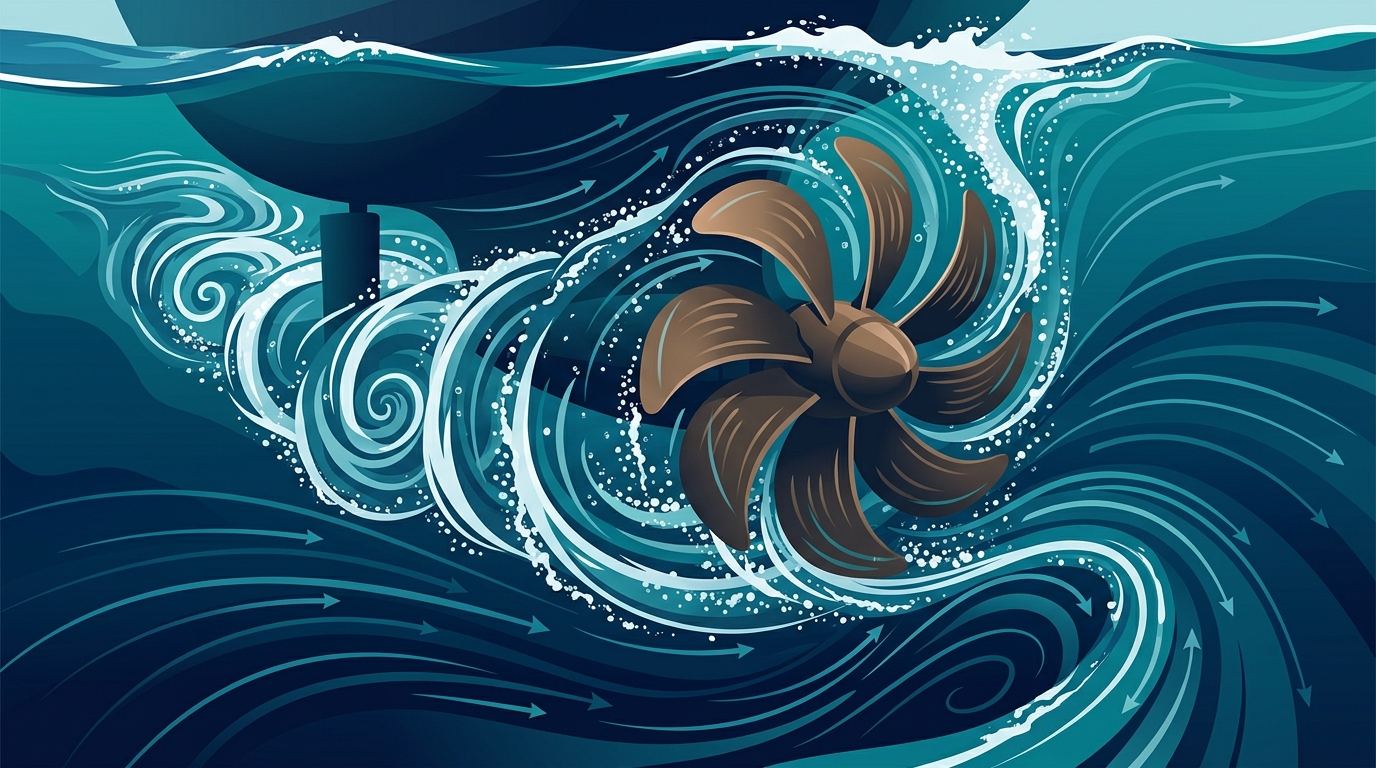
A propeller is a screw turning in water — but unlike a screw in a solid nut, it never advances exactly its pitch per revolution. That shortfall is called slip, and slip is not a defect to be eliminated: it is how a propeller generates thrust at all.
The Screw Propeller: A Rotating Wing
A ship's main engine turns a shaft, and the shaft turns a screw propeller — the device that converts rotational power into the forward thrust that overcomes resistance. To reason about how well it does that job, naval architects first agree on a small set of geometric parameters that describe any propeller, regardless of its absolute size.
- Diameter (D) — the diameter of the circle swept by the blade tips, twice the distance from the shaft centreline to a blade tip. Diameter sets the scale of the propeller and the area of the disc it acts on.
- Pitch (P) — the linear distance the propeller would advance in one revolution if it were turning in a solid, with no slip. Pitch is the screw analogy: a coarse thread (large P) bites more water per turn.
- Pitch ratio (P/D) — pitch divided by diameter, the single dimensionless number that characterises how 'coarse' the blade is. Typical P/D ranges from about 0.6 to 1.4; many cargo propellers sit near 0.8–1.0.
- Blade area ratio (BAR) — the developed area of all the blades divided by the propeller disc area (¼πD²). A higher BAR spreads thrust over more surface, which matters directly for cavitation in Lesson 4.
- Number of blades — typically three to seven. More blades smooth out thrust fluctuations but slightly reduce efficiency and complicate blade numbering.
- Handedness — a right-handed propeller turns clockwise (viewed from astern) to drive the ship ahead; the blades are skewed to suit. Twin-screw ships usually fit opposite-handed propellers so the hull's wake stays symmetric.
These six parameters fully describe the bare geometry; everything in this module — thrust, torque, efficiency, cavitation — flows from them.
Theoretical Pitch, Apparent Slip and Real Slip
Because water is not a solid, a propeller never advances exactly its pitch per revolution. Hold a propeller to a fixed pitch P and turn it at n revolutions per second and it would, in a rigid medium, move forward at the theoretical speed P·n. The ship, though, moves at its real speed V, which is slower than P·n — the difference is the slip that lets the blades push water aft and so generate thrust.
The apparent slip compares the theoretical advance to the ship's speed through the water: sapp = (P·n − V)/(P·n). A positive slip is normal under power: the propeller is 'winding' through the water, accelerating it aft. If slip were zero the propeller would be advancing exactly its pitch and producing no thrust at all — which only happens at the towed, no-power limit. Slip is therefore not waste to be eliminated; a finite slip is how thrust is generated. The apparent slip uses the ship speed V, which is convenient because V is easy to measure. The more fundamental real slip replaces V with the speed of advance Va — the speed of the water actually arriving at the propeller disc — which is the subject of Lesson 3. For this lesson's examples we use apparent slip with V.
- P = (P/D) × D = 0.95 × 5.2 = 4.94 m
- n = 110 rpm = 110/60 = 1.8333 rev/s
- Theoretical advance speed P·n = 4.94 × 1.8333 = 9.057 m/s
- Apparent slip = (P·n − V)/(P·n) = (9.057 − 7.5)/9.057 = 1.557/9.057 = 0.172
- P = (P/D) × D = 1.0 × 4.5 = 4.5 m
- n = 120 rpm = 120/60 = 2.0 rev/s
- P·n = 4.5 × 2.0 = 9.0 m/s
- Apparent slip = (P·n − V)/(P·n) = (9.0 − 8.0)/9.0 = 1.0/9.0 = 0.111
The Advance Ratio J — the Propeller's Speed Parameter
Just as a hull's behaviour is organised by the Froude number, a propeller's behaviour is organised by a single dimensionless speed parameter, the advance ratio J. It compares the speed at which water flows axially through the propeller disc (Va, the speed of advance) to the rotational speed of the blade tips (proportional to n·D): J = Va/(n·D).
J is the master variable of propeller performance: the thrust coefficient, torque coefficient and efficiency in Lesson 2 are all plotted against J. Physically, at low J (slow advance, fast spin) the blades bite hard and produce lots of thrust but inefficiently; at high J (fast advance, slow spin) the blades barely grip and thrust falls away. There is a best J in between where efficiency peaks.
A subtle but crucial point: Va is NOT the ship speed V. Because the hull drags a wake of water along with it, the water arrives at the propeller moving more slowly than the ship — Va is less than V. The size of that wake deficit is the wake fraction, quantified in Lesson 3, and it changes J and therefore everything downstream. For this lesson's example we are simply given Va.
- J = Va/(nD) = 6.0/(2.0 × 4.5)
- 2.0 × 4.5 = 9.0
- J = 6.0/9.0 = 0.667
A common misconception is that slip should be driven to zero for efficiency. It should not. Zero slip means the propeller advances exactly its pitch and accelerates no water — which means zero thrust. A finite slip is the very mechanism by which the blades impart momentum to the water and so generate the thrust that overcomes resistance. What you optimise is the advance ratio J (and with it the open-water efficiency of Lesson 2), not the slip itself.
Check your understanding
- A screw propeller is described by diameter D, pitch P, pitch ratio P/D, blade area ratio BAR, blade count, and handedness
- Apparent slip sapp = (P·n − V)/(P·n) is positive under power and is the mechanism of thrust generation, not pure loss
- The advance ratio J = Va/(nD) is the propeller's master speed parameter; Va < V because of the hull wake (Lesson 3)