
Cost Variance (CV)
Measuring if you are over or under budget using Earned Value
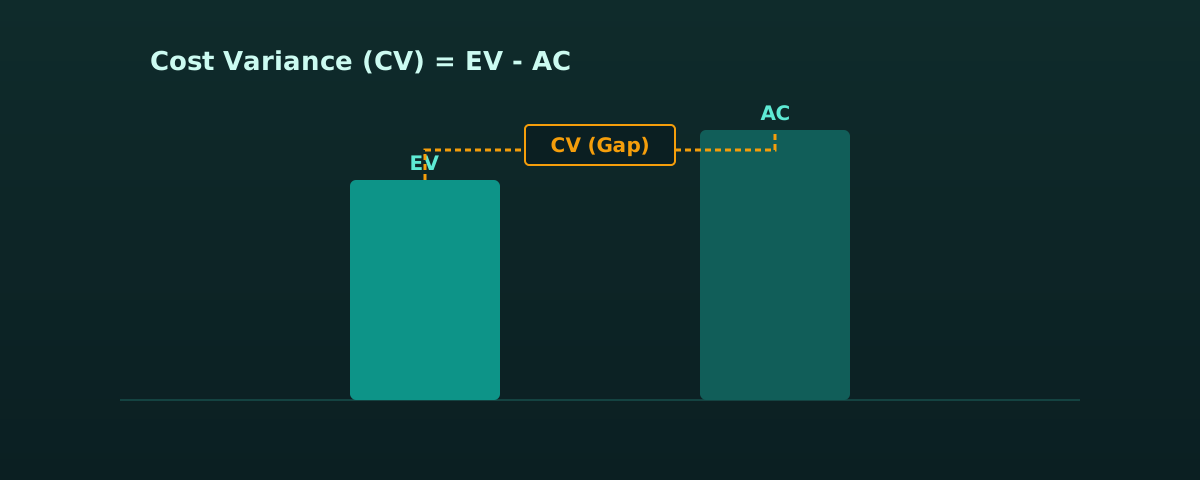
A project has spent $520,000, but only completed $480,000 worth of work. Is it over or under budget, and by how much?
Are we over budget?
Cost Variance (CV) is the primary metric for determining if a project is over or under budget. It compares the budgeted cost of work actually performed (Earned Value) against the actual cost of that work (Actual Cost).
Reading the formula
The Cost Variance is simply the Earned Value (EV) minus the Actual Cost (AC). A negative CV means you spent more than the work is worth (over budget). A positive CV means you spent less than the work is worth (under budget).
You can also express CV as a percentage of the Earned Value to understand the magnitude of the variance. The formula is CV% = CV / EV. For example, a CV of -$40,000 and EV of $480,000 gives a CV% of -8.3%.
- 1. Calculate CV: CV = EV - AC = $480,000 - $520,000 = -$40,000.
- 2. Since CV is negative, the project is over budget.
- 3. Calculate CV%: CV% = CV / EV = -$40,000 / $480,000 = -0.0833.
- 4. Convert to percentage: -8.3%.
💡 Hint
Check your understanding
- CV = EV - AC measures cost performance.
- A negative CV means the project is over budget.
- CV% = CV / EV shows the relative size of the variance.