
Case Study: Recovery
Using EVM to diagnose a distressed project and plan a credible recovery
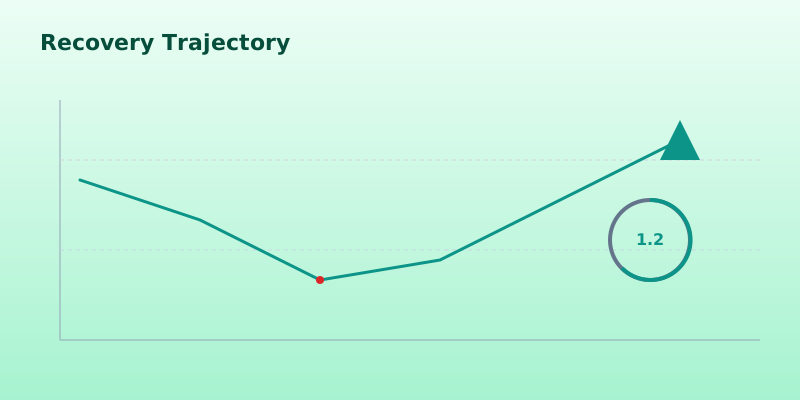
A project is 20% over budget and only 40% done. Can you still hit the original target, or is it time to renegotiate?
The Situation
Consider a synthetic software implementation project with a Budget at Completion (BAC) of $1,000,000. At the current reporting period, the project has earned $400,000 of value (EV) but has spent $500,000 (AC). The Cost Performance Index (CPI) is 0.80, meaning the project is over budget. This case study explores whether the team can recover to the original budget.
TCPI tells you the efficiency required for the remaining work to meet a specific financial target. If TCPI is significantly higher than your historical CPI, recovery is unlikely without changing the project constraints.
Calculating the Forecast and Recovery Target
Using the standard EAC formula assuming the current cost variance is typical of future performance, EAC = BAC / CPI. This gives $1,000,000 / 0.80 = $1,250,000. To avoid this overrun and still finish at the original BAC of $1,000,000, the remaining work must be performed at a much higher efficiency.
If the required TCPI is deemed impossible, project managers must pull recovery levers: reducing scope (lowering BAC), resequencing work to flatten the critical path, or aggressively reducing the burn rate to bring AC closer in line with EV.
- 1. Calculate CPI: CPI = EV / AC = 400,000 / 500,000 = 0.80
- 2. Calculate EAC (typical variance): EAC = BAC / CPI = 1,000,000 / 0.80 = $1,250,000
- 3. Calculate TCPI for BAC: TCPI = (BAC - EV) / (BAC - AC) = (1,000,000 - 400,000) / (1,000,000 - 500,000) = 600,000 / 500,000 = 1.20
💡 Hint
Check your understanding
- CPI and EAC provide a snapshot of current cost health and the projected total cost.
- TCPI quantifies the efficiency needed on remaining work to hit a specific financial target (e.g., BAC).
- If the required TCPI is significantly higher than historical performance, recovery levers like scope reduction must be considered.