
Well-Logging Fundamentals
How sensors lowered into - or carried by - the drill string reveal the rock and fluids behind the steel and mud.
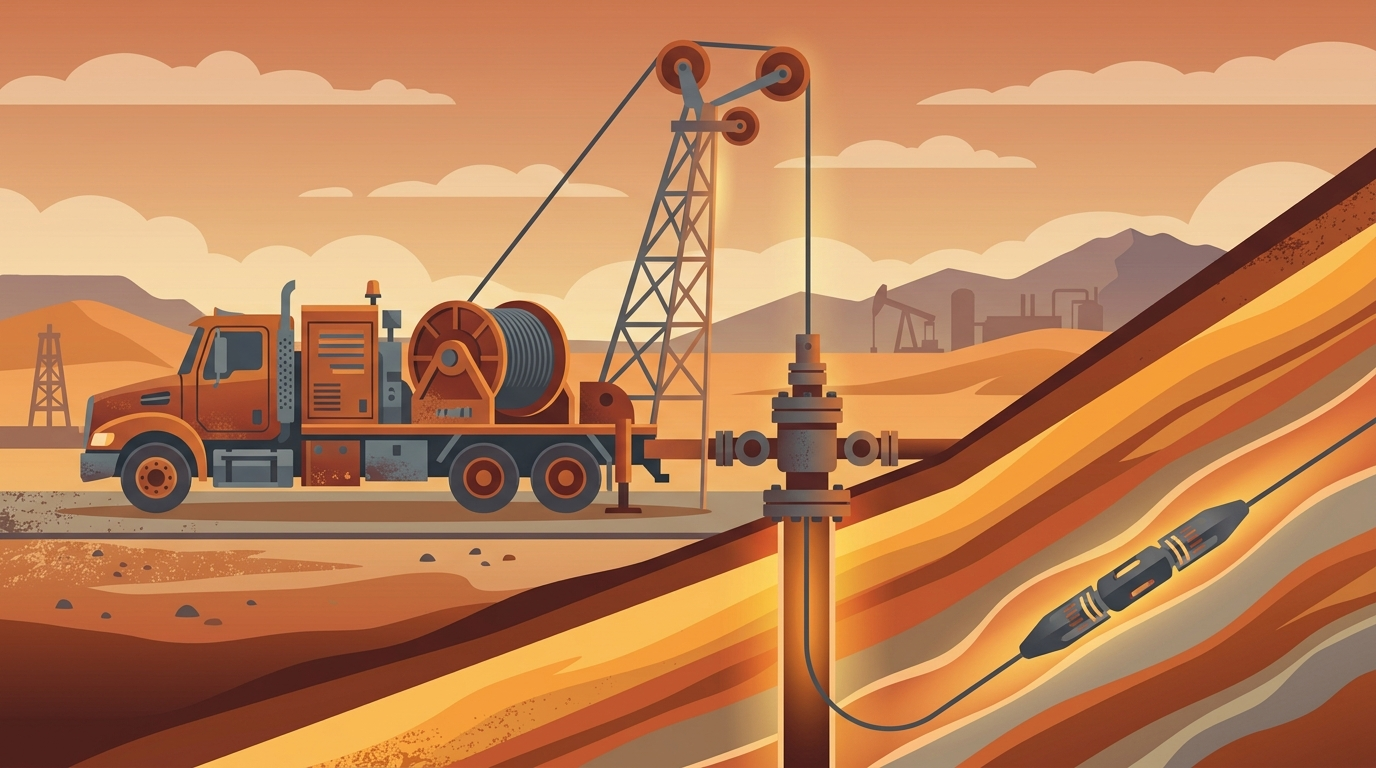
A well is drilled blind - logs are the eyes that tell us what rock, fluid, and pay sit behind the steel and mud.
Wireline vs LWD
Wireline logs are run on a cable after the drill string is pulled: sensors are lowered to total depth and pulled up at constant speed, continuously recording versus depth. Logging-while-drilling (LWD) places equivalent sensors just above the drill bit, so measurements are made while drilling, soon after the rock is first exposed. Wireline gives the deepest, most complete suites; LWD gives early, real-time data in deviated or horizontal wells where wireline is impractical.
The Invaded Borehole Environment
Drilling mud must hold back formation pressure, so its pressure exceeds the formation's. Mud filtrate is squeezed out through the mud cake and into permeable rock, displacing native fluid near the wellbore. The result is a zoned invasion profile: a flushed zone ($R_{xo}$), where filtrate has replaced nearly all moveable fluid; a transition (invaded) zone of mixed fluids; and the virgin (undisturbed) zone ($R_t$), which still holds the original formation fluids. Shallow-reading tools sample the flushed zone; deep-reading tools reach the virgin zone.
Every log falls into one of three families. Lithology logs (gamma ray, spontaneous potential) sort rock types - shales from clean sands and carbonates. Porosity logs (density, neutron, sonic) estimate pore volume. Resistivity logs come in shallow ($R_{xo}$) and deep ($R_t$) flavours to read invaded versus virgin rock. Combined on depth-aligned tracks, they let us identify reservoir rock, estimate porosity and water saturation, and sum net pay.
- In the flushed zone, mud filtrate has replaced most of the native brine. Because the filtrate is more resistive than the brine it displaced, the shallow-reading tool sees a higher-resistivity fluid near the borehole.
- In the virgin zone, the rock still holds the original, more-conductive brine, so the deep-reading tool measures the true, lower resistivity.
- Therefore the shallow curve reads higher resistivity than the deep curve (a positive separation), and that separation is direct evidence that the bed is permeable - invasion only happens in permeable rock.
- Interpretation: the separation between shallow and deep curves maps the invaded zone and confirms permeability; no arithmetic is needed for this qualitative diagnosis.
Check your understanding
- Wireline logs are run post-drill on a cable; LWD logs are acquired at the bit while drilling.
- Overbalanced mud filtrate invades permeable beds, forming flushed, transition, and virgin zones.
- Logs come in three families - lithology, porosity, and resistivity - that combine to find pay and quantify porosity and saturation.