
Casing Seat Selection & String Design Loads
We run casing to isolate zones, protect the hole, and keep the well under control - and each string is sized for three loads: burst, collapse, and tension.
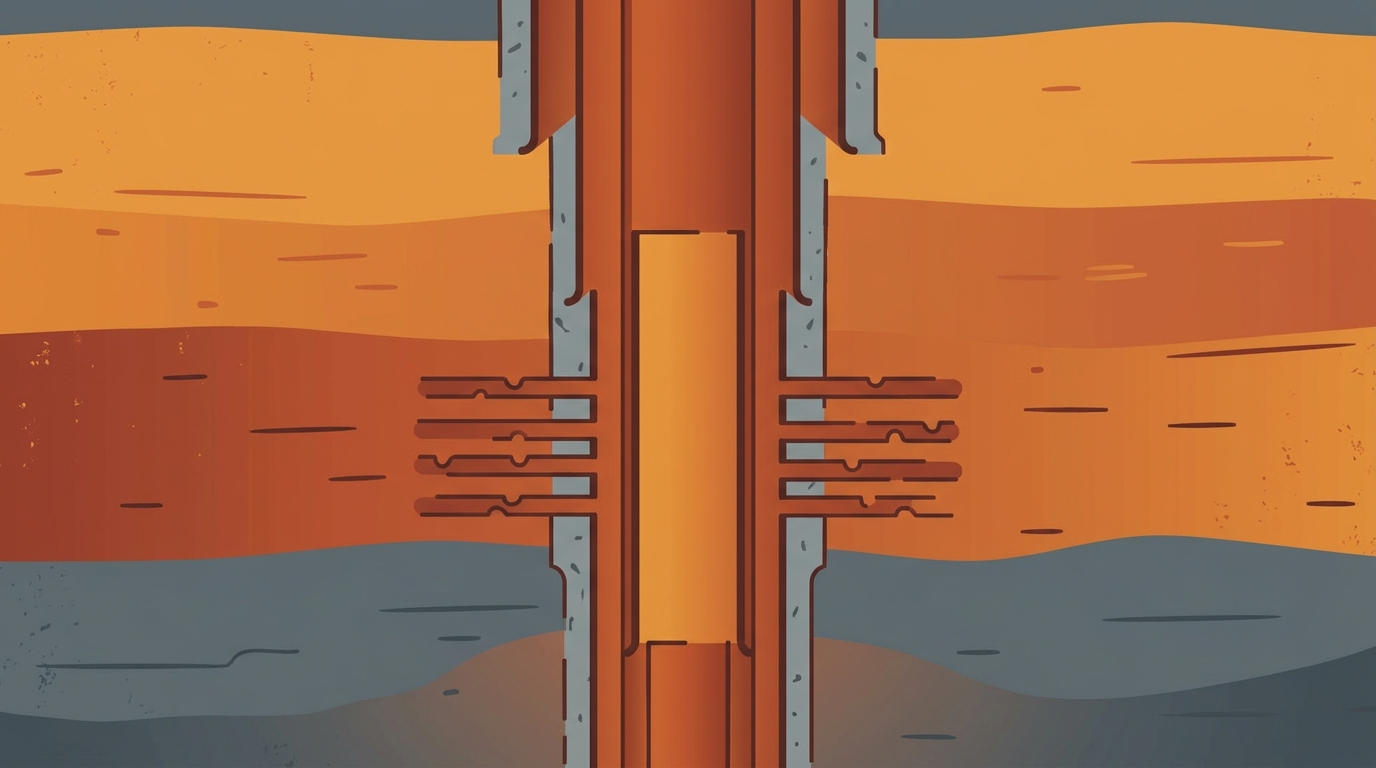
An open hole is fragile - casing is the steel lining that turns a temporary borehole into a controlled, zoned well.
Why We Run Casing
A freshly drilled borehole is just an open hole in the earth - unstable, and connected to every formation it crosses. Casing - the steel pipe cemented into the well - is what turns that temporary hole into a permanent, controlled well. We run casing for four reasons: to isolate zones (keep separate formations - and their fluids and pressures - apart); to protect the hole from collapse and washout; to enable well control, giving the BOP and later the wellhead a competent anchor; and to allow deeper drilling, since each casing string sets a new, smaller starting point for the next hole section below it.
The Casing String Hierarchy
Casing is run as a nested set of strings, each smaller and deeper than the last. Starting from the top, the conductor casing is the large, shallow first string that stabilizes the soft surface soils and is often driven or cemented in. Below it the surface casing seals off freshwater aquifers and protects shallow formations. The intermediate casing isolates troublesome zones - weak, overpressured, or unstable formations - encountered while drilling deeper. Finally, the production casing (or a production liner hung off inside the previous string) is run across the reservoir to provide the conduit for produced fluids. Each successive string is smaller in diameter, telescoping down to the pay zone.
Where each casing seat (the depth a casing string is set) lands is not arbitrary. As a well is drilled deeper, the pore-pressure and fracture gradients rise at different rates, so a single mud weight will not stay inside the mud-weight window (the gap between the pore-pressure gradient below and the fracture gradient above) for the whole open hole. A casing seat is set at the depth where the next planned mud weight would otherwise leave the window - too light and the well flows in, too heavy and the rock fractures. Setting a seat there and cementing that string in place lets the next open-hole section be drilled with a heavier mud that fits its own, narrower window. This ties casing-seat selection directly back to the mud-weight window from the geomechanics lesson.
The Three Design Loads (Given from Solid Mechanics)
Once the seats are set, each casing string is sized to survive three primary loads. These come straight from the Solid Mechanics course - thin-wall pressure-vessel and axial-stress results - and are treated here as given rather than re-derived. Burst is the net internal pressure that tries to inflate and split the pipe, the maximum internal pressure minus the external backup pressure, $P_i - P_o$. Collapse is the opposite - the net external pressure that tries to crush the pipe inward. Axial tension is the pull of the string's own weight hanging in the hole, $W = w \times L$, where $w$ is the pipe's weight per foot and $L$ the hung length. Each load is compared against the pipe's rated capacity using a design factor (a safety factor, $DF$): the minimum required rating equals the design load multiplied by the design factor.
- (a) Net burst load: $P_i - P_o = 6000 - 2000 = 4000$ psi.
- Required burst rating: $\text{load} \times DF = 4000 \times 1.1 = 4400$ psi.
- (b) Air weight: $W = w \times L = 47 \times 10{,}000 = 470{,}000$ lbf.
- Required tensile rating: $\text{load} \times DF = 470{,}000 \times 1.6 = 752{,}000$ lbf.
Check your understanding
- Casing is run to isolate zones, protect the hole, enable well control, and allow deeper drilling, in a telescoping hierarchy from conductor through surface and intermediate to production casing/liner.
- Each casing seat is set where the next mud weight would leave the mud-weight window, so each open-hole section is drilled with a mud that fits.
- Each string is checked against three solid-mechanics loads - burst (net internal pressure), collapse (net external pressure), and axial tension (string weight) - each multiplied by a design factor.