
Hydraulic Fracturing & Matrix/Acid Stimulation
Stimulation lowers the skin - either by hydraulically fracturing tight rock open with proppant, or by dissolving near-well damage with acid - to boost productivity.
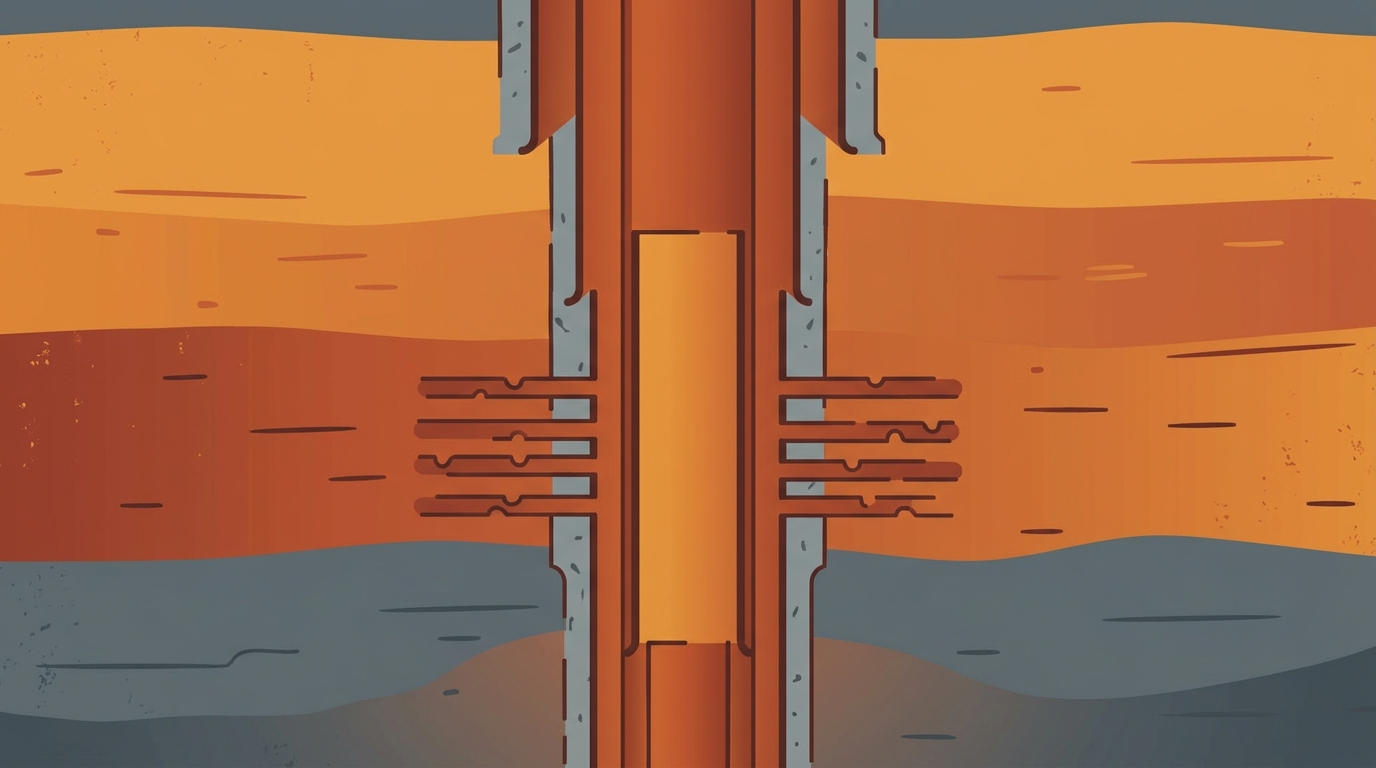
When the rock near the well resists flow, productivity suffers - stimulation is the set of techniques that removes that restriction.
Stimulation and Skin
Around every well, something always resists flow - the rock's own low permeability, or damage done to the near-well formation during drilling and completion. Engineers lump that extra resistance into a single number called the skin: a positive skin means extra flow restriction (the well produces less than an ideal, undamaged well would), while stimulation aims to lower the skin, even making it negative, to boost productivity. There are two broad families of stimulation, chosen by where the restriction is and how permeable the rock is. This lesson describes the concepts and purpose of stimulation; it is educational and descriptive, not an operational frac-design deliverable.
Hydraulic Fracturing
The first family is hydraulic fracturing, the technique that unlocked the shale plays. The idea is to pump fluid into the well at a pressure above the formation's fracture (breakdown) pressure - high enough to physically split the rock and create a fracture. Once the fracture is open, proppant - solid grains such as sand or ceramic - is carried into it; when pumping stops and the fracture tries to close, the proppant props it open, leaving a highly conductive channel. The fracture's value comes from its conductivity, $k_f w$ (the fracture permeability times its width), and its half-length, $x_f$ - together they let fluid flow far into the well through rock that was too tight to produce on its own. Hydraulic fracturing is the defining completion step in low-permeability rock and especially in shale.
The second family is matrix stimulation (acidizing), used when the problem is near-well damage rather than tight rock. Here acid is injected below the fracture pressure - just enough to flow into the rock matrix without breaking it - to dissolve the damaging material and open flow paths. In carbonate reservoirs (limestone, dolomite), hydrochloric acid (HCl) dissolves the rock, creating branching wormholes that bypass the damaged zone. In sandstone, where HCl reacts little, a mud acid blend of HCl and hydrofluoric acid (HF) dissolves the clays and drilling-mud damage instead. Matrix acidizing is described here for its concept and purpose, not as an operational treatment design.
Dimensionless Fracture Conductivity
How good is a propped fracture? Engineers judge it with the dimensionless fracture conductivity, $F_{CD} = \dfrac{k_f w}{k\, x_f}$ - the fracture's conductivity ($k_f w$) divided by the reservoir permeability $k$ times the fracture half-length $x_f$. Physically, $F_{CD}$ compares how easily fluid flows along the fracture with how easily it flows into the fracture from the rock. A high $F_{CD}$ means the fracture offers so little resistance that it behaves like an infinite-conductivity fracture - the fracture is not the bottleneck, the reservoir is. A common rule of thumb is that a fracture needs an $F_{CD}$ of at least about $1.6$ to be effective (the widely cited optimum for a fixed proppant volume), while an $F_{CD}$ of roughly $10$ or more behaves as effectively infinite-conductivity.
- (a) Breakdown pressure: $P_f = 0.70 \times TVD = 0.70 \times 8000$.
- $= 5600$ psi - the pressure that must be exceeded to break the rock.
- (b) Denominator: $k \times x_f = 0.5 \times 100 = 50$ md-ft.
- $F_{CD} = \dfrac{k_f w}{k\, x_f} = \dfrac{500}{50} = 10$.
- This is well above the $\approx 1.6$ effective-fracture optimum and around the $\approx 10$ level, so it behaves as an effectively infinite-conductivity fracture.
Check your understanding
- Stimulation boosts productivity by lowering the skin; the two families are hydraulic fracturing and matrix (acid) stimulation.
- Hydraulic fracturing pumps fluid above the breakdown pressure to create a fracture, then places proppant to hold it open; the fracture's value is its conductivity ($k_f w$) and half-length ($x_f$), and it is the key completion step in low-permeability rock and shale.
- Matrix acidizing injects acid below fracture pressure (HCl for carbonate, forming wormholes; mud acid HCl+HF for sandstone); dimensionless fracture conductivity $F_{CD} = \dfrac{k_f w}{k\, x_f}$ measures fracture quality, with $\approx 1.6$ the rule-of-thumb optimum for an effective frac and $\approx 10$ or more behaving as effectively infinite-conductivity.