
The EOQ Formula
The order size that balances ordering cost against holding cost
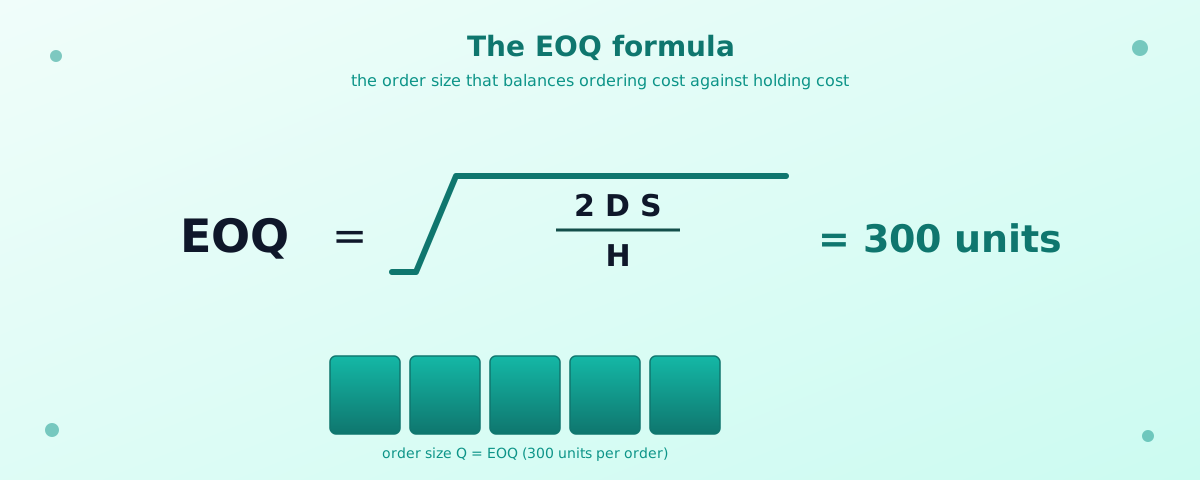
Order too often and setup costs pile up; order too rarely and shelves fill with costly stock. The economic order quantity is the order size that balances the two.
Two costs pull against each other
Every time Meridian Supply places an order it pays a fixed ordering (setup) cost ($S$, in dollars per order): paperwork, handling, freight, and line setup. Order often and these costs pile up. But every unit held in stock carries a holding cost ($H$, dollars per unit per year) -- the cash, space, insurance, and spoilage of Module 1. Order in giant batches and shelves fill with costly stock. The economic order quantity (EOQ) is the order size that balances these two forces against annual demand ($D$, units per year).
Reading the formula
The formula EOQ = sqrt(2DS/H) finds the order size where ordering and holding costs reach their lowest combined total. With annual demand D=2,400 units, an order cost S=$75, and a holding cost H=$4 per unit per year: 2DS/H = 2 x 2400 x 75 / 4 = 90,000, and sqrt(90,000) = 300. So Meridian should order 300 units at a time -- not so often that ordering costs dominate, not so rarely that holding costs do.
The factor 2 under the square root comes from differentiating total cost and setting it to zero; the square root itself is what makes EOQ forgiving -- it softens the effect of any single input. Raise demand fourfold and EOQ only doubles; the model never recommends ordering nothing or everything at once.
- 1. 2DS/H = 2 x 2400 x 75 / 4 = 360,000 / 4 = 90,000.
- 2. EOQ = sqrt(90,000) = 300 units per order.
💡 Hint
- 1. 2DS/H = 2 x 1600 x 25 / 2 = 80,000 / 2 = 40,000.
- 2. EOQ = sqrt(40,000) = 200 units.
Check your understanding
- EOQ = sqrt(2DS/H), with D annual demand, S order cost, and H holding cost per unit per year.
- It is the order size that minimizes total annual ordering plus holding cost.
- The square root makes EOQ robust -- big changes in inputs produce smaller changes in Q.