
The Thrust Equation & Propulsive Efficiency

Momentum exchange and the efficiency of converting power to thrust
Aerospace EngineeringPropulsionFree preview
⏱️ About 25 min
The Thrust Equation & Propulsive Efficiency — illustration
Decorative illustration.

How do jet engines generate thrust? It all comes down to Newton's second law applied to a moving fluid.

💡
The big idea: Thrust is generated by accelerating a mass of air, and propulsive efficiency measures how effectively this acceleration converts available power into useful work.
🎯 By the end, you'll be able to
  • Derive the ideal momentum thrust equation.
  • Calculate propulsive efficiency \(\eta_p\).
  • Analyze the trade-off between thrust and efficiency.
📎 Helpful to know first
  • Familiarity with basic Newtonian mechanics, mass flow rate, and kinematics.

The Momentum Principle

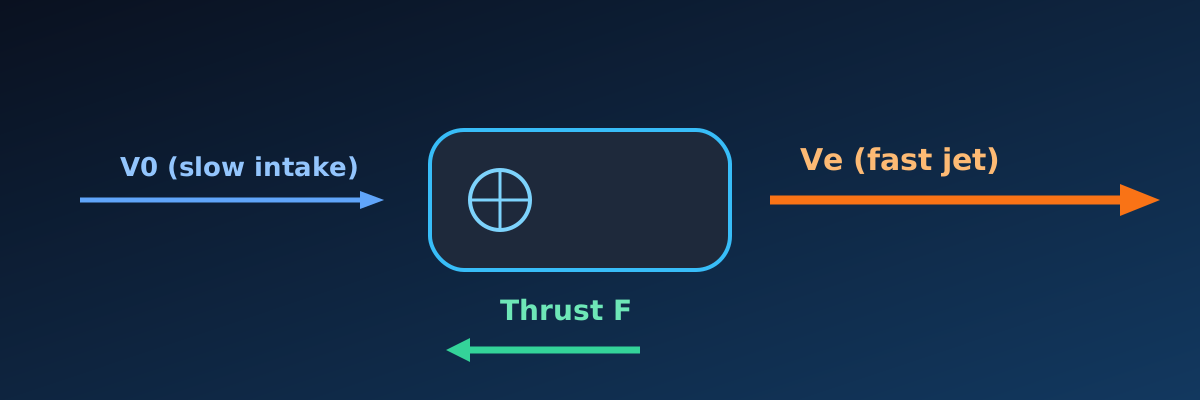
Air-breathing engines produce thrust by taking in air at velocity \(V_0\) and expelling it at a higher exhaust velocity \(V_e\). By Newton's second law, the net force is proportional to the change in momentum of the airflow.

Propulsive Efficiency

Not all generated power goes into useful thrust; some is wasted as kinetic energy in the exhaust slipstream. The ratio of useful propulsive power to total mechanical power is the propulsive efficiency \(\eta_p\).

\[ F = \dot m\,(V_e - V_0) \]
\[ \eta_p = \dfrac{2V_0}{V_0 + V_e} \]
🔑 Maximizing Efficiency

To maximize \(\eta_p\), the exhaust velocity \(V_e\) should be as close as possible to the freestream velocity \(V_0\). However, this reduces thrust unless mass flow \(\dot m\) is increased.

🎮 Propulsive Efficiency Explorer LIVE
Predict first: Adjust mass flow, freestream, and exhaust velocities to see their effect on thrust and \(\eta_p\).
Visualization of thrust and efficiency trade-offs.
📝 Worked example: An engine ingests air at \(V_0 = 200\) m/s and exhausts it at \(V_e = 400\) m/s. The mass flow rate is \(\dot m = 50\) kg/s. Calculate the thrust and propulsive efficiency.
  1. 1. Calculate thrust: \(F = \dot m(V_e - V_0) = 50 \times (400 - 200) = 10,000\) N = 10 kN.
  2. 2. Calculate efficiency: \(\eta_p = 2V_0 / (V_0 + V_e) = 2(200) / (200 + 400) = 400 / 600 = 0.667\).
✓ Thrust = 10 kN, Propulsive Efficiency = 66.7%
✏️ Practice: If an engine has \(V_0 = 250\) m/s and \(V_e = 500\) m/s, what is the propulsive efficiency \(\eta_p\)?
Solution
  1. Hint: Use the formula \(\eta_p = 2V_0 / (V_0 + V_e)\).
  2. Answer: 0.667 (66.7%)

Check your understanding

1. What happens to propulsive efficiency if \(V_e\) approaches infinity?
As \(V_e \to \infty\), \(\eta_p \to 0\) because most power is wasted as kinetic energy in the exhaust.
2. To maintain thrust while increasing efficiency (lowering \(V_e\)), one must:
Since \(F = \dot m(V_e - V_0)\), lowering \(V_e\) requires increasing \(\dot m\) to maintain the same thrust.
✅ Key takeaways
  • Thrust is the rate of change of momentum: \(F = \dot m(V_e - V_0)\).
  • Propulsive efficiency \(\eta_p = 2V_0 / (V_0 + V_e)\).
  • High efficiency requires large mass flow and small velocity change.
➡️ While pure jets rely on high exhaust velocity, propellers take the opposite approach: massive mass flow with small velocity change. Let's examine them next.