
Net Present Value
Turn future cash flows into one decision today
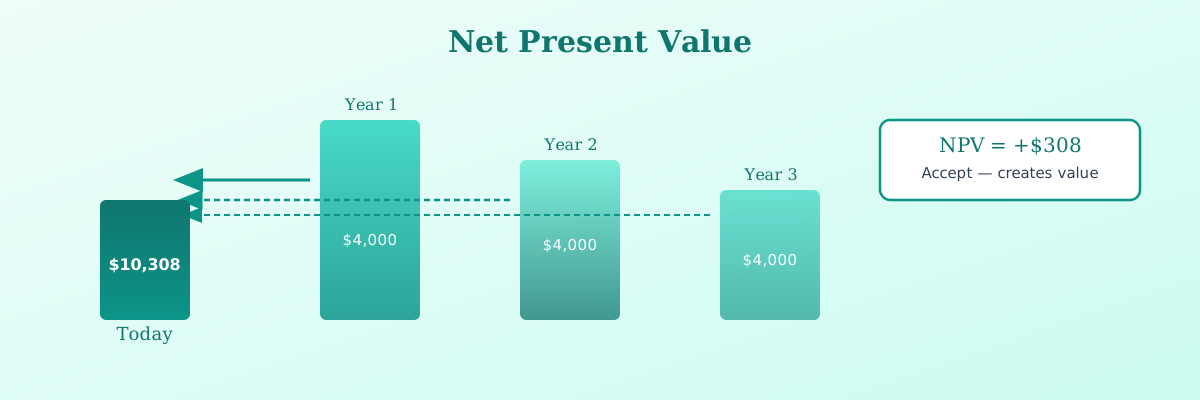
A project costs $10,000 today and returns $4,000 a year for three years. At an 8% cost of capital, is it worth doing - and by how much?
Every cash flow is worth less the later it arrives
A project is a stream of future cash flows bought with money spent today. Because a dollar next year is worth less than a dollar now, you cannot simply add the cash flows up. You discount each one back to today, then compare the total with what you paid.
Reading the formula
$CF_{t}$ is the cash flow in period $t$, $r$ is the discount rate (the cost of capital), $n$ is the project life, and $CF_{0}$ is the up-front investment. Each future cash flow is divided by $(1+r)^{t}$, so cash further away is discounted more heavily.
Accept the project when $NPV > 0$: the discounted cash flows more than repay the investment at the required return. Reject it when $NPV < 0$. A zero NPV means the project earns exactly the cost of capital.
- 1. Discount each cash flow: $4000/1.08 = 3703.70$.
- 2. $4000/1.08^{2} = 4000/1.1664 = 3429.36$.
- 3. $4000/1.08^{3} = 4000/1.259712 = 3175.33$.
- 4. Sum of present values: $3703.70 + 3429.36 + 3175.33 = 10308.39$.
- 5. NPV: $10308.39 - 10000 = 308.39$.
💡 Hint
Check your understanding
- NPV discounts every future cash flow to today and subtracts the investment.
- NPV $= \sum CF_{t}/(1+r)^{t} - CF_{0}$.
- Accept when NPV is positive; a higher discount rate lowers NPV.