
The Two-Body Problem
Newtonian Gravitation and Kepler's Third Law
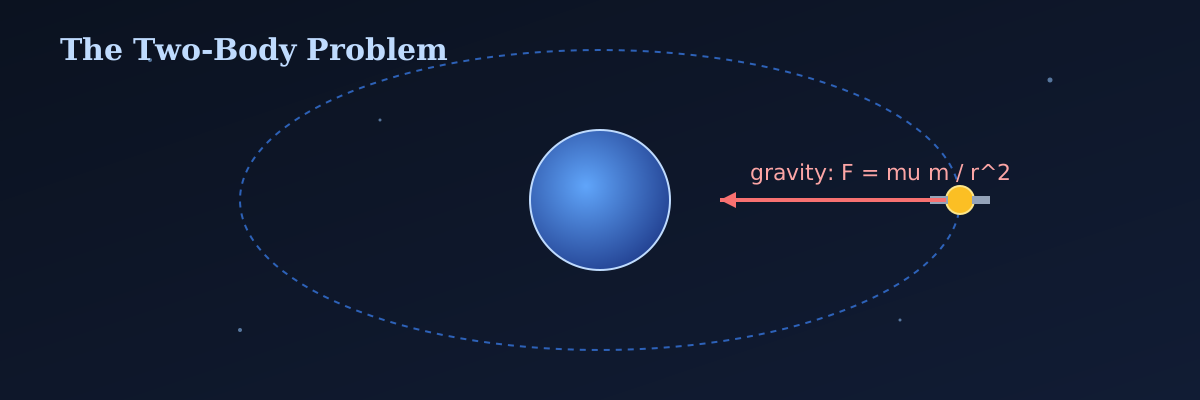
If Earth's gravity pulls inward, how does the Moon stay suspended in the sky instead of crashing into us?
Newton's Law of Universal Gravitation
The foundation of orbital mechanics lies in Newton's law of universal gravitation, which states that two masses attract each other with a force proportional to the product of their masses and inversely proportional to the square of the distance between them. In the restricted two-body problem, we assume the primary body (Earth) is fixed and the secondary body (satellite) has negligible mass.
Equation of Motion
Applying Newton's second law to the gravitational force gives us the fundamental differential equation governing orbital motion. The gravitational parameter \(\mu\) is the product of the gravitational constant and the mass of Earth, \(\mu = 398600\) km\(^3\)/s\(^2\).
Circular Orbits
For a circular orbit, the radius \(r\) is constant. The velocity required to maintain this orbit is perpendicular to the radius vector. For a circular orbit, the semi-major axis \(a\) is simply the radius \(r\).
Kepler's Third Law states that the square of the orbital period is directly proportional to the cube of the semi-major axis (\(T^2 \propto a^3\)). This law holds for all closed orbits under an inverse-square gravitational field.
- 1. Given \(\mu = 398600\) km\(^3\)/s\(^2\) and \(a = 7000\) km.
- 2. Orbital velocity \(v = \sqrt{\mu/a} = \sqrt{398600/7000} = 7.546\) km/s.
- 3. Orbital period \(T = 2\pi\sqrt{a^3/\mu} = 2\pi\sqrt{7000^3/398600} = 5828.5\) s.
- 4. Convert to minutes: \(T = 5828.5 / 60 = 97.14\) min.
- Hint: Use v=sqrt(mu/r) and T=2 pi sqrt(a^3/mu).
- Answer: v = 7.059 km/s; T = 118.7 min.
Check your understanding
- The restricted two-body problem reduces orbital motion to a single ordinary differential equation.
- Circular orbit velocity is found by balancing gravitational force and centripetal acceleration.
- Kepler's Third Law links the orbital period directly to the semi-major axis.