
Steady Level Flight: Thrust Required
Balancing lift, weight, thrust, and drag in unaccelerated flight
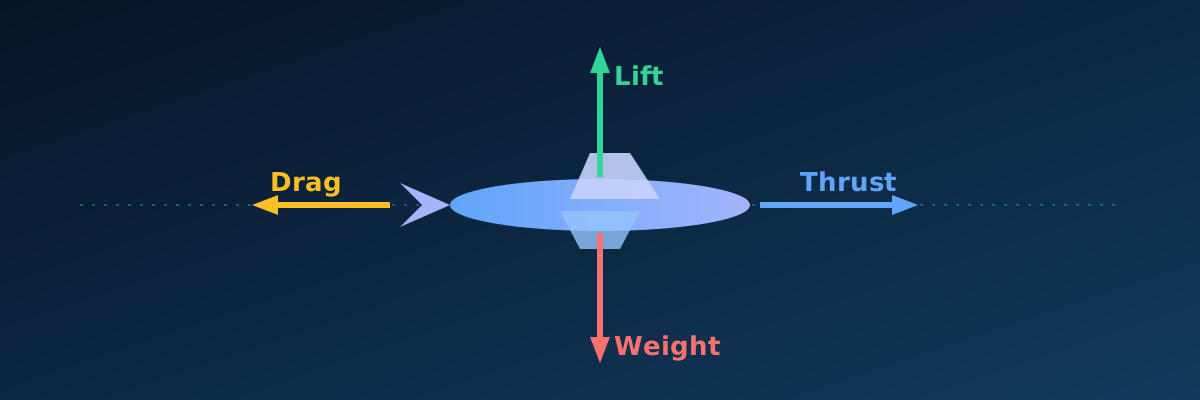
In steady, level flight, the sky is a delicate balance: lift exactly equals weight, and thrust exactly equals drag. But how much thrust do we actually need?
The Equilibrium of Flight
For an aircraft in steady, level flight, there is no acceleration. This means forces must perfectly balance. Vertical equilibrium requires lift \(L\) to equal weight \(W\). Horizontal equilibrium requires thrust \(T\) to equal drag \(D\). We assume small angles and treat the parabolic drag polar as \(C_D = C_{D0} + k C_L^2\).
The drag polar splits drag into zero-lift drag (parasite) and induced drag. The induced drag factor \(k\) depends on aspect ratio and efficiency, typically calculated as k = 1/(pi e AR).
Dynamic Pressure and Lift Coefficient
To find the thrust required at a given velocity \(V\), we must first find the lift coefficient \(C_L\) needed to sustain weight. This relies on dynamic pressure, \(q = 0.5 ho V^2\).
Thrust Required vs Velocity
At low speeds, high \(C_L\) is required, leading to massive induced drag. At high speeds, zero-lift drag dominates. The thrust required \(T_R\) traces a U-shaped curve against airspeed, defining the performance envelope of the aircraft.
- 1. Calculate dynamic pressure: q = 0.5*1.225*100^2 = 6125 Pa.
- 2. Calculate C_L = W/(q*S) = 50000/(6125*25) = 0.3265.
- 3. Calculate C_D = 0.02 + 0.045*0.3265^2 = 0.0248.
- 4. Calculate Drag = C_D * q * S = 0.0248 * 6125 * 25 = 3797 N.
- Hint: Dynamic pressure q is proportional to V^2.
- Answer: It quadruples to 24500 Pa, since dynamic pressure scales with velocity squared.
Check your understanding
- Steady level flight requires lift to equal weight and thrust to equal drag.
- The drag polar \(C_D = C_{D0} + k C_L^2\) captures parasite and induced drag.
- Thrust required varies with airspeed, creating a U-shaped performance curve.