
The Conceptual Design Loop
Iterative convergence of aircraft takeoff weight
How do engineers guess the weight of an aircraft that does not exist yet, and then make that guess self-consistent?
The Design Loop
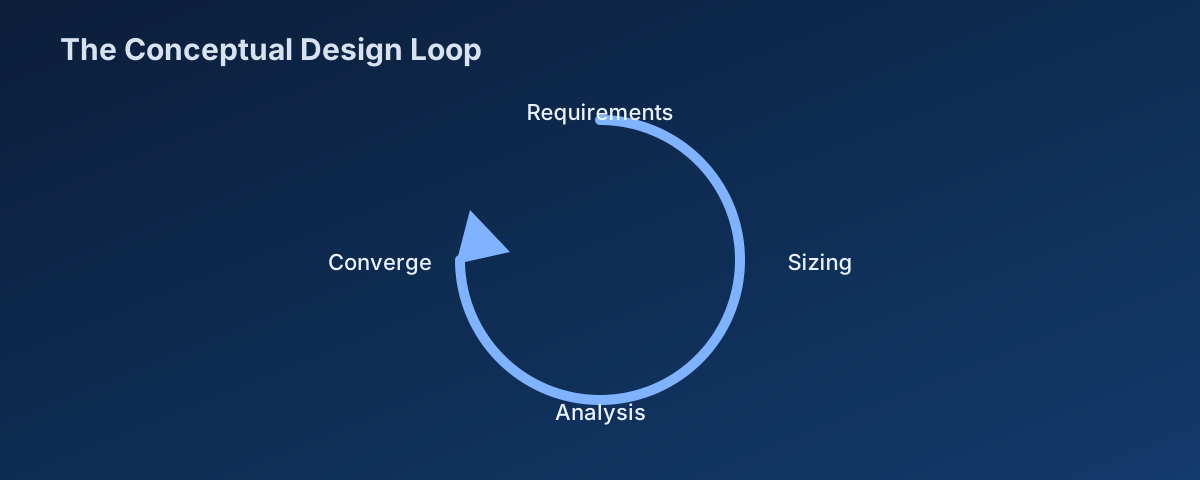
At the conceptual stage, an aircraft is defined by a set of requirements: range, payload, speed. To size the aircraft, we must determine the Maximum Takeoff Weight (\(W_0\)). However, \(W_0\) depends on the fuel weight \(W_f\) and the empty weight \(W_e\), which in turn depend on \(W_0\). This circular dependency requires an iterative approach known as the conceptual design loop.
Components of Weight
The total takeoff weight is the sum of the fixed weights (crew and payload) and the variable weights (fuel and structure). The fixed weight \(W_{fixed}\) is known from the requirements. The fuel and empty weights are typically expressed as fractions of the takeoff weight: \(W_f/W_0\) and \(W_e/W_0\).
Iterative Convergence
In practice, we solve this fixed-point problem by iterating. We start with an initial guess for \(W_0\) and update it based on the current estimates of the weight fractions. The iteration continues until the change in \(W_0\) between steps is within a specified tolerance.
The iteration converges if the sum of the fuel and empty weight fractions \((f_f + f_e)\) is less than 1. If their sum approaches or exceeds 1, the fixed weight becomes an insignificant fraction of the total, and the design is physically impossible.
- 1. Calculate the denominator: \(1 - 0.25 - 0.55 = 0.20\).
- 2. Divide the fixed weight by the denominator: \(W_0 = 500 / 0.20 = 2500\) kg.
- Hint: First calculate \(1 - f_f - f_e\), then divide 500 by that result.
- Answer: W_0 = 2000 kg
Check your understanding
- The conceptual design loop solves the circular dependency between takeoff weight and its components.
- The fixed-point equation for takeoff weight relies on accurate fuel and empty weight fractions.
- Convergence requires that the sum of variable weight fractions be strictly less than 1.