
Circulation & Kutta Condition

Kutta-Joukowski lift and the starting vortex
Aerospace EngineeringAirfoilsFree preview
⏱️ About 16 min
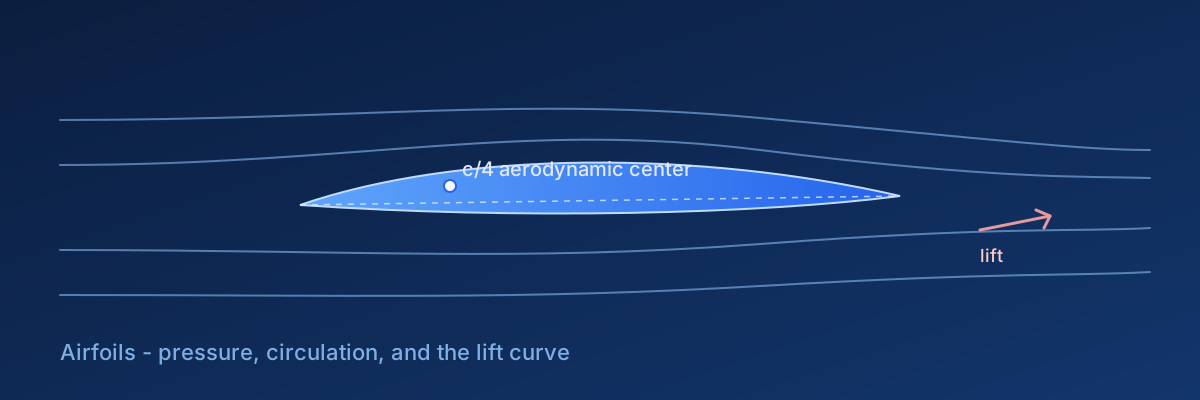
Circulation & Kutta Condition — illustration
Decorative illustration.

Why does an airfoil need a sharp trailing edge to generate lift efficiently?

💡
The big idea: The Kutta condition forces flow to leave smoothly at the trailing edge, fixing circulation and thus determining lift.
🎯 By the end, you'll be able to
  • Define circulation and apply the Kutta-Joukowski theorem.
  • Explain the physical significance of the Kutta condition.
  • Describe Kelvin's theorem and the starting vortex.
📎 Helpful to know first
  • Pressure Coefficient & Surface Pressure

Circulation

Circulation (Gamma) is the line integral of velocity around a closed curve enclosing the airfoil. According to the Kutta-Joukowski theorem, lift per unit span (L') is directly proportional to circulation.

\[ \Gamma = \oint_C \vec{V}\cdot d\vec{s} \]
\[ L' = \rho_\infty V_\infty \Gamma \]
🔑 The Kutta Condition

Viscosity forces the rear stagnation point to the sharp trailing edge so the flow leaves smoothly. This condition mathematically fixes Gamma (and thus lift) for a given airfoil and angle of attack.

Starting Vortex

When an airfoil starts moving, a starting vortex is shed at the trailing edge. By Kelvin's circulation theorem, total circulation must remain zero, so an equal and opposite circulation is generated around the airfoil.

📝 Worked example: Given Gamma = 20 m^2/s, rho_inf = 1.225 kg/m^3, V_inf = 50 m/s, find lift per unit span L'.
  1. 1. L' = rho_inf * V_inf * Gamma.
  2. 2. L' = 1.225 * 50 * 20.
  3. 3. L' = 1225 N/m.
✓ L' = 1225 N/m
✏️ Practice: If circulation Gamma doubles while rho_inf and V_inf remain constant, what happens to lift L'?
Solution
  1. Hint: L' is directly proportional to Gamma in L' = rho_inf * V_inf * Gamma.
  2. Answer: L' doubles.

Check your understanding

1. The Kutta condition states that flow must leave the airfoil:
The Kutta condition requires flow to leave smoothly at the sharp trailing edge.
2. According to Kelvin's theorem, when a starting vortex is shed, circulation around the airfoil is:
Total circulation is conserved, so the airfoil gains circulation equal and opposite to the shed starting vortex.
✅ Key takeaways
  • Circulation is the line integral of velocity around the airfoil.
  • Kutta-Joukowski gives lift per unit span as L' = rho * V_inf * Gamma.
  • The Kutta condition fixes Gamma by forcing smooth flow at the trailing edge.
➡️ With circulation and the Kutta condition established, we can use Thin Airfoil Theory to predict lift analytically.
🎓 Go deeper: external courses & trusted references
Foundational aerospace courses (OpenCourseWare)

External sites are listed for reference only. This course is independent and has no affiliation with, or endorsement from, the institutions named.