
Expected Monetary Value
One probability-weighted number per option
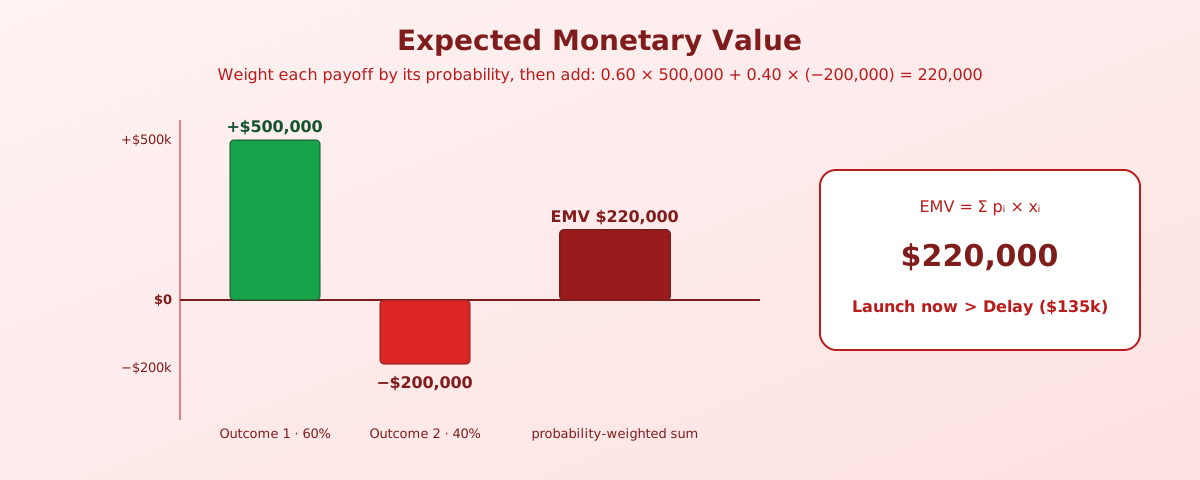
Northwind Trading weighs launching now versus delaying. Launch now carries a 60% chance of a $500,000 gain and a 40% chance of a $200,000 loss, for an EMV of 0.60 x 500,000 + 0.40 x (-200,000) = $220,000. Delaying is safer at a 90% chance of a $150,000 gain and 10% of $0, EMV $135,000. On a single probability-weighted number, launch now wins.
One number per option
When a choice leads to several outcomes, you need a way to compare it against rival choices on common ground. Expected Monetary Value (EMV) does this by weighting each outcome's payoff by its probability. For each outcome multiply its probability (as a decimal) by its payoff, then add those products; the option with the higher EMV is the better bet, on average. The probabilities for one option must add up to 1 (100%).
Reading the formula
For "Launch now" the outcomes are a 60% chance of +$500,000 and a 40% chance of -$200,000, so EMV = 0.60 x 500,000 + 0.40 x (-200,000) = 300,000 - 80,000 = $220,000. For "Delay" the outcomes are a 90% chance of +$150,000 and a 10% chance of $0, so EMV = 0.90 x 150,000 + 0.10 x 0 = $135,000. Because 220,000 is greater than 135,000, Launch now has the higher EMV and is the better choice.
EMV is the average payoff if you could repeat the same decision many times under the same odds. A single run may still land on the bad outcome, so EMV compares options on expected terms, not as a promise of any single result.
- 1. EMV = sum of probability x payoff.
- 2. = 0.60 x 500,000 + 0.40 x (-200,000) = 300,000 - 80,000.
- 3. = $220,000.
💡 Hint
- 1. EMV = 0.70 x 300,000 + 0.30 x (-100,000).
- 2. = 210,000 - 30,000 = $180,000.
Check your understanding
- EMV = sum of probability x payoff across an option's outcomes.
- Probabilities for one option are entered as percents that sum to 100.
- Pick the option with the higher EMV.