
Soil Formation & Soil Profiles
Soil is not just dirt — it is a layered, living system shaped by climate, organisms, and time.
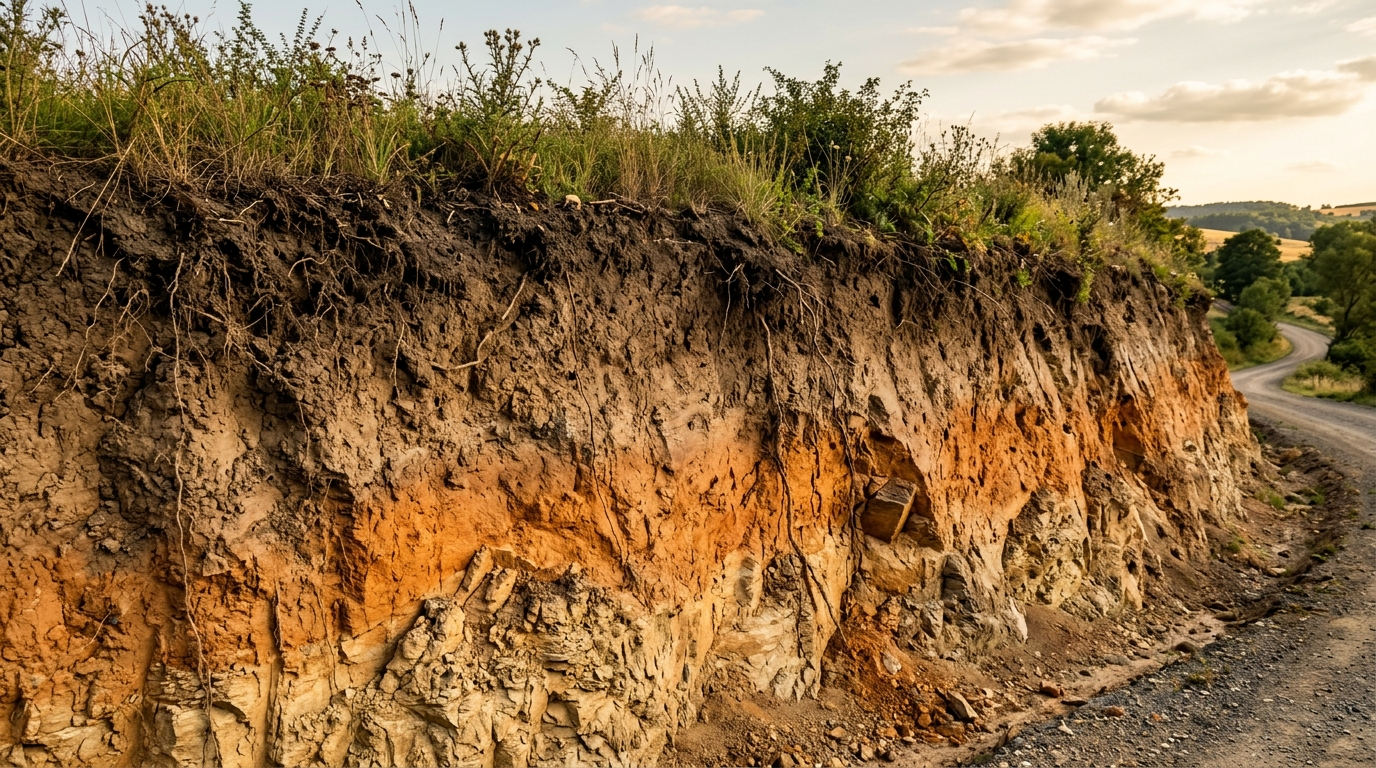
If you dig a hole almost anywhere on land, you will hit layers. The top is dark and crumbly; below it, colours shift to browns, reds, and yellows; deeper still, the material starts to look like the rock beneath. Those layers are not random — they are a soil profile, and each one records the interplay of climate, life, and time. Soil is geology's autobiography.
What soil is — and is not
Soil is a natural body at Earth's surface, made of weathered rock material, organic matter, water, air, and living organisms. It is not merely 'dirt' — it is a structured, three-dimensional system with distinct layers called horizons.
Soil differs from sediment in two key ways:
- Soil forms in place through weathering and biological activity, and it develops horizons.
- Sediment is transported material (by water, wind, or ice) and lacks the organised horizon structure of a true soil.
The four master horizons
Most soils show a vertical sequence of horizons. From top to bottom:
- O horizon (organic): The top layer, dominated by decaying leaf litter, needles, and humus. It is dark, loose, and rich in organic carbon. In some forests it is thick; in grasslands it may be thin or merged into the A horizon.
- A horizon (topsoil): A mixture of mineral grains and organic matter. This is where most biological activity occurs — roots, fungi, bacteria, and burrowing animals. It is typically darker than the layers below because of its organic content.
- B horizon (subsoil): The zone of accumulation. Materials leached (washed) down from above — clay, iron oxides, aluminium — collect here. It is often denser, more brightly coloured (reds, yellows, browns), and less fertile than the A horizon.
- C horizon: Partially weathered parent material, transitioning into fresh bedrock below. It has little organic matter and retains much of the original rock's structure.
Below the C horizon lies unweathered bedrock (R horizon), which is not technically soil but the foundation everything sits on.
CLORPT: the five soil-forming factors
Why does soil look different from one place to another? Five factors control the outcome:
- C — Climate: Temperature and precipitation drive the rate of chemical weathering and leaching. Warm, wet climates produce deep, highly weathered soils; cold, dry climates produce thin, weakly developed soils.
- L — Organisms (Living things): Plants add organic matter; roots open pores; microbes cycle nutrients. A prairie with deep grass roots builds a thick, dark A horizon; a pine forest builds an acidic O horizon.
- O — Relief (topography / slope): Steep slopes shed water and erode, so soils stay thin. Flat lowlands collect water and sediment, so soils deepen. South-facing slopes in the Northern Hemisphere are warmer and drier, altering soil development.
- R — Parent material: The rock or sediment that weathers to form soil controls the mineral composition, texture, and chemistry. Granite weathers to sandy, quartz-rich soil; basalt weathers to clay-rich, fertile soil.
- T — Time: Soils develop slowly. A freshly deposited sand dune has almost no horizon development; a million-year-old landscape can have metres of deeply weathered soil.
- Climate: The rainforest is warm and wet, so chemical weathering and leaching are intense. The desert is dry, so weathering is slow and mechanical.
- The rainforest soil will be thick, deeply leached (nutrients washed away), rich in iron oxides (red colour), with a prominent B horizon of clay accumulation.
- The desert soil will be thin, poorly developed, possibly with salt accumulation near the surface, and the bedrock may be close to the surface.
Check your understanding
- Soil is a natural body with distinct horizons (O, A, B, C), not merely 'dirt' or sediment.
- The O horizon is organic matter; the A is topsoil; the B is subsoil where leached materials accumulate; the C is weathered parent material.
- Soil formation is controlled by CLORPT: Climate, Organisms, Relief, Parent material, and Time.
- Warm, wet climates produce deep, leached soils; cold or dry climates produce thin, weakly developed soils.
- Parent material and slope also strongly influence soil texture, depth, and fertility.
🎓 Go deeper: university courses & trusted references
Handpicked external material for this module — for when you want the full university treatment of surface processes.
External sites are listed for reference only. This course is independent and has no affiliation with, or endorsement from, the institutions named.