
Waves, Tides & Coastal Processes
The coastline is a battleground between land and sea — constantly rebuilt by waves, tides, and longshore drift.
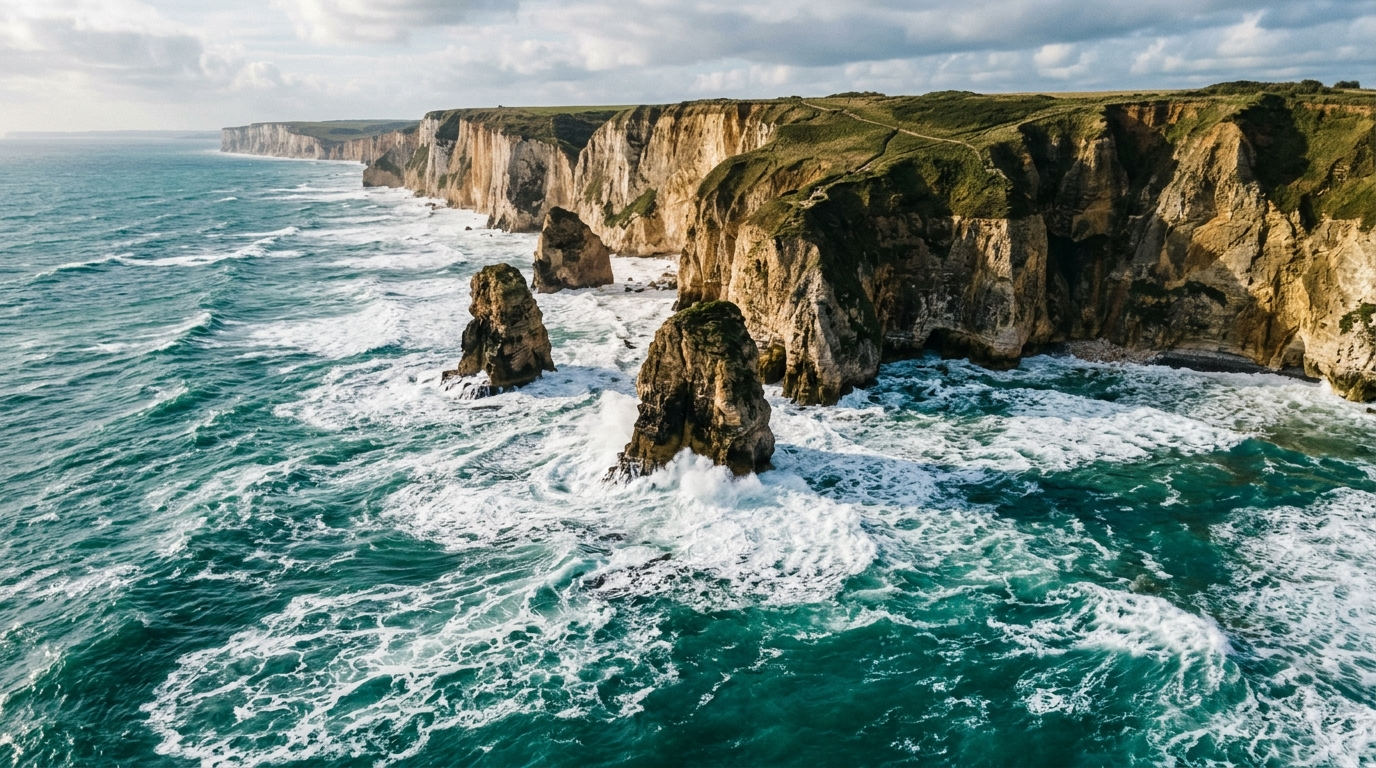
Every wave that breaks on a beach is a geologic event. Over a year, the waves pounding a single stretch of coastline deliver more energy than a nuclear bomb. That energy builds sand spits, moves barrier islands, and grinds cliffs into gravel. The coastline you see today is only a snapshot in an endless tug-of-war between land and sea.
Waves: energy from wind to water
Waves are created by wind blowing over water. The energy they carry depends on wind speed, duration, and the distance over which the wind blows (the fetch). In the open ocean, waves are gentle swells; as they approach shallow water, the bottom drags on the wave, slowing it and causing the wave to grow taller until it breaks.
Waves rarely approach a coastline straight on. They usually arrive at an angle, and this simple fact drives the most important coastal transport process: longshore drift.
Longshore drift: the river of sand
When a wave hits the beach at an angle, the swash (water and sediment rushing up the beach) moves up at that same angle. The backwash (water and sediment draining back) flows straight down under gravity. The result is a net zigzag motion that transports sediment along the coast.
This longshore drift can move enormous volumes of sand — millions of tonnes per year on some coasts. It is why beaches change shape seasonally and why sediment accumulates in certain places while eroding from others.
Erosional coasts: cliffs, arches, and stacks
On coasts with hard rock and high wave energy, erosion dominates:
- Wave-cut cliffs: Steep rock faces carved by wave action at their base. As the cliff is undercut, rock above collapses and the cliff retreats inland.
- Wave-cut platform: A flat, rocky bench exposed at low tide, formed as the cliff retreats and the base is planed off by wave abrasion.
- Sea arches and stacks: Where waves attack headlands along zones of weakness (fractures or bedding planes), they may punch through to form an arch. When the arch roof collapses, an isolated sea stack remains.
Depositional coasts: beaches, spits, and barriers
Where sediment supply is abundant and wave energy is lower, deposition builds:
- Beach: A strip of sediment (sand, gravel, or cobbles) along the shoreline, constantly shifting with waves and tides.
- Spit: An elongated ridge of sand or gravel extending from the mainland into open water, formed by longshore drift. A baymouth bar closes off a bay.
- Tombolo: A spit that connects an offshore island to the mainland.
- Barrier island: A long, narrow, low-lying island parallel to the coast, separated from the mainland by a lagoon. Barrier islands migrate landward as sea level rises and storms overwash them.
Tides: the daily rise and fall
Tides are the periodic rise and fall of sea level caused by the gravitational pull of the Moon and Sun. They modulate coastal processes by changing the water level at which waves break:
- High tide: Waves reach higher up the beach or cliff, increasing erosion of the upper shore.
- Low tide: Wave energy is focused lower, and the intertidal zone is exposed.
Spring tides (highest high tides, lowest low tides) occur when the Sun and Moon align; neap tides (smallest range) occur when they are at right angles.
Check your understanding
- Waves deliver enormous energy to coasts; their power depends on wind speed, duration, and fetch.
- Longshore drift transports sediment along the coast in a zigzag pattern driven by oblique wave approach.
- Erosional coasts feature cliffs, wave-cut platforms, arches, and sea stacks.
- Depositional coasts feature beaches, spits, tombolos, and barrier islands.
- Tides modulate where waves break and how much of the shore is exposed to erosion each day.
🎓 Go deeper: university courses & trusted references
Handpicked external material for this module — for when you want the full university treatment of surface processes.
External sites are listed for reference only. This course is independent and has no affiliation with, or endorsement from, the institutions named.