
What Is a Wave?
Drop a stone in a pond and watch closely — the water doesn't travel across the surface, but a pattern does, and that pattern is a wave.
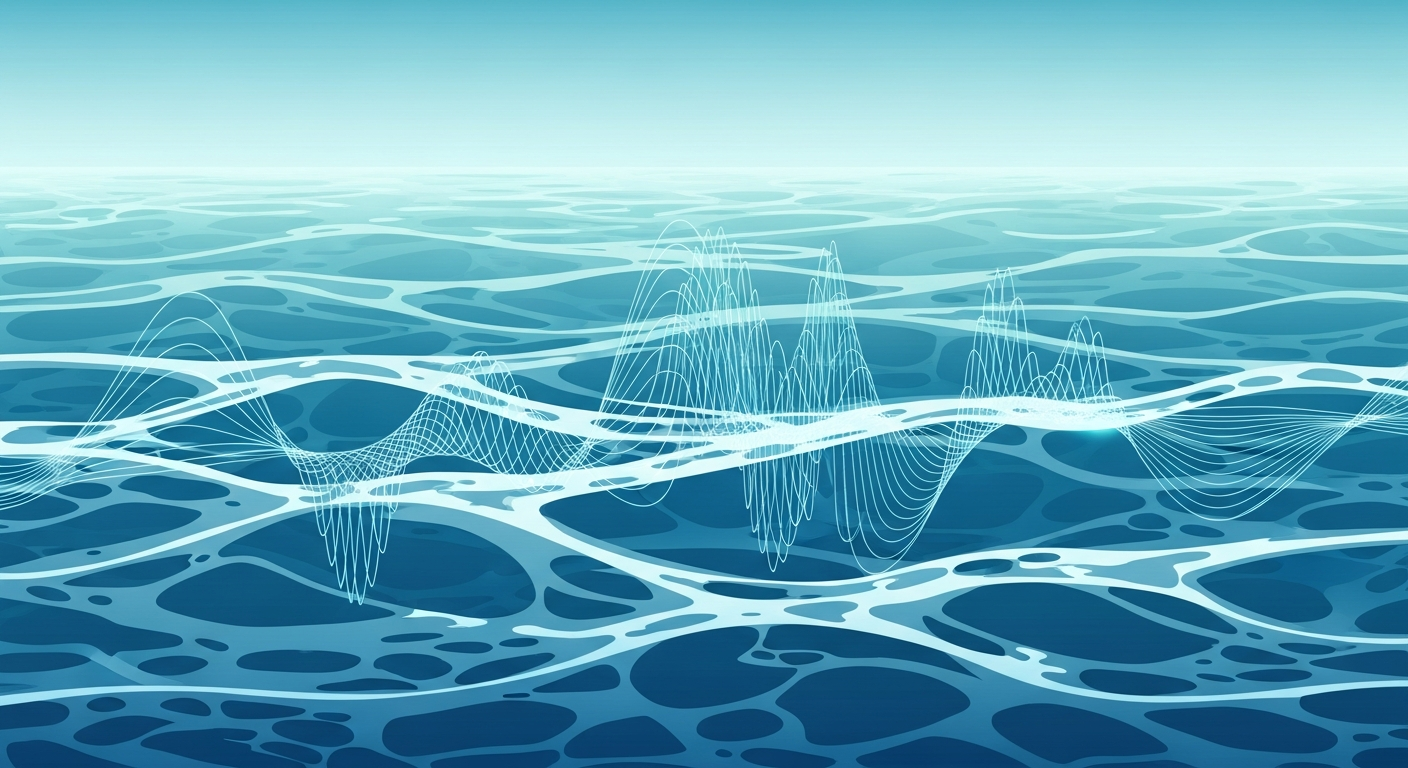
Energy on the move
Picture a stadium crowd doing 'the wave.' No single fan travels around the stadium — each person just stands up and sits back down at the right moment. But watch from above, and a wave clearly sweeps around the whole stadium. That's the trick of every wave in physics: the medium (water, air, a rope, the crowd) oscillates in place, while the pattern — and the energy that drives it — moves on.
This is why a floating leaf mostly bobs up and down as ripples pass under it, rather than sailing across the pond. The water isn't being transported to shore; the disturbance is.
Every mechanical wave is a disturbance that repeats in space and time. The particles of the medium oscillate around a fixed position — they don't hitch a ride with the wave. What actually travels forward is energy, carried by the coordinated motion of those oscillating particles.
Two ways to shake things up
Waves come in two basic flavors, based on how the medium moves relative to the direction the wave travels:
- Transverse waves: the medium moves perpendicular to the direction of travel. Shake a rope up and down and the wave moves sideways down its length. Light and other electromagnetic waves are also transverse.
- Longitudinal waves: the medium moves parallel to the direction of travel, squeezing into compressions and stretching into rarefactions. Push a slinky back and forth and you'll see the coils bunch up and spread out as the pulse moves forward. Sound waves in air work the same way.
Reading a wave's 'vital signs'
Four measurements describe any wave completely:
- Amplitude: the maximum displacement from the resting (equilibrium) position — it's what makes a wave 'tall' or 'loud,' and it's related to how much energy the wave carries.
- Wavelength (\( \lambda \)): the distance between two consecutive identical points on the wave, like crest to crest.
- Period (T): the time it takes for one full wave cycle to pass a fixed point, measured in seconds.
- Frequency (f): how many full cycles pass a fixed point per second, measured in hertz (Hz).
Amplitude tells you about energy and intensity. Wavelength, period, and frequency all describe the wave's rhythm and are linked by \( v = f\lambda \).
- Write the speed equation: \( v = f\lambda \).
- Substitute the known values: \( v = 2.5\ \text{Hz} \times 0.4\ \text{m} \).
- Multiply: \( v = 1.0\ \text{m/s} \).
- Find the period using \( T = \frac{1}{f} = \frac{1}{2.5\ \text{Hz}} \).
- Divide: \( T = 0.4\ \text{s} \).
- Start from \( v = f\lambda \) and solve for wavelength: \( \lambda = \frac{v}{f} \).
- Substitute the values: \( \lambda = \frac{340\ \text{m/s}}{440\ \text{Hz}} \).
- Divide: \( \lambda \approx 0.77\ \text{m} \).
It's tempting to think shaking a rope faster makes the wave travel faster down the rope. It doesn't. For a given medium (a specific rope at a specific tension, or sound in air at a given temperature), wave speed \( v \) is fixed by the medium's physical properties. If you increase the frequency, the wavelength has to shrink to compensate, since \( v = f\lambda \) must still hold. Amplitude doesn't affect speed either — a big shake and a small shake travel down the same rope at the same speed, just with different amounts of energy.
Check your understanding
- Waves transport energy through a medium without transporting the matter of the medium itself.
- Transverse waves oscillate perpendicular to travel (light, rope waves); longitudinal waves oscillate parallel to travel (sound, slinky pulses).
- Amplitude describes a wave's height/energy; wavelength, period, and frequency describe its rhythm, linked by \( T = 1/f \).
- Wave speed follows \( v = f\lambda \): for a fixed medium, speed is constant, so frequency and wavelength trade off against each other.
🎓 Go deeper: external courses & trusted references
External sites are listed for reference only. This course is independent and has no affiliation with, or endorsement from, the institutions named.