
Simple Harmonic Motion
Why springs, swings, and pendulums all secretly move to the same beat.
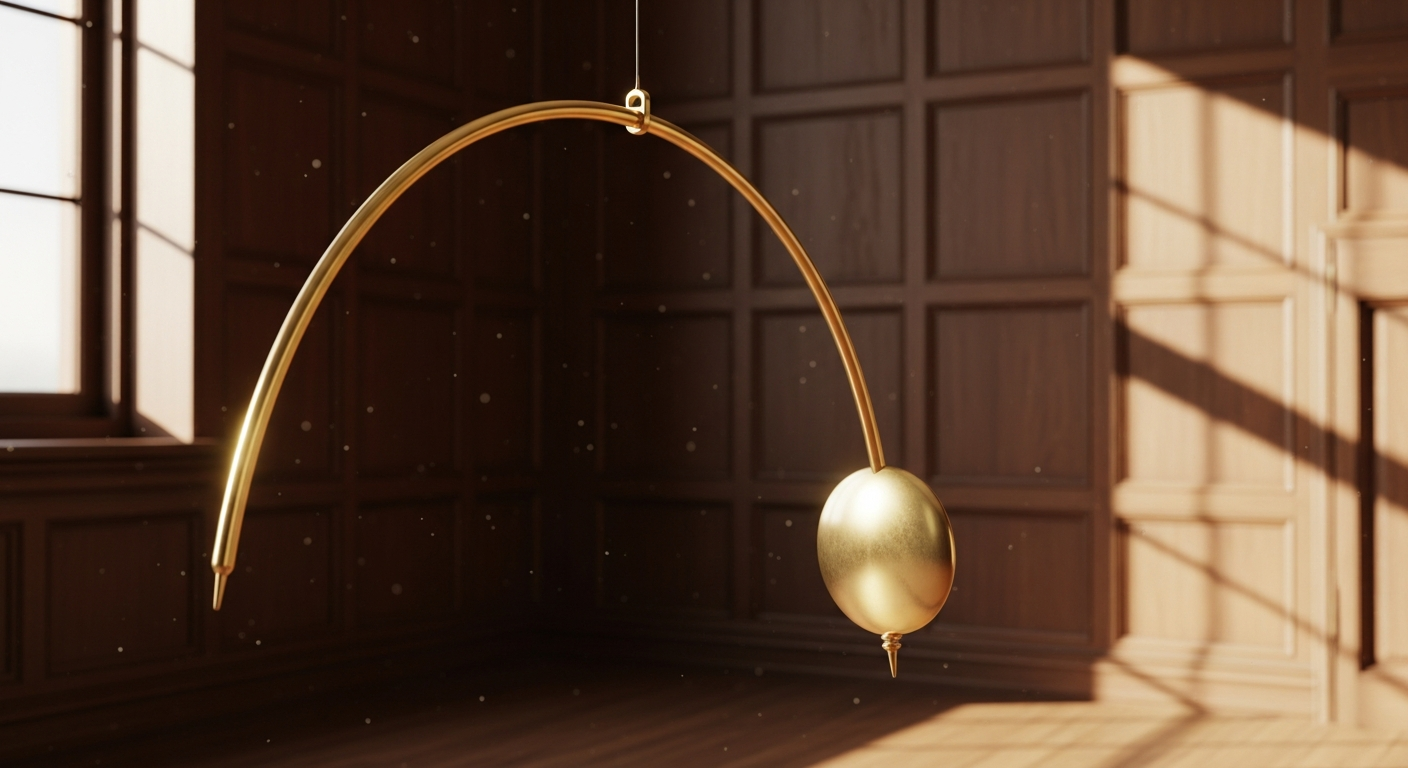
Why things wobble back
Push a swing, pluck a guitar string, tap a mass hanging from a spring — nudge any of these away from where they want to rest, and they don't just drift off. They swing back, overshoot, swing back again, and settle into a steady, repeating rhythm. That rhythm has a name: simple harmonic motion (SHM). Once you see the one idea underneath it, pendulums, springs, and even vibrating atoms all start to look like variations on the same theme.
Simple harmonic motion happens whenever the force pulling something back toward equilibrium is directly proportional to how far it's been displaced — and always points the opposite way. Double the displacement, double the restoring force. That relationship is captured in one compact equation, and it's the seed everything else in this lesson grows from.
From force to rhythm
Feed \( F = -kx \) into Newton's second law and solve, and something remarkable falls out: the motion is automatically periodic, and the time for one full cycle — the period — depends only on the physical properties of the system, never on how far you initially displaced it. A gentle push and a hard yank take the same amount of time to complete a swing.
Energy trades places, but never disappears
As the mass swings through equilibrium, it's moving fastest — all of the system's energy is kinetic. At the extremes of the swing, it stops for an instant to reverse direction — all of that energy is now stored as potential energy. Add them up at any point in the cycle and the total stays exactly constant: \( E = \tfrac{1}{2}kA^2 \), where A is the amplitude. SHM is really just energy continuously handing itself back and forth between two forms, on a perfectly regular schedule.
- Period depends only on mass and spring constant: \( T = 2\pi\sqrt{m/k} \)
- Plug in: \( T = 2\pi\sqrt{2.0/200} = 2\pi\sqrt{0.010} = 2\pi(0.100) \)
- \( T \approx 0.63\ \text{s} \)
- Total energy comes from the amplitude: \( E = \tfrac12 k A^2 = \tfrac12(200)(0.050)^2 \)
- \( E = \tfrac12(200)(0.0025) = 0.25\ \text{J} \)
- \( T = 2\pi\sqrt{L/g} \)
- \( T = 2\pi\sqrt{1.0/9.8} = 2\pi\sqrt{0.102} = 2\pi(0.319) \)
- \( T \approx 2.0\ \text{s} \)
- Since \( T \propto \sqrt{L} \), quadrupling L multiplies T by \( \sqrt{4} = 2 \)
These clean formulas rely on some fine print. The pendulum equation only holds for small swing angles (roughly under 15°) — swing it wildly and the restoring force stops being proportional to displacement, so the period creeps longer than the formula predicts. Also notice that the pendulum's mass never appears in \( T = 2\pi\sqrt{L/g} \) — a bowling ball and a golf ball on identical strings swing at exactly the same rate. And for both the spring and the pendulum, the period doesn't depend on amplitude either: swing wide or narrow, the timing stays the same. That amplitude-independence is what made pendulum clocks reliable timekeepers in the first place.
Check your understanding
- SHM arises whenever the restoring force is proportional to displacement and points opposite to it: F = -kx.
- A mass-spring system oscillates with period T = 2π√(m/k); a pendulum (small angles) with T = 2π√(L/g) — neither depends on amplitude.
- Total mechanical energy in SHM stays constant, continuously trading between kinetic energy (maximum at equilibrium) and potential energy (maximum at the extremes).
- Pendulum period doesn't depend on the bob's mass, and the small-angle approximation is what keeps the formula accurate.
🎓 Go deeper: external courses & trusted references
External sites are listed for reference only. This course is independent and has no affiliation with, or endorsement from, the institutions named.